Welcome to our Plant Library! This is a new feature on our website to showcase the vast selection of plants that we carry across different seasons. We are continuously adding products, so if you are looking for a specific plant not listed below, we encourage you to call or visit to see if we have it in stock! 

298 products « Page 1 of 3 »
Filter
Clear All
Categories
Sub-Categories
Tags
Trees & Shrubs
Perennials

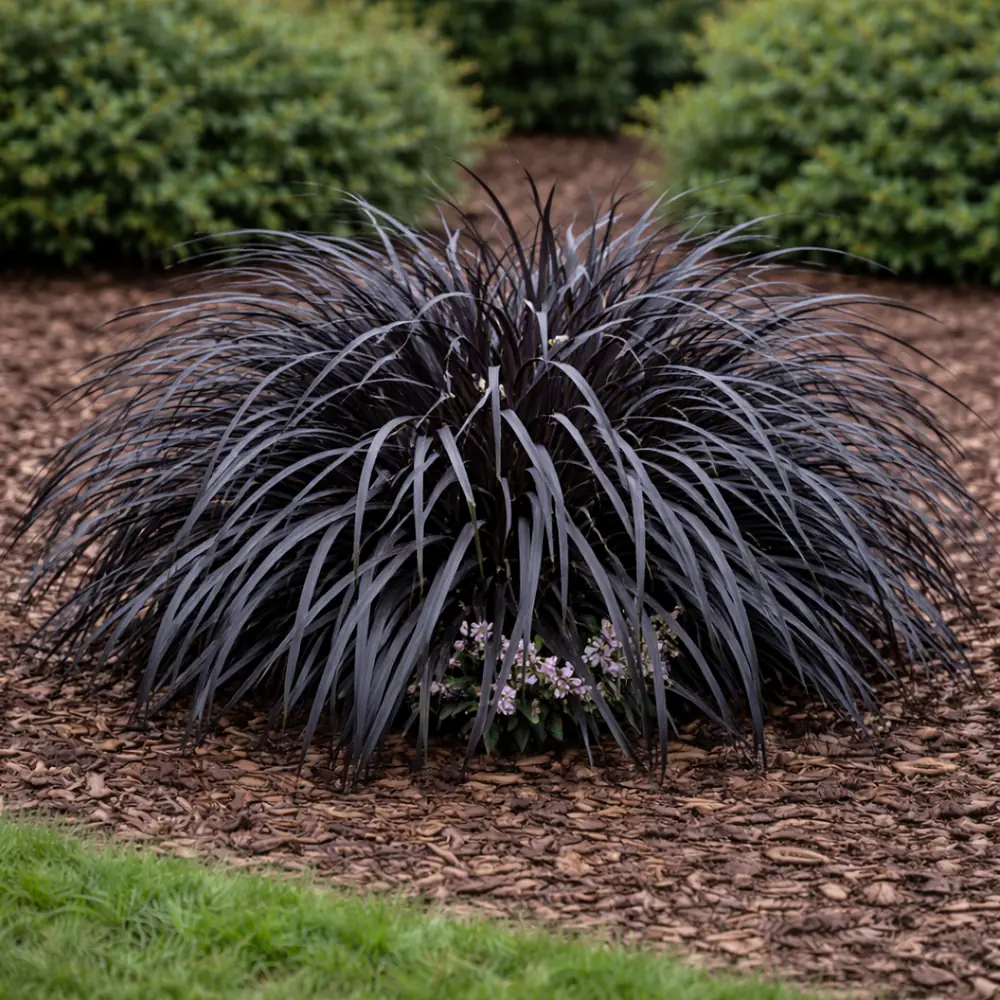
Black Mondo Grass
Ophiopogon planiscapus ‘Nigrescens’

  1. Mature Size: 6–8″ H × 10–12″ W
  2. Light Requirements: Part shade to full shade; tolerates morning sun
  3. Ideal Soil Conditions: Moist, well‑drained, organically rich soil
  4. Notable Characteristics: Dramatic deep black foliage in low mounding clumps. Produces small lilac flowers and blue berries. Excellent contrast plant in shade borders, rock gardens, or containers.
  5. Deer Resistance: Moderate to High
Trees & Shrubs

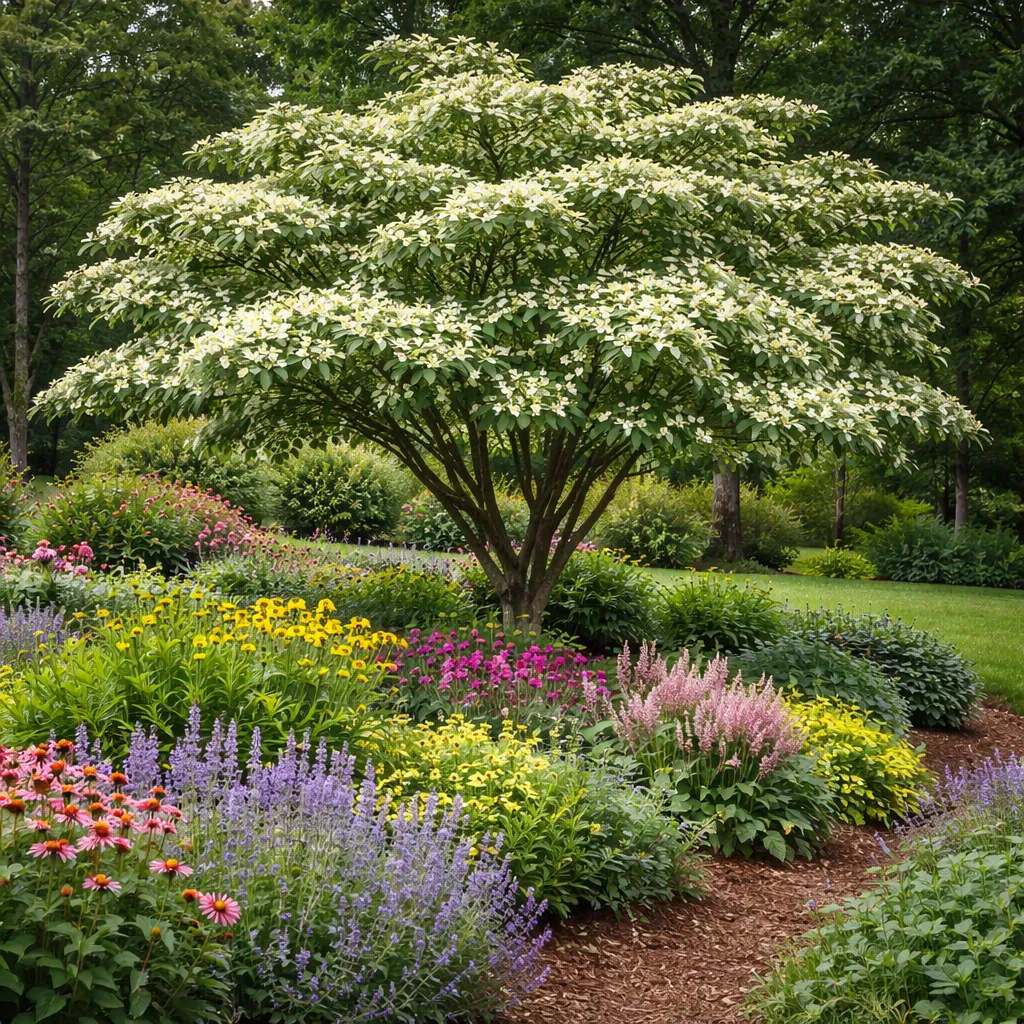
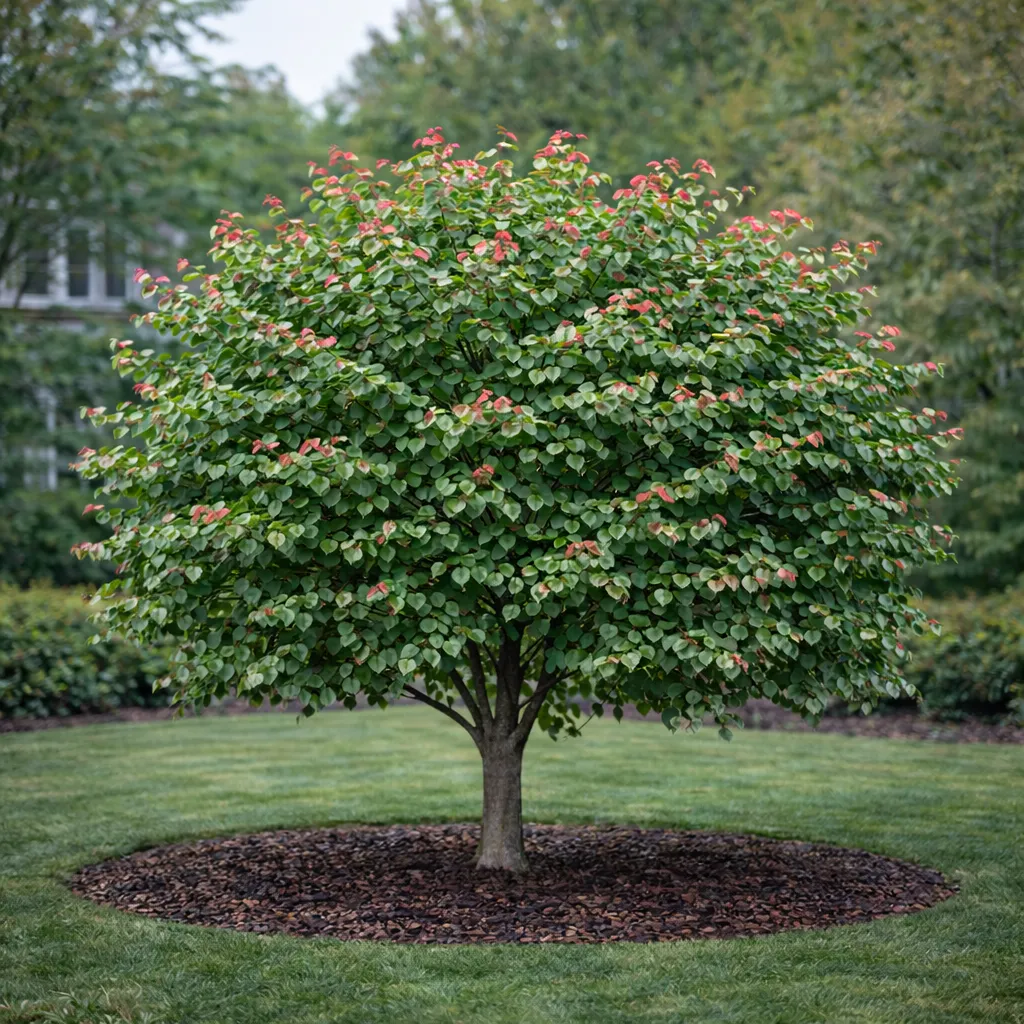
Botanical Name: Cornus kousa
Common Name: Kousa Dogwood

Mature Height and Width:
15–25′ tall × 15–25′ wide

Growth Habit:
Small deciduous ornamental tree with upright form in youth maturing to a broad, layered, horizontal branching structure; develops sculptural multi-tiered canopy with moderate interior openness.

Foliage Description:
Medium to dark green ovate foliage with subtle surface texture and opposite arrangement; dense summer canopy transitioning to attractive fall coloration.

Flower Description (if applicable):
Showy creamy white to soft blush four-bracted blooms appearing after leaf emergence; bracts pointed and slightly overlapping with greenish true flowers at center.

Bloom Time:
Late spring to early summer

Fall Color (if applicable):
Attractive red to burgundy fall coloration with occasional purple tones.

Light Requirements:
Full sun to partial shade

Hardiness Zone:
5–8

Notable Landscape Uses:
Specimen tree, patio tree, lawn accent, woodland edge planting, courtyard focal point, layered understory tree, residential foundation accent.

Deer Resistance:
Low to moderate; young growth may be browsed in Northeast landscapes.

Botanical Name: Acer palmatum ‘Shishigashira’

Common Name: Lion’s Head Japanese Maple

Mature Height and Width: 8–12′ tall × 6–8′ wide

Growth Habit: Upright, compact, and densely branched; forms a rounded to oval canopy with stiff, ascending branch structure. Internodes are short, creating a tight, architectural framework.

Foliage Description: Small, crinkled, heavily textured palmate leaves with tightly curled margins. Spring and summer foliage is rich medium green with a glossy surface. Leaves cluster densely along upright stems, creating a tufted appearance.

Flower Description: Small reddish-purple flowers in spring; not ornamentally significant.

Bloom Time: Mid-spring

Fall Color: Exceptional golden-yellow to orange with frequent red highlights; often one of the strongest fall displays among green Japanese maples.

Light Requirements: Full sun to partial shade; tolerates more sun exposure than many palmatum cultivars in Zones 5–7 when adequately irrigated.

Hardiness Zone: USDA Zones 5–8

Notable Landscape Uses:
Architectural specimen for formal gardens; vertical accent in foundation plantings; courtyard focal point; collector gardens; structured element in Japanese-inspired landscapes; suitable for larger decorative containers.

Deer Resistance: Moderate
Not a preferred browse species, but compact new growth can be nipped, particularly in winter or high-pressure deer regions. Young plants are more susceptible and benefit from protection during establishment.

Botanical Name: Acer palmatum ‘Mikawa Yatsubusa’

Common Name: Mikawa Yatsubusa Dwarf Japanese Maple

Mature Height and Width: 6–8′ tall × 4–6′ wide

Growth Habit: Compact, upright to broadly pyramidal form with exceptionally tight, layered branching. Dense, architectural structure with very short internodes creating a stacked, shingled foliage appearance. Slow growing.

Foliage Description: Small to medium palmate leaves (5–7 lobes) held densely along stems. Spring foliage emerges bright green with slight reddish edging, maturing to rich medium green in summer. Leaves overlap tightly, creating a textured, tiered look unique to the cultivar.

Flower Description: Small reddish-purple flowers in spring; not ornamentally significant.

Bloom Time: Mid-spring

Fall Color: Brilliant yellow to orange, often with warm golden tones; color develops evenly across the canopy.

Light Requirements: Full sun to partial shade; benefits from some afternoon protection in hotter exposures to prevent leaf scorch.

Hardiness Zone: USDA Zones 5–8

Notable Landscape Uses:
Architectural specimen for small gardens; focal point in foundation beds; ideal for Japanese-style or collector gardens; accent in courtyard plantings; suitable for large decorative containers; valued for its distinctive layered structure.

Deer Resistance: Moderate
Not a preferred deer browse, but tender new growth may be sampled in spring or during food scarcity. Dense branching does not prevent browsing if pressure is high. Young plants should be protected in heavy deer areas.

Botanical Name: Acer palmatum ‘Skeeter’s Broom’

Common Name: Skeeter’s Broom Japanese Maple

Mature Height and Width: 8–12′ tall × 4–6′ wide

Growth Habit: Upright, narrow, and compact; dense, broom-like branching structure with tight internodes. Maintains a refined, vertical silhouette with age.

Foliage Description: Small, palmate leaves (typically 5 lobes) emerging bright crimson-red in spring. Summer foliage matures to deep burgundy-red and generally holds color better than many red dwarf forms. Leaves are noticeably smaller and more compact than standard Acer palmatum cultivars.

Flower Description: Small purplish-red flowers in spring; not ornamentally significant.

Bloom Time: Mid-spring

Fall Color: Bright scarlet to crimson-red

Light Requirements: Full sun to partial shade; performs well in full sun in Zones 5–7 with adequate moisture.

Hardiness Zone: USDA Zones 5–8

Notable Landscape Uses:
Narrow vertical accent in foundation plantings; specimen for smaller landscapes; architectural focal point in courtyard gardens; formal garden designs; suitable for larger decorative containers in protected settings.

Deer Resistance: Moderate
While not a primary deer preference, the compact structure can make new growth accessible. Browsing typically occurs on tender spring growth or in winter when food sources are limited. Young plants benefit from protection in high-pressure areas.

Botanical Name: Acer palmatum ‘Twombly’s Red Sentinel’

Common Name: Twombly’s Red Sentinel Japanese Maple

Mature Height and Width: 15–20′ tall × 6–8′ wide

Growth Habit: Strongly upright, columnar form with a narrow, vertical branching structure. Maintains a tight silhouette compared to broader red Japanese maples.

Foliage Description: Deep burgundy-red palmate leaves (5–7 lobes). Emerges rich crimson in spring and holds dark red coloration well through summer with minimal fading. Leaves are slightly smaller and more compact along vertical stems.

Flower Description: Small purplish-red spring flowers; not ornamentally significant.

Bloom Time: Mid-spring

Fall Color: Bright scarlet to crimson-red

Light Requirements: Full sun to partial shade; tolerates more sun than many red Japanese maples in Zones 5–7 when adequately irrigated.

Hardiness Zone: USDA Zones 5–8

Notable Landscape Uses:
Vertical accent in narrow planting beds; architectural focal point near entryways; columnar specimen for tight foundation plantings; formal garden settings; contrasting vertical element among low shrubs; suitable for limited-space residential landscapes.

Deer Resistance: Moderate
Japanese maples are not typically preferred browse, but upright forms can experience tip browsing, particularly on young plants in winter or high-pressure deer regions. Protection is recommended during establishment.


Botanical Name: Acer shirasawanum ‘Autumn Moon’

Common Name: Autumn Moon Japanese Maple

Mature Height and Width: 8–10′ tall × 8–10′ wide

Growth Habit: Upright, rounded to broadly vase-shaped form; moderately dense branching with a balanced canopy. Slower growing than Acer palmatum cultivars.

Foliage Description: Large, rounded palmate leaves with 9–11 lobes. Emerges vibrant orange-yellow to chartreuse with pinkish-red margins in spring. Summer foliage matures to soft golden-yellow with orange overlay and subtle green undertones in shade. Color intensity increases with filtered light.

Flower Description: Small purplish-red flowers in spring; followed by ornamental red samaras that may add subtle seasonal interest.

Bloom Time: Mid-spring

Fall Color: Brilliant orange to fiery red

Light Requirements: Partial shade to filtered sun; prefers protection from hot afternoon sun to prevent leaf scorch.

Hardiness Zone: USDA Zones 5–7

Notable Landscape Uses:
Specimen tree for woodland gardens; focal point in protected foundation beds; understory accent beneath taller shade trees; courtyard planting; high-end residential landscapes where foliage color contrast is desired.

Deer Resistance: Moderate
While not a preferred browse plant, deer will feed on tender foliage and new growth, especially in spring or during food scarcity. Young plants require protection in high-pressure areas.

Botanical Name: Acer palmatum var. dissectum ‘Orangeola’

Common Name: Orangeola Dwarf Japanese Maple

Mature Height and Width: 4-6′ tall × 4-6′ wide

Growth Habit: Gracefully cascading, semi-upright dissectum form; develops a strong central structure with long, flowing pendulous branches. More vertical presence than many laceleaf types while retaining a weeping character.

Foliage Description: Finely dissected laceleaf foliage. Emerges bright orange-red to fiery crimson in spring, matures to deep red with bronze undertones in summer, often showing interior green shading in lower canopy.

Flower Description: Small reddish-purple spring flowers; not ornamentally significant.

Bloom Time: Mid-spring

Fall Color: Outstanding orange to scarlet-red; often one of the strongest fall displays among red dissectums.

Light Requirements: Full sun to partial shade; best color retention with morning sun and afternoon protection in hotter exposures.

Hardiness Zone: USDA Zones 5–8

Notable Landscape Uses:
Specimen tree for island beds; accent near patios or entryways; cascading focal point on slopes; Japanese-style gardens; layered understory planting beneath taller canopy trees; large containers in protected settings.

Deer Resistance: Moderate
Japanese maples are not preferred forage, but deer may browse tender new growth, especially in winter or in high-pressure areas. Young plants are more susceptible than established specimens.

Botanical Name: Acer palmatum var. dissectum ‘Crimson Queen’

Common Name: Crimson Queen Dwarf Japanese Maple

Mature Height and Width: 8–10′ tall × 10–12′ wide

Growth Habit: Low, cascading, mounded form with strongly pendulous, arching branches; develops a layered, umbrella-like structure with age.

Foliage Description: Deep crimson-red, finely dissected laceleaf foliage. Emerges bright red in spring, matures to rich burgundy-red in summer, holding color well compared to many dissectum types.

Flower Description: Small, inconspicuous reddish-purple flowers borne in spring; not ornamentally significant.

Bloom Time: Mid-spring

Fall Color: Brilliant scarlet to deep crimson

Light Requirements: Full sun to partial shade; best color retention in morning sun with afternoon protection in hotter exposures.

Hardiness Zone: USDA Zones 5–8

Notable Landscape Uses:
Specimen tree for island beds; focal point in foundation plantings; accent for courtyard and patio gardens; Japanese-style landscapes; cascading element near walls, water features, or slopes; suitable for large decorative containers.

Deer Resistance: Moderate
Japanese maples are not preferred forage, but tender new growth may be browsed, particularly in winter or high-pressure deer areas. Young plants are more vulnerable than established specimens.

Botanical Name: Acer palmatum ‘Bloodgood’

Common Name: Bloodgood Japanese Maple

Mature Height & Width: 15–20′ tall × 15–20′ wide

Growth Habit: Upright, broad-rounded canopy with balanced branching; develops a graceful, layered structure with age

Foliage: Deep burgundy-red, palmate leaves (5–7 lobes) emerging rich crimson in spring; retains strong red coloration through summer with slight bronzing in high heat

Flower Description: Small, inconspicuous purplish-red flowers in clusters

Bloom Time: Mid to late spring

Fall Color: Brilliant scarlet to crimson

Light Requirements: Full sun to partial shade; benefits from afternoon protection in hotter exposures

Hardiness Zone: USDA Zones 5–8

Notable Landscape Uses:
Specimen tree; focal point in foundation plantings; courtyard gardens; woodland edge plantings; patio accent; high-end residential landscapes; Japanese-inspired garden design.

Botanical Name: Picea glauca ‘Pendula’

Common Name: Weeping White Spruce

Mature Height and Width:
20–30′ tall × 6–10′ wide (varies with staking and training)

Growth Habit: Strong central leader with pronounced pendulous branching. Narrow pyramidal to irregular columnar form depending on staking. Branches cascade downward along trunk, creating vertical draping effect. Moderate growth rate.

Foliage Description: Short, fine-textured blue-green to gray-green needles borne densely along pendulous branchlets. Softer texture than Colorado spruce. Moderate density with visible trunk and interior structure.

Flower Description: Inconspicuous; not ornamental.

Bloom Time: Spring (non-ornamental reproductive structures).

Fall Color: Evergreen; consistent blue-green to gray-green year-round.

Light Requirements: Full sun.

Hardiness Zone: USDA Zones 2–6 (performs well in Northeast Zones 5–6).

Notable Landscape Uses: Vertical specimen; accent tree; focal point in island bed; entry feature; narrow evergreen statement; architectural garden element.

Deer Resistance: Moderate-High
Young plants may experience browsing in Northeast Zones 5–7.
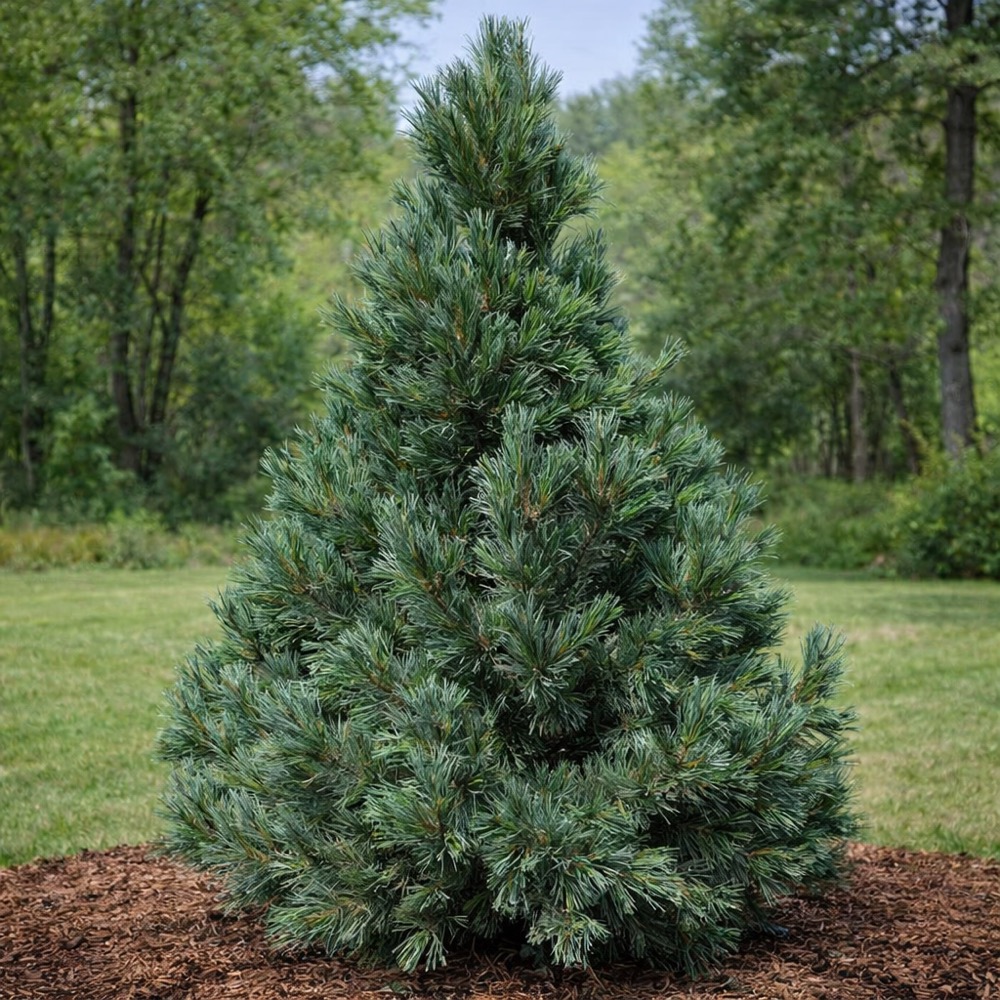
Vanderwolf’s Pyramid Limber Pine

Pinus flexilis ‘Vanderwolf’s Pyramid’

  1. Mature Size: 20–30′ H × 10–15′ W
  2. Light Requirements: Full sun
  3. Ideal Soil Conditions: Well-drained soils; tolerates dry, rocky, or poor soils once established
  4. Notable Characteristics:
    Dense, upright pyramidal form with long, twisted, blue-green needles that give a soft, graceful texture. Excellent specimen for year-round structure and color. Drought tolerant and very cold hardy.
  5. Deer Resistance: Moderate to High

Botanical Name: Cedrus atlantica ‘Glauca’

Common Name: Blue Atlas Cedar (Upright Form)

Mature Height and Width:
40–60′ tall × 30–40′ wide

Growth Habit: Upright pyramidal when young, maturing to a broad pyramidal to irregularly spreading canopy. Strong central leader with wide, layered horizontal scaffold branches. Moderate growth rate.

Foliage Description: Short, stiff needles borne in dense clusters along woody stems. Silver-blue to blue-gray coloration. Needle clusters create textured layered branch planes with visible structural depth.

Flower Description: Inconspicuous; not ornamental.

Bloom Time: Spring (non-ornamental reproductive structures).

Fall Color: Evergreen; consistent blue-gray foliage year-round.

Light Requirements: Full sun for strongest blue coloration and structural density.

Hardiness Zone: USDA Zones 6–9 (reliable in protected Zone 6; marginal in colder Zone 5 sites).

Notable Landscape Uses: Large lawn specimen; park planting; estate-scale focal point; windbreak component; architectural evergreen statement.

Deer Resistance: High
Coarse branching and clustered needles provide strong resistance in Northeast Zones 5–7 once established.

Botanical Name: Cedrus atlantica ‘Glauca Pendula’

Common Name: Weeping Blue Atlas Cedar

Mature Height and Width:
10–25′ tall × 10–20′ wide (highly variable depending on staking and training)

Growth Habit: Strong central leader when staked, with dramatically pendulous cascading branches. Irregular sculptural form. Architecture determined by early training; develops broad horizontal spread if not vertically trained. Moderate growth rate.

Foliage Description: Short stiff needles in dense clusters along drooping branchlets. Intense silver-blue to powder-blue coloration. Needles arranged in rosettes along woody stems, creating textured layered drape.

Flower Description: Inconspicuous; not ornamental.

Bloom Time: Spring (non-ornamental reproductive structures).

Fall Color: Evergreen; consistent blue to blue-gray year-round.

Light Requirements: Full sun for strongest color and density.

Hardiness Zone: USDA Zones 6–9 (reliable in protected Zone 6; marginal in colder Zone 5 sites).

Notable Landscape Uses: Specimen focal point; sculptural accent; island bed feature; courtyard planting; architectural evergreen centerpiece; sloped garden accent.

Deer Resistance: High
Sharp clustered needles and coarse branching provide strong resistance in Northeast Zones 5–7 once established.

Botanical Name: Picea abies ‘Cupressina’

Common Name: Columnar Norway Spruce

Mature Height and Width:
25–35′ tall × 6–10′ wide

Growth Habit: Strongly upright, narrowly columnar evergreen with a dominant central leader. Ascending branches held close to trunk, forming a tight vertical profile. Moderate growth rate.

Foliage Description: Short, dark green needles borne densely along ascending branchlets. Texture moderately coarse compared to arborvitae. Canopy dense but with visible vertical branch structure.

Flower Description: Inconspicuous; not ornamental.

Bloom Time: Spring (non-ornamental reproductive structures).

Fall Color: Evergreen; consistent deep green year-round.

Light Requirements: Full sun for best density and structure.

Hardiness Zone: USDA Zones 3–7.

Notable Landscape Uses: Vertical accent; narrow privacy screen; property line planting; driveway flanking; formal evergreen column; windbreak component.

Deer Resistance: Moderate-High
Young plants may experience browsing in Northeast Zones 5–7.

Botanical Name: Picea pungens ‘Hoopsii’

Common Name: Hoopsi Blue Spruce

Mature Height and Width:
30–50′ tall × 15–20′ wide

Growth Habit: Upright pyramidal evergreen with strong central leader and evenly spaced horizontal branch tiers. Symmetrical when young, maturing with natural contour variation. Moderate growth rate.

Foliage Description: Stiff, sharply pointed needles with intense silver-blue to steel-blue coloration. Needles held radially around branches, producing dense layered branch planes. Consistent blue coloration across canopy in full sun.

Flower Description: Inconspicuous; not ornamental.

Bloom Time: Spring (non-ornamental reproductive structures).

Fall Color: Evergreen; consistent silver-blue foliage year-round.

Light Requirements: Full sun for strongest blue coloration and density.

Hardiness Zone: USDA Zones 2–7.

Notable Landscape Uses: Specimen evergreen; lawn focal point; windbreak component; large-scale foundation backdrop; winter structure tree.

Deer Resistance: Moderate
Young plants may experience browsing pressure in Northeast Zones 5–7.

Botanical Name: Picea pungens ‘Globosa’

Common Name: Globosa Blue Spruce

Mature Height and Width:
3–5′ tall × 4–6′ wide

Growth Habit: Dwarf, broadly rounded to flattened globe form. Low, spreading evergreen with dense branching and layered horizontal structure. Typically wider than tall at maturity. Slow growth rate.

Foliage Description: Short, stiff needles with silver-blue to steel-blue coloration. Dense needle coverage along short internodes. Color consistent throughout canopy with slight natural tonal variation.

Flower Description: Inconspicuous; not ornamental.

Bloom Time: Spring (non-ornamental reproductive structures).

Fall Color: Evergreen; consistent blue foliage year-round.

Light Requirements: Full sun for best color and density.

Hardiness Zone: USDA Zones 2–7.

Notable Landscape Uses: Foundation massing; front border planting; rock garden specimen; walkway edge accent; low evergreen structure; courtyard planting.

Deer Resistance: Moderate-High
May experience occasional browsing in Northeast Zones 5–7.

Botanical Name: Picea pungens ‘Baby Blue’

Common Name: Baby Blue Colorado Spruce

Mature Height and Width:
20–25′ tall × 8–12′ wide

Growth Habit: Narrow pyramidal to conical evergreen with strong central leader and layered horizontal branching. Dense but not compacted. Moderate growth rate.

Foliage Description: Stiff, sharp needles with strong blue to silver-blue coloration. Needles held radially around stems, producing dense layered branch planes. Consistent blue tone across canopy.

Flower Description: Inconspicuous; not ornamental.

Bloom Time: Spring (non-ornamental reproductive structures).

Fall Color: Evergreen; consistent blue foliage year-round.

Light Requirements: Full sun for best color retention.

Hardiness Zone: USDA Zones 2–7.

Notable Landscape Uses: Specimen evergreen; windbreak component; privacy screen; lawn focal point; winter structure tree; holiday tree form.

Deer Resistance: Moderate-High
Young plants may experience browsing in Northeast Zones 5–7.

Botanical Name: Picea pungens ‘Fat Albert’

Common Name: Fat Albert Blue Spruce

Mature Height and Width:
15–25′ tall × 10–20′ wide

Growth Habit: Broad pyramidal evergreen with strong central leader. Dense, symmetrical branching forming a wide conical silhouette. Slower growing and fuller than seed-grown Colorado spruce.

Foliage Description: Stiff, sharply pointed needles with intense silver-blue to steel-blue coloration. Needles borne radially along branches, producing dense layered branch tiers. Consistent blue tone in full sun.

Flower Description: Inconspicuous; not ornamental.

Bloom Time: Spring (non-ornamental reproductive structures).

Fall Color: Evergreen; consistent silver-blue foliage year-round.

Light Requirements: Full sun for strongest color and density.

Hardiness Zone: USDA Zones 2–7 (reliable in Northeast Zones 5–7).

Notable Landscape Uses: Lawn specimen; foundation backdrop; windbreak component; evergreen focal point; formal accent tree.

Deer Resistance: High
Sharp needles and dense branching provide strong resistance in Northeast Zones 5–7 once established.

Botanical Name: Picea pungens ‘Iseli Fastigiate’

Common Name: Columnar Blue Spruce

Mature Height and Width:
25–35′ tall × 8–12′ wide

Growth Habit: Narrow upright pyramidal to columnar evergreen with strong central leader. Ascending branches held relatively tight to trunk while maintaining visible horizontal tiering. Moderate growth rate.

Foliage Description: Stiff, sharply pointed needles with silver-blue to steel-blue coloration. Needles borne radially around stems, creating dense layered branch structure. Consistent blue coloration in full sun.

Flower Description: Inconspicuous; not ornamental.

Bloom Time: Spring (non-ornamental reproductive structures).

Fall Color: Evergreen; consistent silver-blue foliage year-round.

Light Requirements: Full sun for best density and blue coloration.

Hardiness Zone: USDA Zones 2–7.

Notable Landscape Uses: Narrow privacy screen; vertical accent; property line planting; driveway flanking; formal evergreen column; windbreak component.

Deer Resistance: High
Sharp needles and dense branching provide strong resistance in Northeast Zones 5–7 once established.

Botanical Name: Picea glauca var. densata

Common Name: Black Hills Spruce

Mature Height and Width:
30–50′ tall × 15–25′ wide

Growth Habit: Dense pyramidal evergreen with strong central leader and uniform horizontal branching. More compact and fuller than standard white spruce. Moderate growth rate.

Foliage Description: Short dark green needles borne densely along branchlets. Foliage finer-textured and slightly shorter than Colorado spruce. Consistent deep green coloration without blue cast.

Flower Description: Inconspicuous; not ornamental.

Bloom Time: Spring (non-ornamental reproductive structures).

Fall Color: Evergreen; consistent dark green year-round.

Light Requirements: Full sun for best density and structure.

Hardiness Zone: USDA Zones 2–6 (reliable in Northeast Zones 5–6).

Notable Landscape Uses: Windbreak planting; privacy screen; lawn specimen; shelterbelt tree; northern landscape evergreen.

Deer Resistance: Moderate to High
Generally resistant once established in Northeast Zones 5–7; young trees may experience occasional tip browsing.

Botanical Name: Picea pungens ‘Blue Falls’

Common Name: Blue Falls Weeping Blue Spruce

Mature Height and Width:
6–10′ tall (staked leader) × 4–8′ wide

Growth Habit: Strongly pendulous evergreen with trailing branches. Height determined by staking; leader grows upward while lateral branches cascade downward. Forms a vertical accent with dramatic weeping curtain effect. Moderate growth rate.

Foliage Description: Stiff silver-blue to blue-gray needles borne densely along pendulous stems. Needles sharp and radially arranged, producing layered draping texture. Consistent cool blue tone in full sun.

Flower Description: Inconspicuous; not ornamental.

Bloom Time: Spring (non-ornamental reproductive structures).

Fall Color: Evergreen; consistent silver-blue coloration year-round.

Light Requirements: Full sun for strongest blue coloration and dense growth.

Hardiness Zone: USDA Zones 2–7 (reliable in Northeast Zones 5–7).

Notable Landscape Uses: Vertical accent; rock garden focal point; cascading over walls; specimen in mixed conifer bed; sculptural evergreen feature.

Deer Resistance: High
Sharp needles provide strong resistance in Northeast Zones 5–7 once established.

Botanical Name: Picea abies ‘Pendula’

Common Name: Weeping Norway Spruce

Mature Height and Width:
10–20′ tall (dependent on staking) × 6–10′ wide

Growth Habit: Strongly weeping evergreen with a narrow, irregular vertical form when staked. Branches cascade sharply downward from a trained central leader. Without staking, habit becomes spreading and ground-hugging. Architecture is highly sculptural and irregular.

Foliage Description: Medium to dark green needles, short and stiff, borne densely along pendulous branches. Foliage texture moderately coarse with visible branch structure beneath. Needles maintain consistent green coloration throughout the season.

Flower Description: Inconspicuous; non-ornamental cones typical of species.

Bloom Time: Spring (cones not primary ornamental feature).

Fall Color: Evergreen; maintains green year-round.

Light Requirements: Full sun for best structure and density.

Hardiness Zone: USDA Zones 3–7 (very reliable in Northeast Zones 5–7).

Notable Landscape Uses: Specimen evergreen; vertical architectural accent; focal point in mixed conifer garden; estate lawn specimen; dramatic entry feature.

Deer Resistance: Moderate to High
Generally avoided once established; occasional winter tip browsing possible under extreme pressure.

Botanical Name: Chamaecyparis obtusa ‘Fernspray Gold’

Common Name: Golden Fernspray Hinoki Cypress

Mature Height and Width:
8–12′ tall × 4–6′ wide (slow to moderate growth rate)

Growth Habit: Upright, irregular pyramidal evergreen with strongly layered, fern-like branching. Vertical leader present. Branching forms flattened horizontal tiers with cascading secondary sprays. Naturally asymmetrical and architectural rather than dense and compact.

Foliage Description: Distinct fern-like, deeply dissected scale sprays with pronounced texture. New growth bright golden-yellow, especially at tips and outer layers. Interior foliage matures to yellow-green to medium green. Branch sprays are finely divided, soft-textured, and clearly separated, creating visible air space between layers.

Flower Description: Inconspicuous; not ornamental.

Bloom Time: Spring (non-ornamental cones).

Fall Color: Evergreen; golden tones persist year-round, slightly deeper green toward interior in winter.

Light Requirements: Full sun to partial shade; best golden coloration in full sun with consistent moisture and good drainage.

Hardiness Zone: USDA Zones 5–8 (reliable in Northeast Zones 5–7 with protection from harsh winter winds).

Notable Landscape Uses: Specimen evergreen; rock garden vertical accent; mixed conifer garden focal point; foundation feature; architectural courtyard planting.

Deer Resistance: High
Consistently strong resistance in Northeast Zones 5–7 field conditions.

Botanical Name: Chamaecyparis obtusa ‘Nana Lutea’

Common Name: Dwarf Golden Hinoki Cypress

Mature Height and Width:
3–5′ tall × 3–5′ wide (slow growing; compact form)

Growth Habit: Dense, irregularly pyramidal to broadly mounded evergreen with layered, shell-like branching. Slow growth rate. Naturally compact with sculptural pad development, not tightly sheared.

Foliage Description: Bright golden-yellow to chartreuse new growth aging to deeper yellow-green interior foliage. Scale-like sprays arranged in cupped, fan-shaped layers creating visible tiered structure and interior depth. Color most intense in full sun.

Flower Description: Inconspicuous; not ornamental.

Bloom Time: Spring (non-ornamental cones).

Fall Color: Evergreen; golden tones persist year-round, slightly deeper in winter.

Light Requirements: Full sun to partial shade; best color and density in full sun with adequate moisture.

Hardiness Zone: USDA Zones 5–8 (reliable in Northeast Zones 5–7 with good drainage).

Notable Landscape Uses: Rock garden specimen; foundation accent; mixed conifer garden; small courtyard focal point; low architectural evergreen in formal beds.

Deer Resistance: High
Consistently strong resistance in Northeast Zones 5–7 field conditions.

Botanical Name: Chamaecyparis obtusa ‘Nana Gracilis’

Common Name: Dwarf Hinoki Cypress

Mature Height and Width:
4-6′ tall × 2-4′ wide (slow growing; often smaller in first decade)

Growth Habit: Dense, irregular pyramidal to broadly conical evergreen with sculptural, layered branching. Slow growth rate. Naturally compact but not tight or sheared.

Foliage Description: Deep rich green scale foliage arranged in tightly layered, fan-like sprays. Shell-like cupped branch pads stack irregularly, creating visible tiered texture and interior depth. New growth slightly lighter green at tips.

Flower Description: Inconspicuous; not ornamental.

Bloom Time: Spring (non-ornamental cones).

Fall Color: Evergreen; dark green retained year-round.

Light Requirements: Full sun to partial shade; best density and structure in full sun with adequate moisture.

Hardiness Zone: USDA Zones 4–8 (very reliable in Northeast Zones 5–7).

Notable Landscape Uses: Foundation accent; rock garden specimen; courtyard focal point; mixed conifer composition; small-scale architectural evergreen.

Deer Resistance: High
Consistently strong resistance in Northeast Zones 5–7 field conditions.

Botanical Name: Chamaecyparis obtusa ‘Aurea’

Common Name: Golden Hinoki Cypress

Mature Height and Width:
15–25′ tall × 8–12′ wide

Growth Habit: Upright pyramidal evergreen with strong central leader and layered, slightly irregular branching. Broader at the base with ascending branch sprays. Slow to moderate growth rate.

Foliage Description: Scale-like foliage arranged in flattened fan-shaped sprays. New growth bright golden-yellow, maturing to yellow-green with darker interior foliage. Layered shell-like branching creates sculptural texture and visible depth.

Flower Description: Inconspicuous; not ornamental.

Bloom Time: Spring (non-ornamental reproductive structures).

Fall Color: Evergreen; golden to yellow-green foliage retained year-round, richest on outer growth.

Light Requirements: Full sun to light partial shade; best golden coloration in full sun without excessive scorch.

Hardiness Zone: USDA Zones 4–8 (reliable in Northeast Zones 5–7).

Notable Landscape Uses: Foundation accent; mixed conifer garden; vertical focal point; courtyard planting; color contrast specimen.

Deer Resistance: High
Hinoki cypress selections show strong resistance in Northeast Zones 5–7 field conditions.

Botanical Name: Chamaecyparis obtusa ‘Gracilis’

Common Name: Slender Hinoki Cypress

Mature Height and Width:
15–20′ tall × 6–10′ wide

Growth Habit: Narrow pyramidal evergreen with irregular layered branching. Strong central leader with ascending branchlets forming loose, shell-like sprays. Slow to moderate growth rate.

Foliage Description: Dark green scale-like foliage arranged in flattened fan-shaped sprays. Texture layered and slightly cupped, creating sculptural depth. Interior branching visible between layers.

Flower Description: Inconspicuous; not ornamental.

Bloom Time: Spring (non-ornamental reproductive structures).

Fall Color: Evergreen; consistent deep green year-round.

Light Requirements: Full sun to partial shade; best density and structure in full sun.

Hardiness Zone: USDA Zones 4–8 (reliable in Northeast Zones 5–7).

Notable Landscape Uses: Foundation vertical accent; courtyard focal point; mixed conifer garden; entry planting; evergreen screen component.

Deer Resistance: Moderate-High
May experience light browsing under heavy pressure in Northeast Zones 5–7.

Botanical Name: Hydrangea paniculata ‘Pink Diamond’ (standard form)

Common Name: Pink Diamond Hydrangea Tree

Mature Height and Width:
8–12′ tall × 6–8′ wide (canopy dimension on grafted standard)

Growth Habit: Tree-form hydrangea trained to a single clear trunk. Broadly rounded to slightly irregular canopy with upright to slightly arching stems. Moderate to vigorous growth rate. More open structure than ‘Phantom.’

Foliage Description: Medium green ovate leaves with serrated margins. Moderate canopy density with visible branching between bloom clusters.

Flower Description: Large conical panicles emerging creamy white and maturing to medium to deep pink as season progresses. Panicles more open and airy than ‘Phantom,’ with visible individual florets and lighter texture.

Bloom Time: Mid-summer through early fall.

Fall Color: Panicles deepen to pink-red; foliage yellow-brown before leaf drop.

Light Requirements: Full sun to partial shade; strongest pink coloration in full sun.

Hardiness Zone: USDA Zones 3–8 (reliable in Northeast Zones 5–7).

Notable Landscape Uses: Lawn specimen; foundation accent; patio focal point; late-season flowering tree; mixed border anchor.

Deer Resistance: Moderate
Flower buds and new growth may be browsed in Northeast Zones 5–7.

Botanical Name: Hydrangea paniculata ‘Phantom’ (standard form)

Common Name: Phantom Hydrangea Tree

Mature Height and Width:
8–10′ tall × 6–8′ wide (canopy dimension on grafted standard)

Growth Habit: Tree-form hydrangea trained to a single clear trunk. Broadly rounded to slightly irregular canopy with strong upright stems supporting large panicles. Vigorous growth rate with substantial stem thickness compared to smaller cultivars.

Foliage Description: Medium to dark green ovate leaves with serrated margins. Larger leaf size than dwarf selections. Moderate canopy density with visible branching beneath bloom clusters.

Flower Description: Very large, dense conical panicles emerging creamy white, often aging to soft blush pink late in season. Panicles thicker and fuller than ‘Limelight,’ with broader base and heavier flower mass.

Bloom Time: Mid-summer through early fall.

Fall Color: Panicles age to pale pink; foliage yellow-brown before leaf drop.

Light Requirements: Full sun to partial shade; strongest stems and largest panicles in full sun.

Hardiness Zone: USDA Zones 3–8 (reliable in Northeast Zones 5–7).

Notable Landscape Uses: Foundation focal point; lawn specimen; patio accent; formal garden element; large late-season flowering feature.

Deer Resistance: Moderate
Flower buds and new growth may be browsed in Northeast Zones 5–7.

Botanical Name: Hydrangea paniculata ‘Limelight’ (standard form)

Common Name: Limelight Hydrangea Tree

Mature Height and Width:
6–8′ tall × 6–7′ wide (grafted standard form; canopy dimension only)

Growth Habit: Tree-form hydrangea trained on a single clear trunk with rounded to broadly oval flowering canopy. Dense upper branching with upright stems supporting large panicles. Moderate to fast growth rate.

Foliage Description: Medium green ovate leaves with serrated margins. Moderate leaf size and density. Leaves provide backdrop beneath large panicles.

Flower Description: Large conical panicles emerging lime-green, transitioning to creamy white, then soft pink to rose in late season. Panicles held upright on strong stems. Dense bloom coverage across canopy.

Bloom Time: Mid-summer through early fall.

Fall Color: Panicles age to pink to muted rose; foliage yellow-brown before leaf drop.

Light Requirements: Full sun to partial shade; strongest stems and bloom density in full sun.

Hardiness Zone: USDA Zones 3–8 (reliable in Northeast Zones 5–7).

Notable Landscape Uses: Foundation focal point; patio accent; small lawn specimen; formal garden element; entry planting.

Deer Resistance: Moderate
Flower buds and new growth may experience browsing pressure in Northeast Zones 5–7.

Botanical Name: Hibiscus syriacus ‘Pink Chiffon’ (standard form)

Common Name: Pink Chiffon Rose of Sharon Tree

Mature Height and Width:
8–12′ tall × 5–7′ wide (canopy dimension on grafted standard)

Growth Habit: Tree-form Rose of Sharon trained to a single clear trunk. Upright-rounded to slightly vase-shaped canopy with moderately dense branching. Moderate growth rate.

Foliage Description: Medium green ovate leaves with serrated margins. Moderate canopy density allowing interior branching visibility.

Flower Description: Semi-double soft pink flowers with layered inner petaloids forming a frilled, ruffled center. Lacks a strong dark burgundy eye. Blooms produced along current season’s growth.

Bloom Time: Mid-summer through early fall.

Fall Color: Yellow; foliage drops with frost.

Light Requirements: Full sun for strongest flowering and canopy structure.

Hardiness Zone: USDA Zones 5–9 (reliable in Northeast Zones 5–7).

Notable Landscape Uses: Patio specimen; foundation accent; container feature (large pot); small lawn focal point; late-season flowering element.

Deer Resistance: Moderate
Tender new growth and flowers may be browsed in Northeast Zones 5–7.

Botanical Name: Hibiscus syriacus ‘Minerva’ (standard form)

Common Name: Minerva Rose of Sharon Tree

Mature Height and Width:
8–12′ tall × 5–7′ wide (canopy dimension on grafted standard)

Growth Habit: Tree-form Rose of Sharon trained to a single clear trunk. Upright-rounded to slightly vase-shaped canopy with moderately dense branching. Moderate growth rate.

Foliage Description: Medium green ovate leaves with coarse serration. Moderate canopy density allowing interior structure visibility.

Flower Description: Large single lavender-pink flowers with a distinct deep red to burgundy eye. Five overlapping petals with prominent central staminal column. Blooms produced on current season’s growth.

Bloom Time: Mid-summer through early fall.

Fall Color: Yellow; foliage drops after frost.

Light Requirements: Full sun for strongest flowering and structural density.

Hardiness Zone: USDA Zones 5–9 (reliable in Northeast Zones 5–7).

Notable Landscape Uses: Lawn specimen; foundation accent; patio planting; late-season flowering focal point; small ornamental tree.

Deer Resistance: Moderate
Tender growth and flower buds may be browsed in Northeast Zones 5–7.

Botanical Name: Hibiscus syriacus ‘Lucy’ (standard form)

Common Name: Lucy Rose of Sharon Tree

Mature Height and Width:
8–12′ tall × 5–7′ wide (canopy dimension on grafted standard)

Growth Habit: Tree-form Rose of Sharon trained to a single clear trunk. Upright-rounded to broadly oval canopy with ascending branching. Moderate growth rate.

Foliage Description: Medium green ovate leaves with serrated margins. Moderate canopy density with visible branching beneath bloom clusters.

Flower Description: Fully double deep pink to rose-red flowers with layered petal structure forming a dense rosette. No prominent dark eye. Flowers borne along current season’s growth.

Bloom Time: Mid-summer through early fall.

Fall Color: Yellow; foliage drops with frost.

Light Requirements: Full sun for strongest flowering and canopy density.

Hardiness Zone: USDA Zones 5–9 (reliable in Northeast Zones 5–7).

Notable Landscape Uses: Front yard focal tree; foundation accent; patio specimen; formal garden planting; late-season flowering highlight.

Deer Resistance: Moderate
New growth and flowers may be browsed in Northeast Zones 5–7.

Botanical Name: Hibiscus syriacus ‘Lavender Chiffon’ (standard form)

Common Name: Lavender Chiffon Rose of Sharon Tree

Mature Height and Width:
8–12′ tall × 4–6′ wide (canopy dimension on grafted standard)

Growth Habit: Tree-form Rose of Sharon trained to a single clear trunk. Upright-rounded to slightly vase-shaped canopy with ascending branching. Moderate growth rate.

Foliage Description: Medium green ovate leaves with coarse serration. Moderate canopy density with visible branch structure between flower clusters.

Flower Description: Semi-double lavender flowers with layered inner petaloids forming a soft, ruffled center. Five primary outer petals with frilled central tuft. Lacks strong dark eye compared to single-flowered cultivars.

Bloom Time: Mid-summer through early fall.

Fall Color: Yellow; foliage drops after frost.

Light Requirements: Full sun for strongest bloom production and canopy structure.

Hardiness Zone: USDA Zones 5–9 (reliable in Northeast Zones 5–7).

Notable Landscape Uses: Front yard focal point; foundation accent; patio planting; small flowering lawn specimen; late-season color element.

Deer Resistance: Moderate
Tender growth and flowers may be browsed in Northeast Zones 5–7.

Botanical Name: Hibiscus syriacus ‘Azurri Blue Satin’ (standard form)

Common Name: Azurri Blue Satin Rose of Sharon Tree

Mature Height and Width:
8–12′ tall × 4–6′ wide (canopy dimension on grafted standard)

Growth Habit: Tree-form Rose of Sharon trained to a single clear trunk. Upright, vase-shaped to rounded canopy with ascending branching. Moderate growth rate. More open and refined branching than older seedling types.

Foliage Description: Medium green, coarsely toothed ovate leaves. Moderate canopy density with visible branching structure. Foliage provides backdrop to prominent summer blooms.

Flower Description: Large single blue to blue-violet flowers with a distinct dark red to burgundy eye. Five-petaled, slightly overlapping form with prominent central staminal column. Blooms produced along current season’s growth.

Bloom Time: Mid-summer through early fall.

Fall Color: Yellow; foliage drops with frost.

Light Requirements: Full sun for strongest bloom production and canopy density.

Hardiness Zone: USDA Zones 5–9 (reliable in Northeast Zones 5–7).

Notable Landscape Uses: Lawn specimen; foundation accent; patio planting; small focal tree; late-season flowering element.

Deer Resistance: Moderate
Tender new growth and flowers may be browsed in Northeast Zones 5–7.

Botanical Name: Salix integra ‘Hakuro Nishiki’ (standard form)

Common Name: Dappled Willow Tree

Mature Height and Width:
6–10′ tall × 6–8′ wide (canopy dimension on grafted standard)

Growth Habit: Tree-form shrub grafted onto a single clear trunk. Rounded to broadly spherical canopy composed of dense fine branching. Rapid growth rate; requires periodic pruning to maintain shape and variegation intensity.

Foliage Description: Variegated narrow lanceolate leaves emerging pink in spring, transitioning to white and green mottled foliage through summer. New growth strongest in color. Moderate to dense canopy with fine-textured branching.

Flower Description: Small inconspicuous catkins in early spring; not ornamental at landscape scale.

Bloom Time: Early spring (non-ornamental catkins).

Fall Color: Yellow; foliage drops late in season.

Light Requirements: Full sun for best variegation and color intensity.

Hardiness Zone: USDA Zones 4–8 (reliable in Northeast Zones 5–7).

Notable Landscape Uses: Foundation accent; courtyard feature; patio planting; small garden focal point; mixed border vertical accent.

Deer Resistance: Low to Moderate
Tender new growth frequently browsed in Northeast Zones 5–7.

Botanical Name: Rhododendron ‘Girard’s Fuchsia’

Common Name: Girard’s Fuchsia Azalea

Mature Height and Width: 2–3′ tall × 3–4′ wide

Growth Habit: Low, compact, mounded evergreen shrub with dense branching. Naturally forms a tight but slightly spreading cushion over time. Moderate growth rate.

Foliage Description: Small, elliptic dark green evergreen leaves with a smooth texture. Foliage often develops a noticeable burgundy-bronze tint in fall and winter in Zones 5–7, adding seasonal interest.

Flower Description: Abundant, vibrant fuchsia-purple single blooms with slightly wavy petal edges. Flowers are saturated in color and densely produced in spring.

Bloom Time: Mid-spring

Fall Color: Evergreen; foliage may develop burgundy-bronze winter coloration.

Light Requirements: Full sun to partial shade; best flowering with 4–6 hours of direct sunlight.

Hardiness Zone: USDA Zones 5–8

Notable Landscape Uses:
Low foundation plantings; mass plantings for bold spring color; woodland-edge gardens; slope plantings; border accents; small-space evergreen shrub; suitable for container use in protected settings.

Deer Resistance: Low to Moderate
Azaleas are commonly browsed by deer, especially new growth and flower buds. Protection is recommended in moderate to heavy deer pressure areas in Zones 5–7.

Botanical Name: Rhododendron ‘Girard’s Rose’

Common Name: Girard’s Rose Azalea

Mature Height and Width:
2–3′ tall × 3–4′ wide

Growth Habit: Low, spreading to mounded evergreen azalea with dense branching. Broadly rounded form, typically wider than tall. Moderate growth rate.

Foliage Description: Small, dark green evergreen leaves with a matte to light natural sheen. Dense foliage coverage with tight twig structure. Leaves may develop slight bronze cast in winter.

Flower Description: Medium-sized single rose-pink flowers with slightly deeper pink blotch. Five-lobed funnel form. Blooms borne in clusters across upper canopy.

Bloom Time: Mid to late spring.

Fall Color: Evergreen; foliage may bronze slightly in winter.

Light Requirements: Partial shade to filtered sun; tolerates morning sun with afternoon protection.

Hardiness Zone: USDA Zones 5–8.

Notable Landscape Uses: Foundation massing; low border; woodland edge planting; evergreen ground-layer structure; small-scale front bed accent.

Deer Resistance: Moderate
Evergreen foliage may experience browsing pressure in Northeast Zones 5–7.

Dappled Willow
Salix integra ‘Hakuro‑nishiki’

  1. Mature Size: 4–7′ H × 4–7′ W (variegation often more pronounced in sun)
  2. Light Requirements: Full sun to part shade (foliage color best in sun)
  3. Ideal Soil Conditions: Moist, well‑drained soil; tolerates wet sites and rain gardens
  4. Notable Characteristics: Distinctive variegated foliage of green, white, and pink flashes early season. Soft, arching habit makes a colorful accent or informal screen.
  5. Deer Resistance: Low to Moderate — browsed when tender growth is available.
    Note: Spring and early summer foliage showy; regular pruning helps maintain compact form.

Botanical Name: Syringa pubescens subsp. patula ‘Miss Kim’

Common Name: Miss Kim Lilac

Mature Height and Width:
4–7′ tall × 5–7′ wide

Growth Habit: Upright-rounded to broadly rounded deciduous shrub. Dense branching with fine twig structure. Moderate growth rate. More refined and compact than common lilac.

Foliage Description: Small, dark green ovate leaves with smooth margins. Foliage appears finer-textured than Syringa vulgaris. Leaves often develop burgundy to reddish-purple tones in fall.

Flower Description: Fragrant single lavender to pale violet flower clusters (panicles) borne at stem tips. Panicles smaller and more refined than common lilac. Individual florets tubular with four-lobed petals.

Bloom Time: Mid to late spring (slightly later than common lilac).

Fall Color: Burgundy to reddish-purple in favorable conditions.

Light Requirements: Full sun for best flowering.

Hardiness Zone: USDA Zones 3–8.

Notable Landscape Uses: Foundation planting; walkway edge; small hedge; mixed border; patio accent; compact screening.

Deer Resistance: Moderate
May experience browsing in Northeast Zones 5–7 but typically less preferred than tender new growth shrubs.

Ivory Halo® Red Twig Dogwood
Cornus alba ‘Bailhalo’

  1. Mature Size: 6–8′ H × 6–8′ W
  2. Light Requirements: Full sun to part shade
  3. Ideal Soil Conditions: Moist, well‑drained soil; adaptable to average conditions
  4. Notable Characteristics: Striking creamy‑white variegated foliage with vivid red stems that light up winter landscapes. Loose, arching habit great for mass plantings or foundation beds.
  5. Deer Resistance: Low to Moderate — browsed in local landscapes, especially new growth.
    Note: Performs well in a variety of sites; good maintenance pruning improves winter stem display.

Botanical Name: Carpinus betulus ‘Fastigiata’

Common Name: European Columnar Hornbeam

Mature Height and Width:
30–40′ tall × 15–20′ wide

Growth Habit: Narrow upright to broadly columnar when young, maturing to a dense oval to upright-oval form. Strong central leader with ascending branches that hold tight vertical structure. Moderate growth rate.

Foliage Description: Deciduous, medium to dark green ovate leaves with serrated margins and pronounced veining. Dense canopy in summer with layered branching. Leaves turn yellow to yellow-brown in fall and may persist into winter (marcescent).

Flower Description: Inconspicuous green catkins in spring; not ornamental.

Bloom Time: Mid-spring.

Fall Color: Yellow to yellow-brown; foliage often persists dried into winter.

Light Requirements: Full sun to partial shade.

Hardiness Zone: USDA Zones 4–8.

Notable Landscape Uses: Formal screening; driveway flanking; property line structure; allee planting; privacy hedge (when clipped); vertical architectural accent.

Deer Resistance: Moderate
Young plants may experience browsing in Northeast Zones 5–7.

Green Weeping Willow
Salix babylonica (standard form)

  1. Mature Size: 30–50′ H × 30–50′ W
  2. Light Requirements: Full sun
  3. Ideal Soil Conditions: Moist to wet, well‑drained soils
  4. Notable Characteristics: Classic weeping form with long cascading branches; great for water’s edge or large spaces.
  5. Deer Resistance: Low to Moderate

Gold Weeping Willow
Salix babylonica ‘Chrysocoma’ (Gold form)

  1. Mature Size: 30–50′ H × 30–50′ W
  2. Light Requirements: Full sun
  3. Ideal Soil Conditions: Moist to wet, well‑drained soils; excellent for rain gardens or edges of water features
  4. Notable Characteristics: Graceful, cascading habit with golden‑toned twig highlights; dramatic focal tree.
  5. Deer Resistance: Low to Moderate

Botanical Name: Liquidambar styraciflua ‘Cherokee’

Common Name: Cherokee Sweetgum

Mature Height and Width:
40–60′ tall × 25–35′ wide

Growth Habit: Upright pyramidal when young, maturing to a broad pyramidal to oval canopy. Strong central leader with ascending scaffold branches. Moderate to fast growth rate.

Foliage Description: Deciduous, star-shaped leaves with five sharply pointed lobes. Medium green during the growing season with moderate density. Leaves held alternately along well-spaced branches, allowing visible canopy structure.

Flower Description: Inconspicuous greenish flowers in spring; not ornamental.

Bloom Time: Mid-spring.

Fall Color: Strong red to burgundy tones, often with orange highlights. Color intensity varies with site conditions.

Light Requirements: Full sun.

Hardiness Zone: USDA Zones 5–9.

Notable Landscape Uses: Large shade tree; street tree (with space); lawn specimen; property line planting; autumn color accent; park or institutional landscapes.

Deer Resistance: Moderate
Young trees may experience browsing pressure in Northeast Zones 5–7.

Botanical Name: Syringa reticulata ‘Ivory Silk’

Common Name: Ivory Silk Japanese Tree Lilac

Mature Height and Width:
20–30′ tall × 15–20′ wide

Growth Habit: Upright oval to broadly rounded small tree with strong central leader. Well-spaced ascending scaffold branches. Moderate growth rate. More tree-form and less suckering than common lilac.

Foliage Description: Medium to dark green ovate leaves with smooth margins. Leaves larger and glossier than Syringa vulgaris. Moderate canopy density with visible branching structure.

Flower Description: Large creamy-white panicles held upright at branch tips. Panicles broad and somewhat conical, appearing in dense clusters across upper canopy. Fragrant.

Bloom Time: Early to mid-summer (later than common lilac).

Fall Color: Yellow to yellow-brown; not highly ornamental.

Light Requirements: Full sun for best flowering and canopy structure.

Hardiness Zone: USDA Zones 3–7 (reliable in Northeast Zones 5–7).

Notable Landscape Uses: Street tree; lawn specimen; patio shade tree; late-season flowering accent; urban planting.

Deer Resistance: Moderate
New growth may experience browsing in Northeast Zones 5–7 but generally less preferred than common lilac.

Bloomerang® Dark Purple Lilac Tree
Syringa reticulata ‘Bloomerang Dark Purple’

  1. Mature Size: 10–12′ H × 8–10′ W
  2. Light Requirements: Full sun
  3. Ideal Soil Conditions: Well‑drained soil rich in organic matter
  4. Notable Characteristics: Upright lilac tree with deep purple blooms; extended bloom season compared to typical tree lilacs.
  5. Deer Resistance: Moderate to High

Miss Kim Lilac Tree
Syringa reticulata ‘Miss Kim’

  1. Mature Size: 6-8′ H × 4-6′ W
  2. Light Requirements: Full sun to part shade
  3. Ideal Soil Conditions: Well‑drained, fertile soils
  4. Notable Characteristics: Small ornamental tree form of Japanese tree lilac with creamy white late spring flowers and tidy habit.
  5. Deer Resistance: Moderate to High

Sugar Tyme® Crabapple
Malus ‘Sugar Tyme’

  1. Mature Size: 12–20′ H × 10–15′ W
  2. Light Requirements: Full sun
  3. Ideal Soil Conditions: Well‑drained soil; tolerates urban stress
  4. Notable Characteristics: Compact tree with showy pink contrast to green foliage and superb disease resistance.
  5. Deer Resistance: Low to Moderate

Splendour® Crabapple (often sold as Profusion Crabapple)
Malus ‘Profusion’

  1. Mature Size: 10–15′ H × 10–15′ W
  2. Light Requirements: Full sun
  3. Ideal Soil Conditions: Moist, well‑drained soil
  4. Notable Characteristics: Bright pink blossoms and strong resistance to common crabapple diseases; good fruit set for wildlife.
  5. Deer Resistance: Low to Moderate

Snowdrift Crabapple
Malus ‘Snowdrift’

  1. Mature Size: 12–15′ H × 10–15′ W
  2. Light Requirements: Full sun
  3. Ideal Soil Conditions: Moist, well‑drained soil
  4. Notable Characteristics: Nearly sterile white blossoms with excellent form and little fruit litter; good fall color and strong branching.
  5. Deer Resistance: Low to Moderate

Royal Raindrops® Crabapple
Malus ‘Royal Raindrops’

  1. Mature Size: 15–20′ H × 15–20′ W
  2. Light Requirements: Full sun
  3. Ideal Soil Conditions: Well‑drained soils with medium fertility
  4. Notable Characteristics: Distinctive purplish foliage with rose‑pink blooms and minimal fruiting; strong disease resistance makes it a reliable landscape tree.
  5. Deer Resistance: Low to Moderate

Prairie Fire Crabapple
Malus ‘Prairiefire’

  1. Mature Size: 15–20′ H × 15–20′ W
  2. Light Requirements: Full sun
  3. Ideal Soil Conditions: Moist, well‑drained soil; tolerates average conditions and urban sites
  4. Notable Characteristics: Deep rosy‑pink buds open to fragrant, single blossoms; excellent disease resistance and good fall color. Moderate fruit that doesn’t litter.
  5. Deer Resistance: Low to Moderate — occasional browsing on young foliage/flowers.
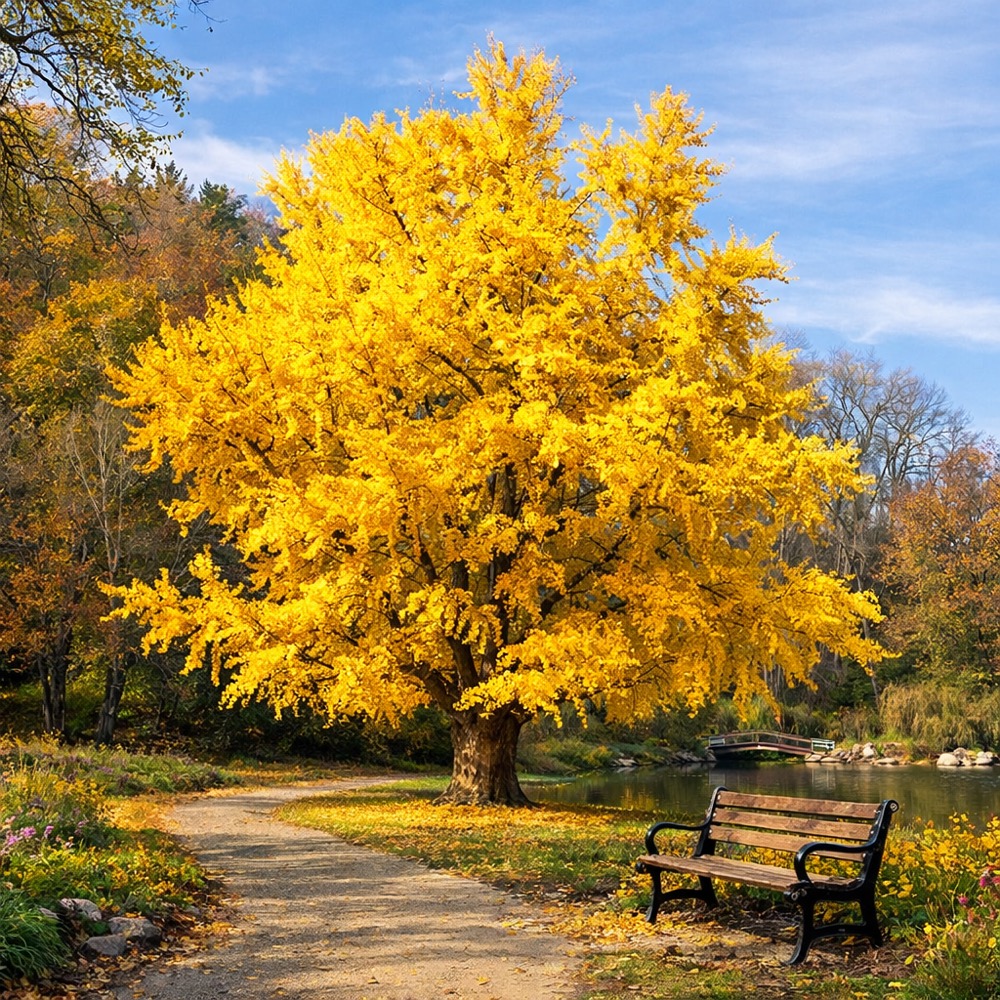
Ginkgo (Maidenhair Tree)
Ginkgo biloba

  1. Mature Size: 50–80′ H × 30–40′ W (varies by cultivar)
  2. Light Requirements: Full sun
  3. Ideal Soil Conditions: Well‑drained soil; tolerant of clay and urban conditions once established
  4. Notable Characteristics: Ancient, fan‑leaf tree with excellent fall color (bright gold). Very tolerant and long‑lived.
  5. Deer Resistance: Moderate to High — generally avoided by deer.

Botanical Name: Cornus × ‘Rutgan’

Common Name: Stellar Pink Dogwood

Mature Height and Width:
15–20′ tall × 15–20′ wide

Growth Habit: Upright-rounded to broadly spreading small deciduous tree. Strong central leader when young, developing layered horizontal branching with age. More open branching structure than Cornus florida. Moderate growth rate.

Foliage Description: Medium green ovate leaves with smooth margins and prominent venation. Leaves slightly thicker and more lustrous than Cornus florida. Moderate canopy density with visible branch structure.

Flower Description: Large overlapping pink bracts (not true petals) surrounding a small central green flower cluster. Bracts deeper pink at emergence, softening slightly as they age. Four-bract form typical of hybrid dogwoods.

Bloom Time: Mid-spring.

Fall Color: Reddish-purple to burgundy.

Light Requirements: Full sun to partial shade; best flowering in full sun with adequate moisture.

Hardiness Zone: USDA Zones 5–8 (reliable in Northeast Zones 5–7).

Notable Landscape Uses: Front yard specimen; foundation accent; woodland-edge focal point; lawn specimen; small canopy tree for residential landscapes.

Deer Resistance: Moderate
Young growth and buds may experience browsing in Northeast Zones 5–7.

Botanical Name: Cornus florida ‘Scarlet Fire’

Common Name: Scarlet Fire Flowering Dogwood

Mature Height and Width:
20–25′ tall × 20–25′ wide

Growth Habit: Upright-rounded to broadly spreading small deciduous tree. Strong central leader when young, maturing to layered horizontal branching with moderate canopy openness. Moderate growth rate.

Foliage Description: Medium to dark green ovate leaves with prominent venation. Leaves slightly glossy with moderate density. Healthy foliage retention through summer under proper siting.

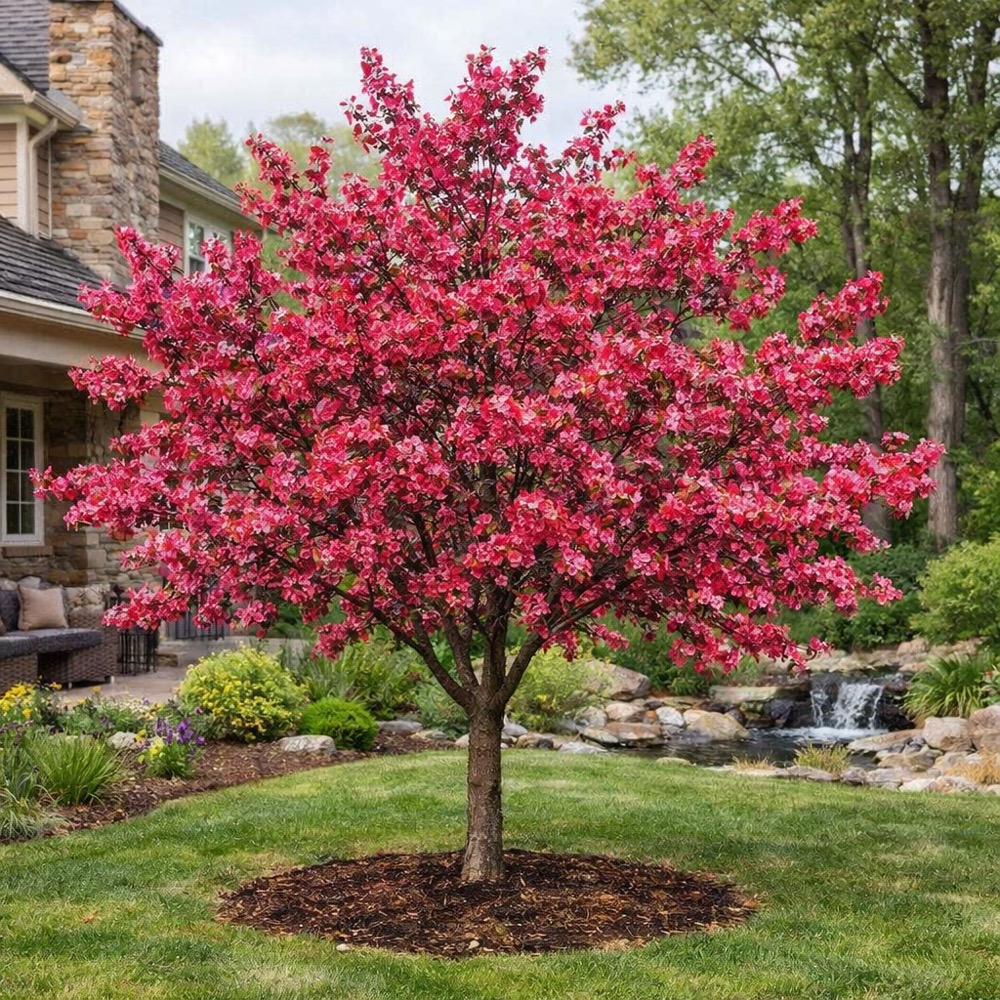
Flower Description: Large overlapping deep pink to rose-red bracts surrounding a small central green flower cluster. Bracts broader and more saturated in color than typical pink Cornus florida selections. Four-bract structure per bloom.

Bloom Time: Mid-spring.

Fall Color: Reddish-purple to burgundy.

Light Requirements: Full sun to partial shade; best performance with morning sun and afternoon protection in hotter sites.

Hardiness Zone: USDA Zones 5–9 (reliable in Northeast Zones 5–7 with appropriate siting).

Notable Landscape Uses: Front yard focal point; lawn specimen; woodland-edge accent; estate planting; high-impact spring flowering tree.

Deer Resistance: Moderate
Young growth and flower buds may experience browsing pressure in Northeast Zones 5–7.

Red Dogwood (Florida)
Cornus florida (red bracted selections)

  1. Mature Size: 15–30′ H × 15–30′ W
  2. Light Requirements: Full sun to part shade
  3. Ideal Soil Conditions: Moist, well‑drained, acidic soils
  4. Notable Characteristics: Vibrant red bracts in spring and strong fall foliage display.
  5. Deer Resistance: Low

Pink Dogwood (Florida)
Cornus florida (pink forms)

  1. Mature Size: 15–30′ H × 15–30′ W
  2. Light Requirements: Full sun to part shade
  3. Ideal Soil Conditions: Moist, acidic, well‑drained soils
  4. Notable Characteristics: Classic pink spring bracts with a spreading form and reliable fall color.
  5. Deer Resistance: Low

Celestial™ Dogwood
Cornus × rutgersensis ‘Celestial’

  1. Mature Size: 15–20′ H × 15–20′ W
  2. Light Requirements: Full sun to part shade
  3. Ideal Soil Conditions: Moist, well‑drained, rich soils
  4. Notable Characteristics: Large white bracts in spring with uniform shape and strong branching.
  5. Deer Resistance: Low
    Note: A Rutgers hybrid known for increased resistance to anthracnose and powdery mildew.
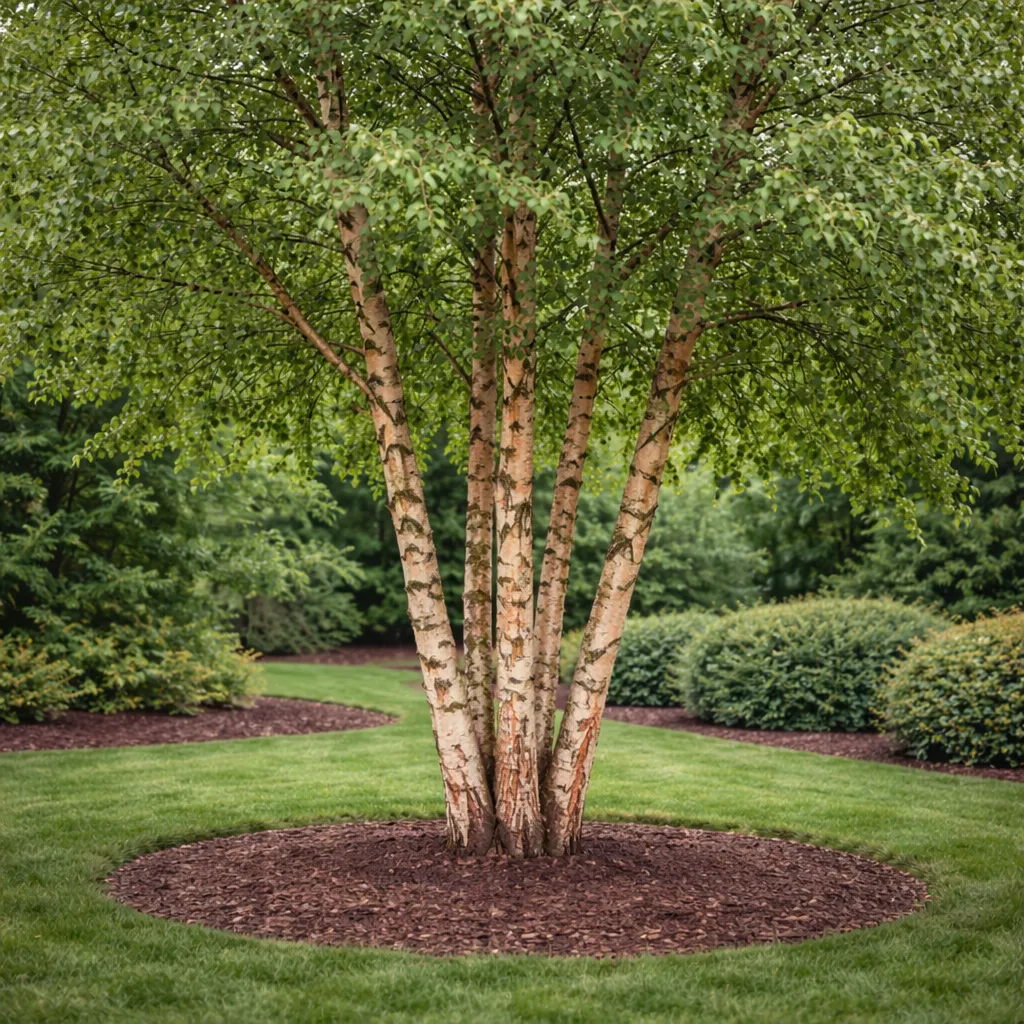
Heritage® River Birch
Betula nigra ‘Cully’ (Heritage®)

  1. Mature Size: 40–60′ H × 30–50′ W
  2. Light Requirements: Full sun to part shade
  3. Ideal Soil Conditions: Moist to wet, well‑drained soils; tolerates clay, heat, and occasional flooding
  4. Notable Characteristics: Improved selection of native river birch with lighter, creamy tan exfoliating bark and vigorous growth. More resistant to leaf spot and heat than the species.
  5. Deer Resistance: Moderate to High — not a preferred browse species
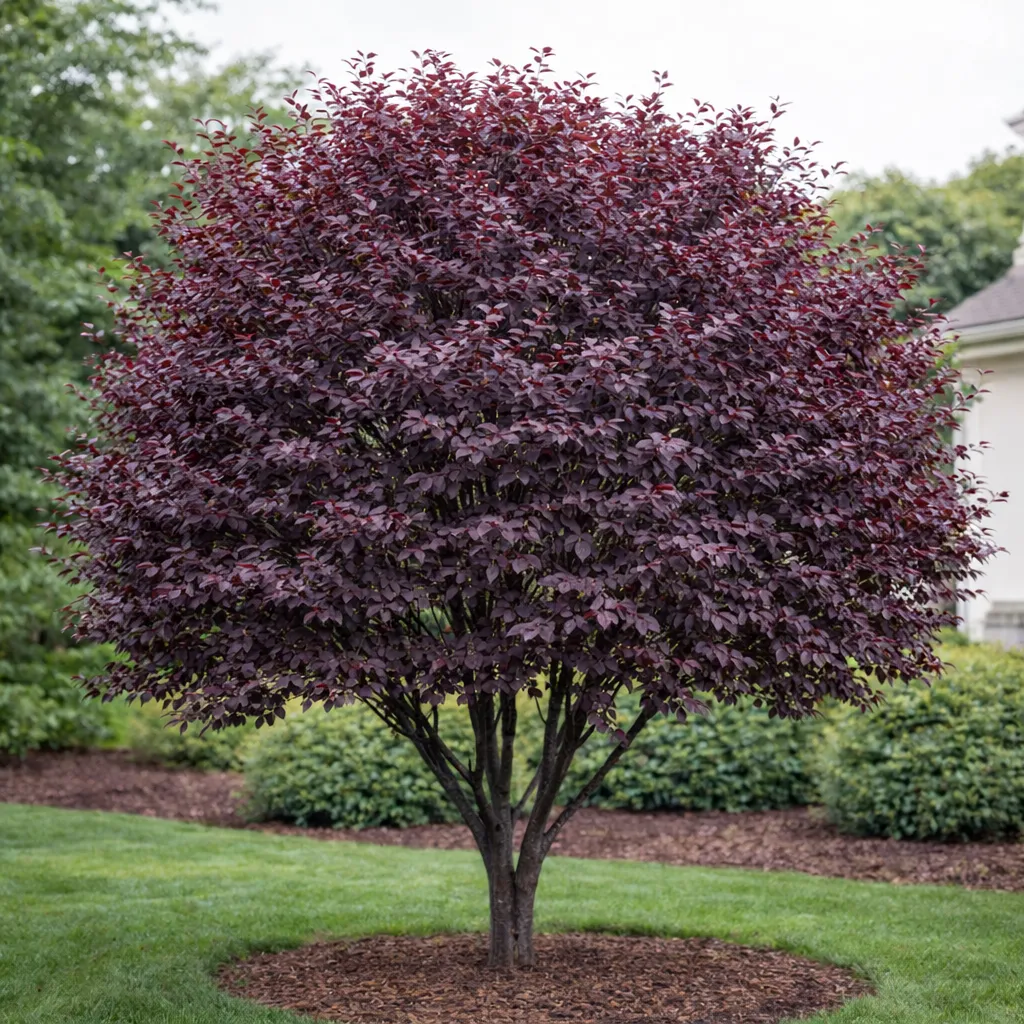
Thundercloud™ Plum
Prunus cerasifera ‘Thundercloud’

  1. Mature Size: 15–25′ H × 15–20′ W
  2. Light Requirements: Full sun
  3. Ideal Soil Conditions: Well‑drained, fertile soils
  4. Notable Characteristics: Dark purple foliage with small rosy blossoms in spring and small plums later. Effective contrast tree.
  5. Deer Resistance: Low

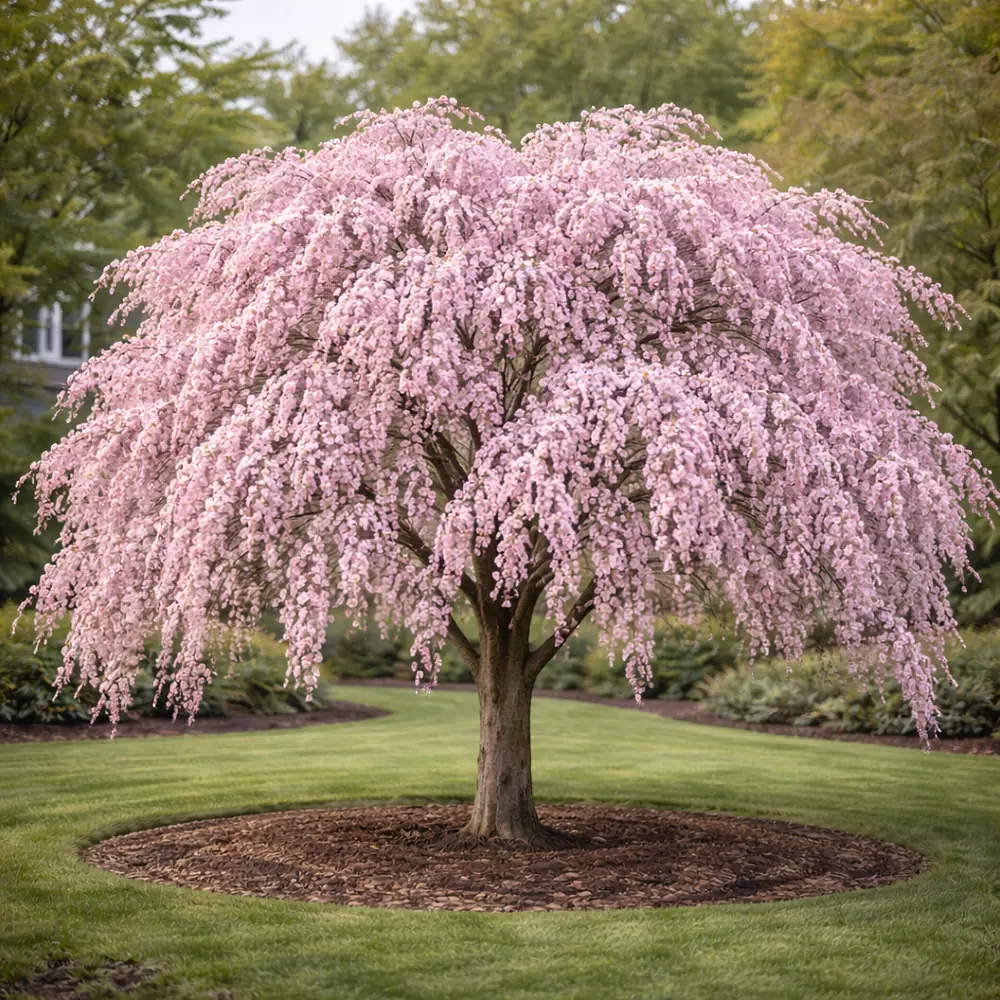
Double Pink Weeping Cherry
Prunus subhirtella ‘Plena’ (or similar cultivar)

  1. Mature Size: 15–25′ H × 15–25′ W (weeping canopy)
  2. Light Requirements: Full sun
  3. Ideal Soil Conditions: Moist, well‑drained soil; mulch to moderate root temperatures
  4. Notable Characteristics: Elegant, pendulous habit with double pink spring blossoms that cascade toward the ground. Great as a garden centerpiece or soft screening tree.
  5. Deer Resistance: Low — young foliage and blossoms may be browsed.
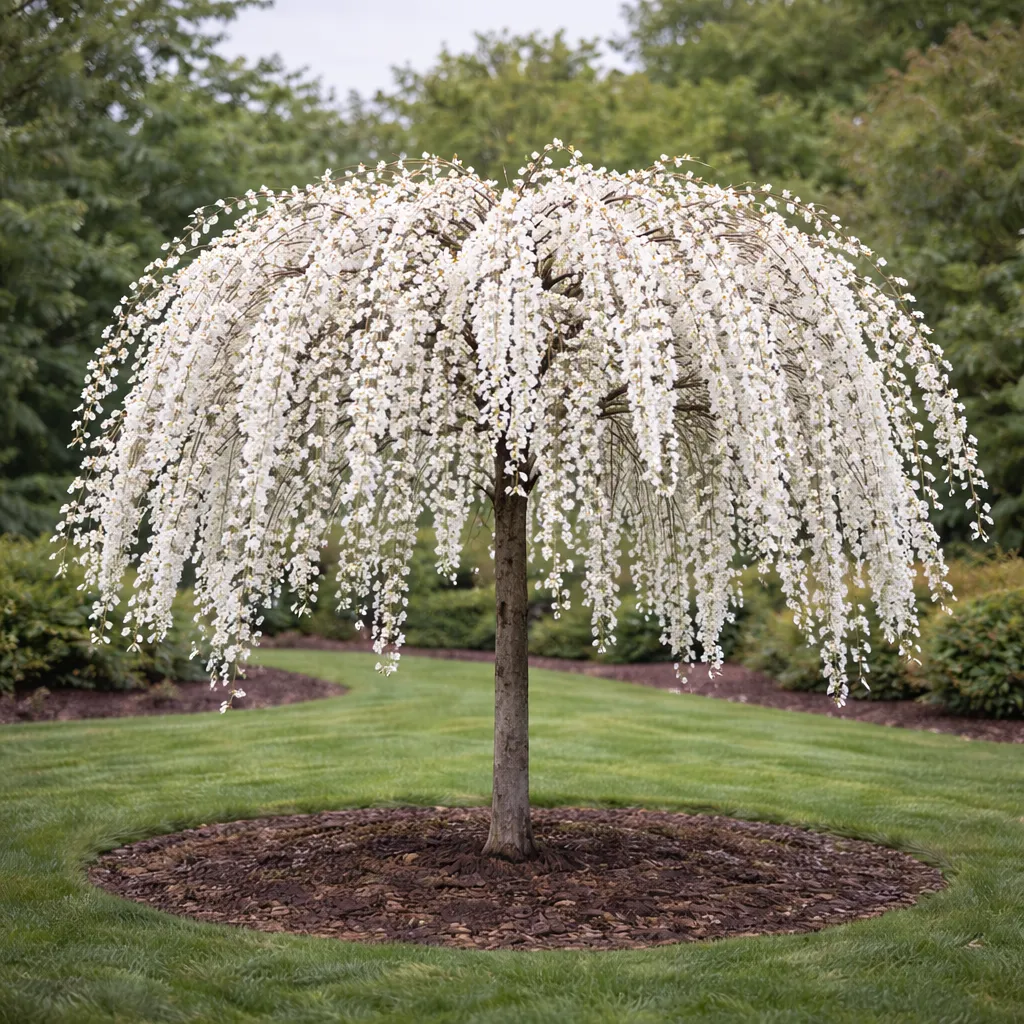
Snow Fountain® Weeping Cherry
Prunus × yedoensis ‘Snow Fountains’

  1. Mature Size: 4-8′ H × 10-12′ W (weeping canopy)
  2. Light Requirements: Full sun
  3. Ideal Soil Conditions: Moist, well‑drained soil; amend with organics where soil is poor
  4. Notable Characteristics: Graceful, cascading branches with abundant snow‑white spring blossoms. Eye‑catching, fountain‑like form perfect as a specimen or focal point in the landscape.
  5. Deer Resistance: Low — Weeping cherries are typically browsed if deer pressure is present.

Botanical Name: Prunus × yedoensis

Common Name: Yoshino Cherry

Mature Height and Width:
30–40′ tall × 30–40′ wide

Growth Habit: Broadly spreading to rounded deciduous flowering tree with strong lateral branching. Develops a wide canopy with arching scaffold limbs. Moderate growth rate.

Foliage Description: Medium green ovate leaves with serrated margins. Leaves emerge bronze-green in spring, mature to medium green in summer. Moderate canopy density with visible branching after bloom.

Flower Description: Single pale pink to nearly white five-petaled flowers borne in abundant clusters along bare branches before full leaf emergence. Blooms create a soft cloud-like effect.

Bloom Time: Early to mid-spring.

Fall Color: Yellow to bronze.

Light Requirements: Full sun for best flowering and canopy development.

Hardiness Zone: USDA Zones 5–8 (reliable in Northeast Zones 5–7).

Notable Landscape Uses: Front yard specimen; street tree; park planting; spring focal point; lawn accent; entry canopy tree.

Deer Resistance: Low to Moderate
Young growth and flower buds may experience browsing in Northeast Zones 5–7.

Okame Cherry
Prunus × incam ‘Okame’

  1. Mature Size: 20–30′ H × 20–30′ W
  2. Light Requirements: Full sun
  3. Ideal Soil Conditions: Moist, well‑drained soils; adaptable once established
  4. Notable Characteristics: Early spring blooms of rosy pink flowers; excellent flowering tree for smaller spaces.
  5. Deer Resistance: Low

Botanical Name: Prunus serrulata ‘Kwanzan’

Common Name: Kwanzan Cherry

Mature Height and Width:
25–35′ tall × 25–35′ wide

Growth Habit: Upright vase-shaped when young, maturing to a broad, rounded to spreading canopy. Strong lateral branching with arching outer limbs. Moderate growth rate.

Foliage Description: Deciduous, medium green serrated leaves emerging bronze in spring. Moderate canopy density with visible branch structure beneath bloom.

Flower Description: Large, fully double pink blossoms borne in dense clusters along branches. Deep pink buds open to rich pink pom-pom style blooms. Flowers lack visible stamens due to double form.

Bloom Time: Mid to late spring.

Fall Color: Yellow to bronze-orange.

Light Requirements: Full sun.

Hardiness Zone: USDA Zones 5–8.

Notable Landscape Uses: Lawn specimen; street tree (with space); spring focal point; park planting; ornamental front yard accent.

Deer Resistance: Low to Moderate
Young growth and flower buds may experience browsing pressure in Northeast Zones 5–7.

Autumnalis Cherry
Prunus × subhirtella ‘Autumnalis’

  1. Mature Size: 20–30′ H × 20–30′ W
  2. Light Requirements: Full sun
  3. Ideal Soil Conditions: Moist, well‑drained soil; consistent moisture during establishment
  4. Notable Characteristics: Light pink blossoms that may bloom sporadically in fall and full in spring — exceptional multi‑season interest.
  5. Deer Resistance: Low — often browsed by deer.

Akebono Cherry
Prunus × yedoensis ‘Akebono’

  1. Mature Size: 25–35′ H × 20–30′ W
  2. Light Requirements: Full sun
  3. Ideal Soil Conditions: Moist, well‑drained soil; tolerates average garden soils
  4. Notable Characteristics: Soft pink double spring blossoms with an upright spreading habit; classic ornamental flowering cherry.
  5. Deer Resistance: Low — browsed readily, especially young foliage and buds.

Botanical Name: Acer rubrum ‘Sun Valley’

Common Name: Sun Valley Red Maple

Mature Height and Width:
35–45′ tall × 25–35′ wide

Growth Habit: Upright oval to rounded canopy with a strong central leader. Dense branching structure with well-spaced ascending scaffold limbs. Moderate growth rate. Seedless selection.

Foliage Description: Deciduous, three- to five-lobed medium green leaves with moderate thickness. Canopy moderately dense with visible layered branching.

Flower Description: Small red flowers in early spring before leaf emergence; not ornamental at landscape scale. Seedless cultivar.

Bloom Time: Early spring.

Fall Color: Bright red to red-orange; typically develops slightly earlier than ‘October Glory’ and is often consistent in intensity.

Light Requirements: Full sun to partial shade.

Hardiness Zone: USDA Zones 4–7 (performs reliably in Northeast Zones 5–7).

Notable Landscape Uses: Lawn shade tree; street tree; front yard specimen; fall color accent; urban planting where seed drop is a concern.

Deer Resistance: Moderate
Young trees may experience browsing pressure in Northeast Zones 5–7.

Sugar Maple
Acer saccharum

  1. Mature Size: 60–80′ H × 40–50′ W
  2. Light Requirements: Full sun to part shade
  3. Ideal Soil Conditions: Moist, well‑drained, slightly acidic soil
  4. Notable Characteristics: Classic maple with rich orange‑red fall color and dense shade canopy. Excellent long‑lived landscape tree.
  5. Deer Resistance: Moderate to High

Red Sunset® Maple
Acer × freemanii ‘Jeffsred’

  1. Mature Size: 40–50′ H × 35–45′ W
  2. Light Requirements: Full sun to part shade
  3. Ideal Soil Conditions: Moist, well‑drained soils
  4. Notable Characteristics: Reliable red fall color with vigorous growth and good urban tolerance.
  5. Deer Resistance: Moderate to High

Botanical Name: Acer rubrum ‘October Glory’

Common Name: October Glory Red Maple

Mature Height and Width:
40–50′ tall × 30–40′ wide

Growth Habit: Upright oval to rounded canopy with a strong central leader when young, maturing to a broad oval form. Moderate to fast growth rate. Balanced scaffold branching with moderate canopy density.

Foliage Description: Deciduous, three- to five-lobed medium green leaves with a smooth upper surface. Moderate leaf size and density. Leaves held evenly along ascending branches with visible canopy layering.

Flower Description: Small red flowers in early spring before or with emerging foliage; not highly ornamental at landscape scale.

Bloom Time: Early spring.

Fall Color: Bright red to deep crimson; color typically develops later than many red maple cultivars and holds well into fall.

Light Requirements: Full sun to partial shade.

Hardiness Zone: USDA Zones 4–9.

Notable Landscape Uses: Lawn shade tree; street tree (with space); large front yard specimen; autumn color accent; park and institutional planting.

Deer Resistance: Moderate
Young trees may experience browsing pressure in Northeast Zones 5–7.
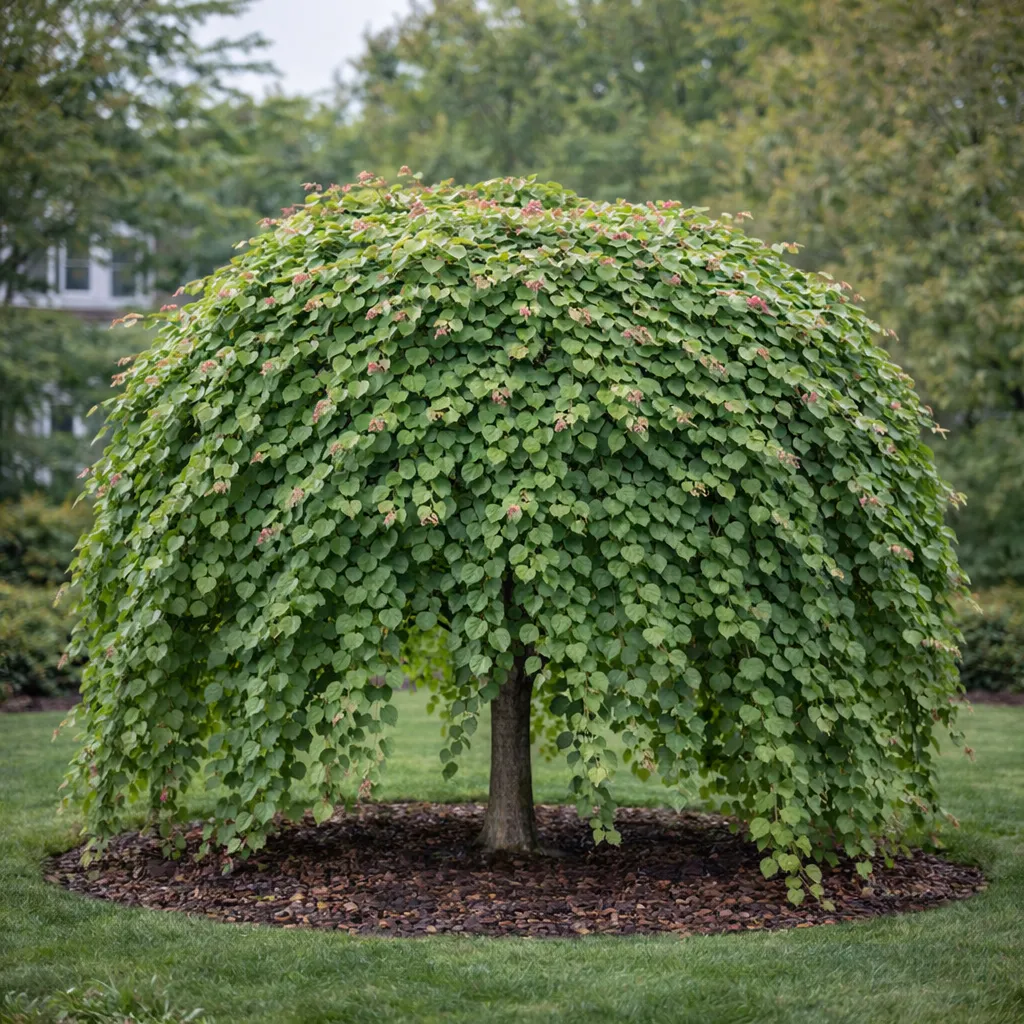
Sunset Cascade™ Redbud
Cercis canadensis ‘Sunset Cascade™’

  1. Mature Size: 10–15′ H × 10–15′ W
  2. Light Requirements: Full sun to part shade
  3. Ideal Soil Conditions: Moist, well‑drained soil
  4. Notable Characteristics: Cascading habit with bold spring flowers and striking silhouette.
  5. Deer Resistance: Low

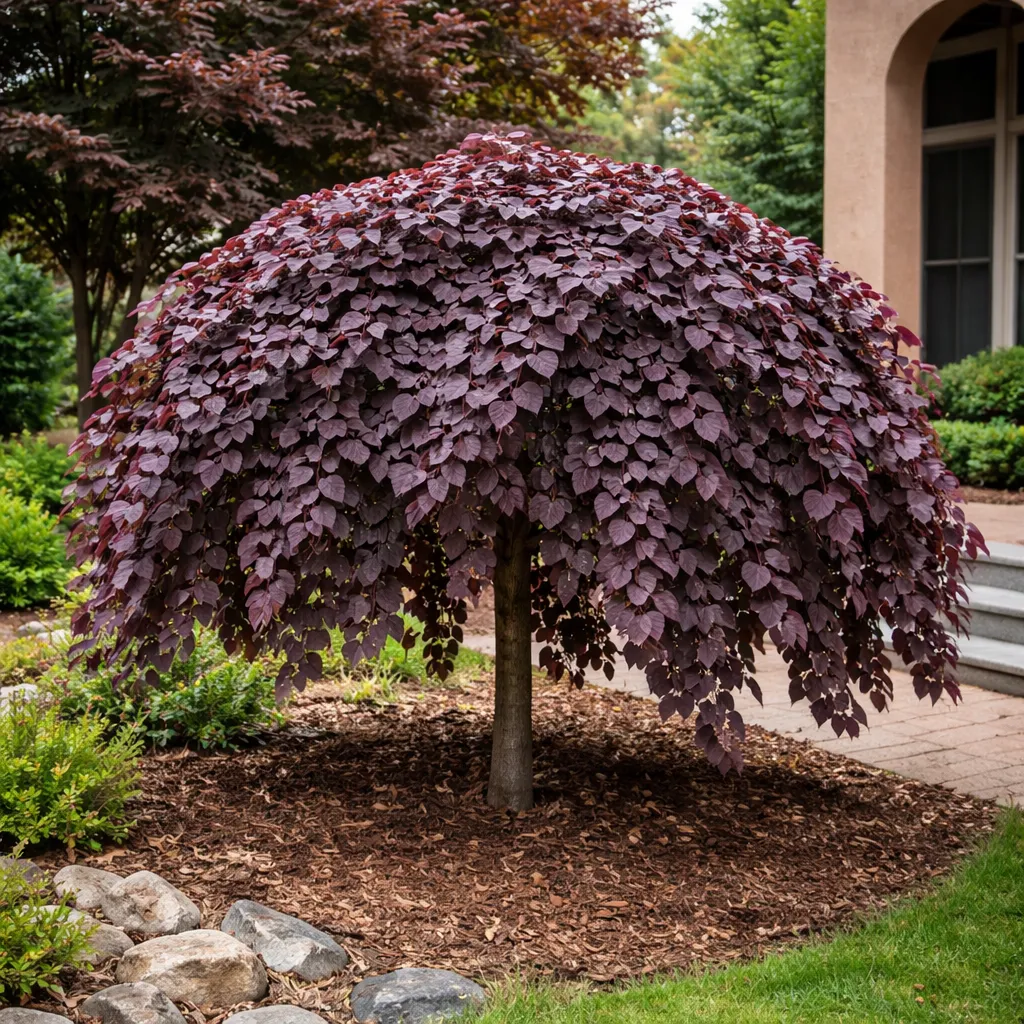
Botanical Name: Cercis canadensis ‘Ruby Falls’

Common Name: Ruby Falls Weeping Redbud

Mature Height and Width:
6–8′ tall (dependent on staking height) × 5–7′ wide
Ultimate height is largely determined by staking; plant will not significantly exceed the height at which the leader is trained.

Growth Habit: Strongly weeping, umbrella-form small ornamental tree. Upright central leader when staked, with branches cascading sharply downward to form a rounded canopy. Naturally dense drape with interior branching visible near trunk.

Foliage Description: Rounded, heart-shaped leaves emerging burgundy to deep purple, maturing to dark wine-purple through summer. Slight gloss, not high sheen. Leaves held densely along pendulous stems, creating layered curtain effect.

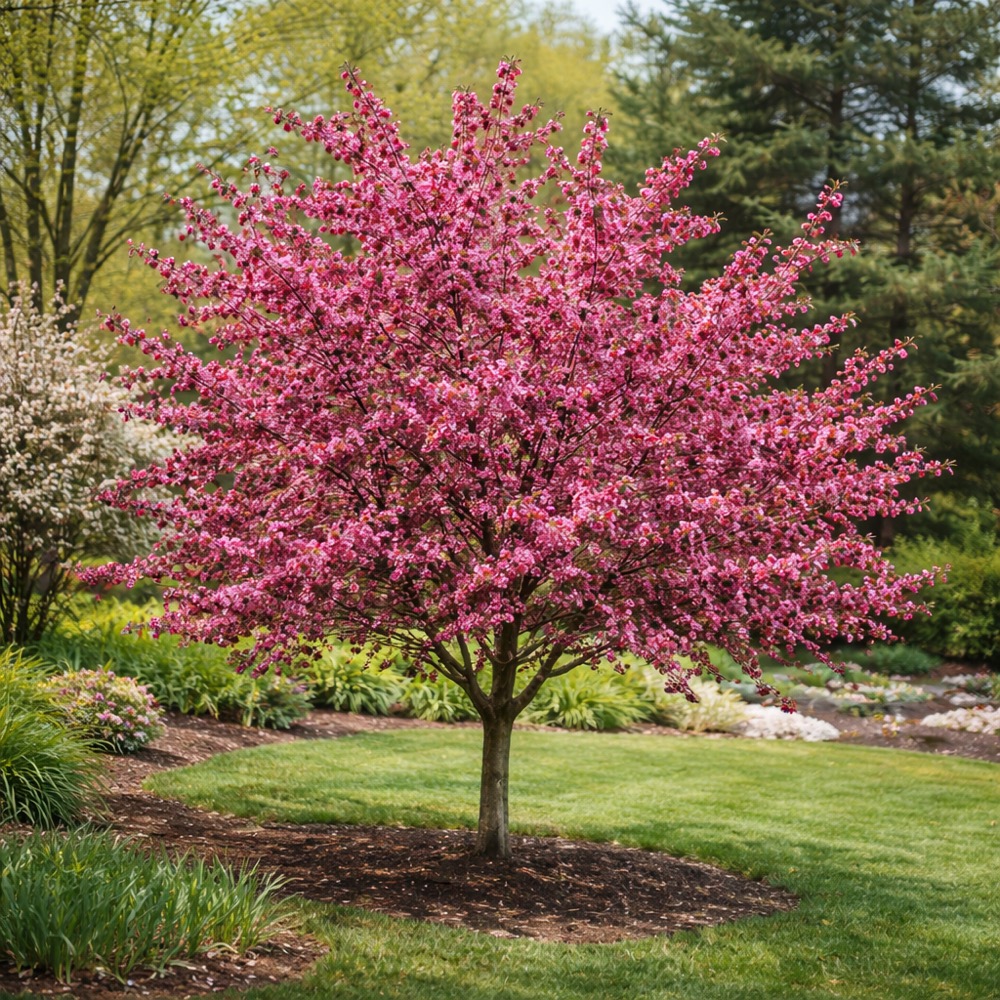
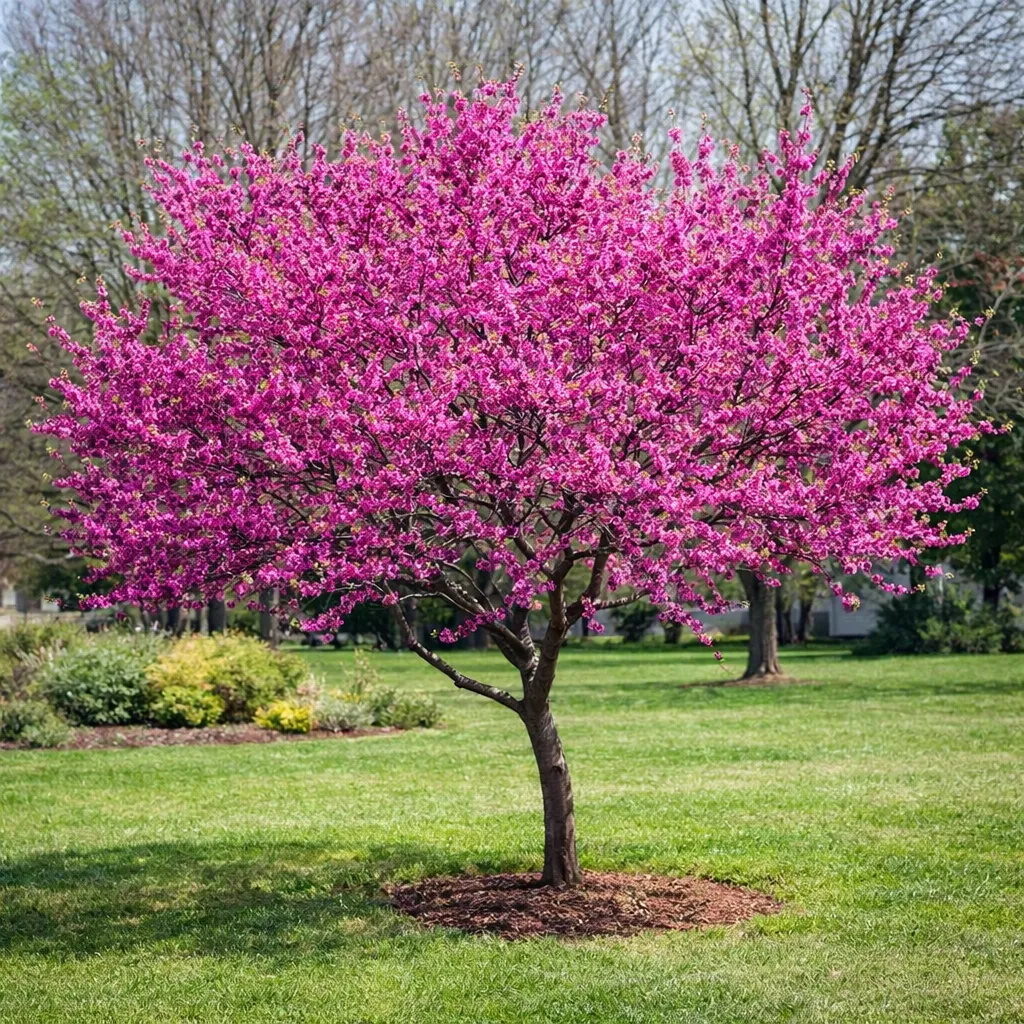
Flower Description: Bright rosy-pink pea-like flowers borne directly along stems and older wood (cauliflorous). Flowers appear before foliage emerges, evenly spaced along weeping branches rather than clustered at tips.

Bloom Time: Early to mid-spring (prior to leaf-out).

Fall Color: Foliage may develop muted maroon to bronze tones before leaf drop.

Light Requirements: Full sun to partial shade; best foliage color in full sun.

Hardiness Zone: USDA Zones 5–9 (reliable in Northeast Zones 5–7).

Notable Landscape Uses: Small courtyard specimen; patio focal point; foundation accent; entry feature; architectural small-space ornamental.

Deer Resistance: Moderate
Young growth may be browsed under heavy pressure; protection recommended when newly planted.
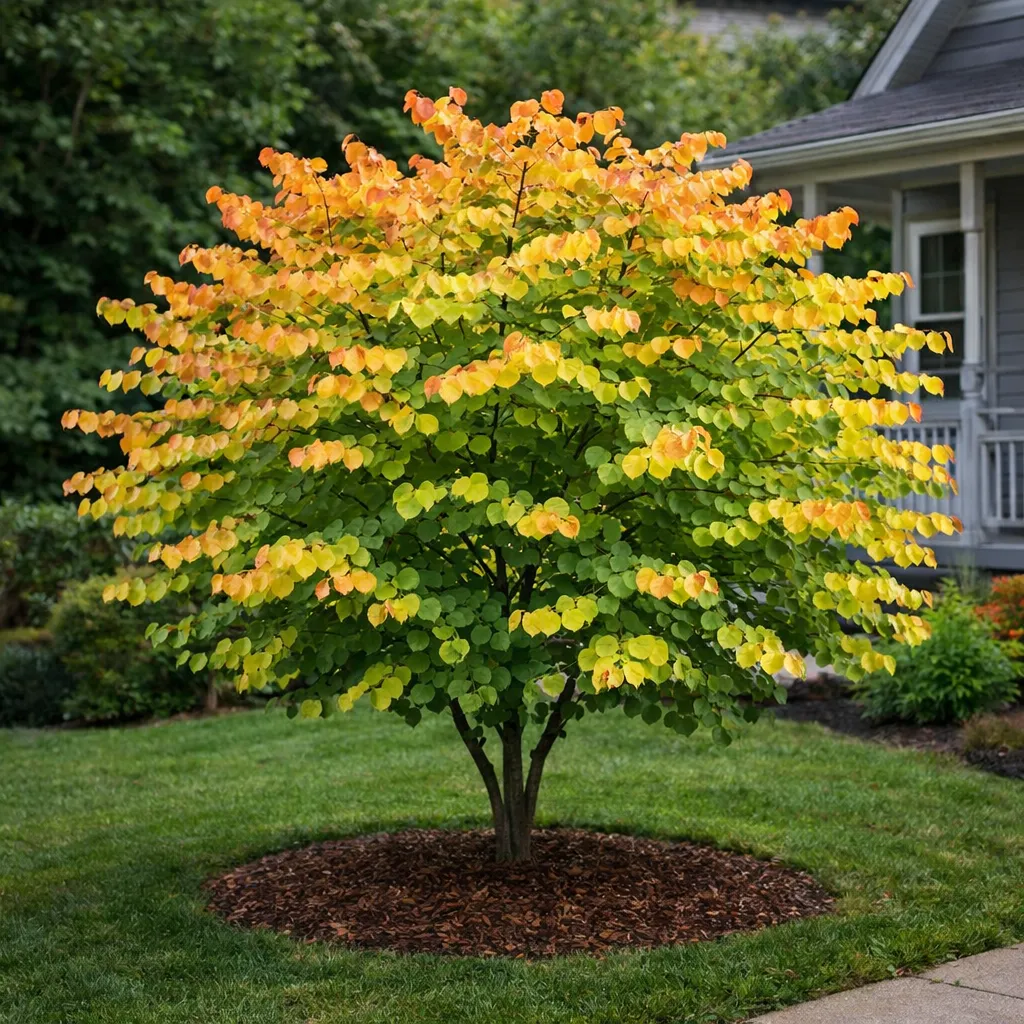
Botanical Name: Cercis canadensis ‘JN2’

Common Name: Rising Sun Redbud

Mature Height and Width:
8–12′ tall × 8–12′ wide

Growth Habit: Upright to broadly vase-shaped small deciduous tree with multiple stems or a short central leader. Open branching structure with layered canopy. Moderate growth rate.

Foliage Description: Heart-shaped leaves emerging apricot-orange, transitioning to golden yellow, then maturing to light green. New growth often displays multiple color stages simultaneously. Moderate canopy density with visible branch structure.

Flower Description: Small rosy-pink pea-like flowers borne along branches before leaf emergence. Typical redbud floral display.

Bloom Time: Early spring (prior to or with emerging foliage).

Fall Color: Yellow.

Light Requirements: Full sun to partial shade; best foliage color in partial shade in hotter sites.

Hardiness Zone: USDA Zones 5–9.

Notable Landscape Uses: Front yard focal point; small lawn specimen; courtyard planting; patio accent tree; color contrast in mixed border.

Deer Resistance: Moderate
Young growth may be browsed in Northeast Zones 5–7.
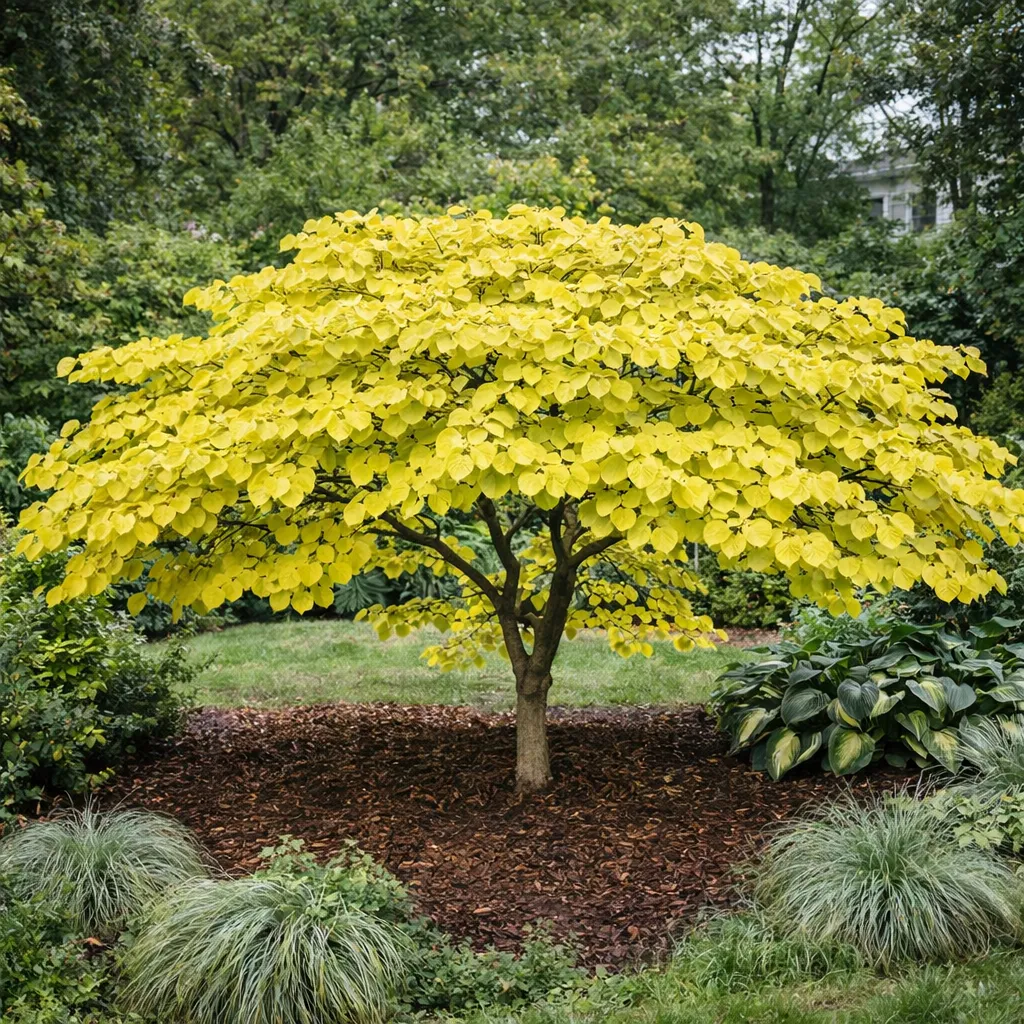
Botanical Name: Cercis canadensis ‘Rise and Shine’

Common Name: Rise and Shine Redbud

Mature Height and Width:
8–12′ tall × 10–15′ wide

Growth Habit: Broad, low-branched small ornamental tree with wide-spreading canopy. Strong horizontal branching with slightly arching tips. Can develop layered, umbrella-like structure with age. Moderate growth rate.

Foliage Description: Rounded, heart-shaped leaves emerging bright golden-yellow in spring. Foliage maintains clear yellow to chartreuse tone through summer when grown in full sun. Interior foliage may deepen slightly toward yellow-green. Leaves moderately spaced, allowing visible branch structure beneath.

Flower Description: Rosy-pink pea-like flowers borne directly along stems and older wood prior to leaf emergence. Flowers appear evenly spaced along branches, not clustered only at tips.

Bloom Time: Early to mid-spring (before leaf-out).

Fall Color: Foliage transitions to soft yellow to light chartreuse tones before leaf drop.

Light Requirements: Full sun to light partial shade; strongest yellow foliage color in full sun with adequate moisture.

Hardiness Zone: USDA Zones 5–9 (reliable in Northeast Zones 5–7).

Notable Landscape Uses: Lawn specimen; focal point in mixed shrub border; patio shade accent; small-scale ornamental for suburban landscapes; color contrast tree against dark evergreens.

Deer Resistance: Moderate
Young growth may be browsed under heavy pressure; protection recommended when newly planted.
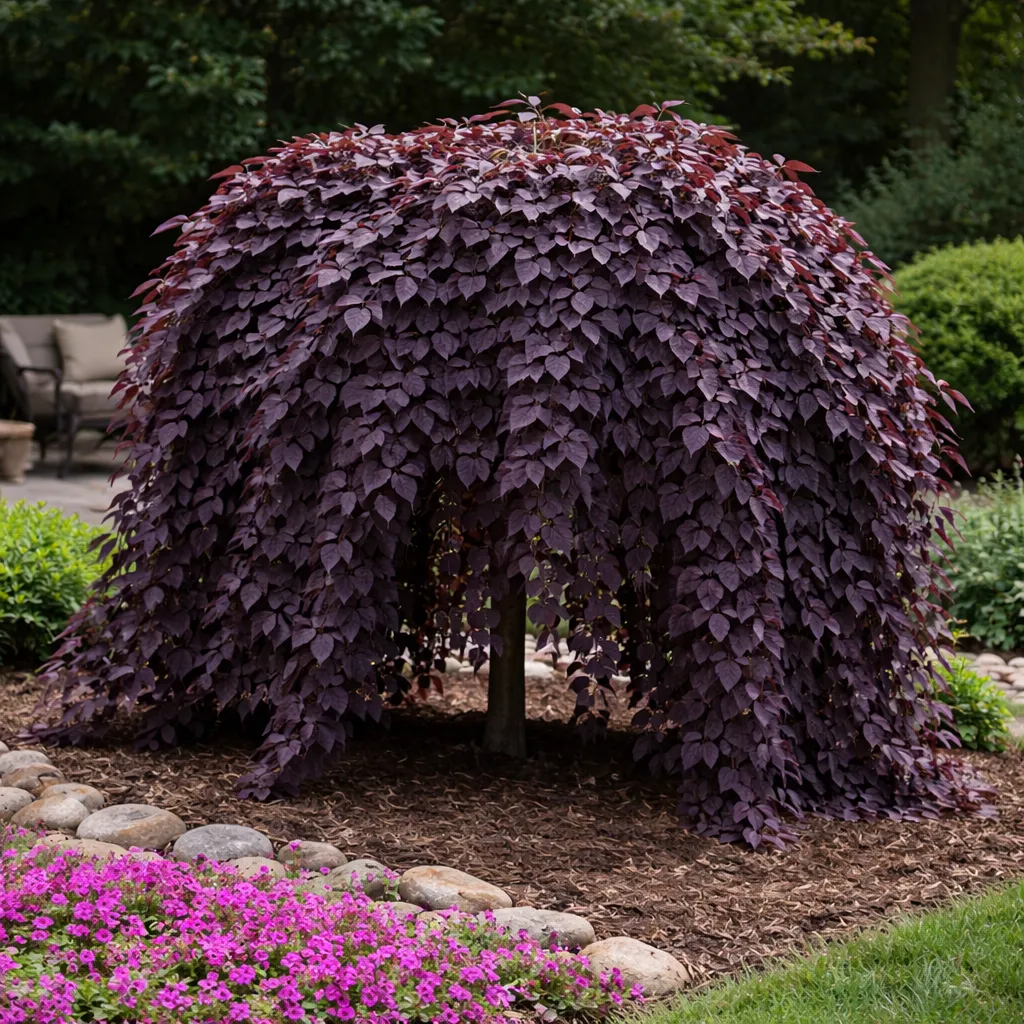
Botanical Name: Cercis canadensis ‘Purple Rain’

Common Name: Purple Rain Weeping Redbud

Mature Height and Width:
6–10′ tall (dependent on staking height) × 6–10′ wide

Growth Habit: Strongly weeping ornamental tree with cascading branch structure forming umbrella-like canopy. Final height determined by staking height of central leader; tree will maintain that height and continue lateral and pendulous growth. Dense layered branching with pronounced downward branch orientation.

Foliage Description: Glossy deep burgundy to purple heart-shaped foliage with smooth texture and dense canopy layering. Leaves maintain dark coloration through summer with minimal fade compared to earlier purple-leaf redbud cultivars.

Flower Description: Rosy lavender-pink pea-like flowers borne along stems and branches prior to leaf emergence. Bloom density moderate with strong trunk and branch flowering typical of Cercis.

Bloom Time: Early spring before foliage emergence.

Fall Color: Variable bronze to muted yellow tones.

Light Requirements: Full sun to part shade; best foliage color in full sun.

Hardiness Zone: USDA Zones 5–9

Notable Landscape Uses: Specimen ornamental tree; patio focal; courtyard accent; small lawn tree; container-trained specimen; architectural focal planting.

Deer Resistance: Moderate
Young growth may experience browsing.
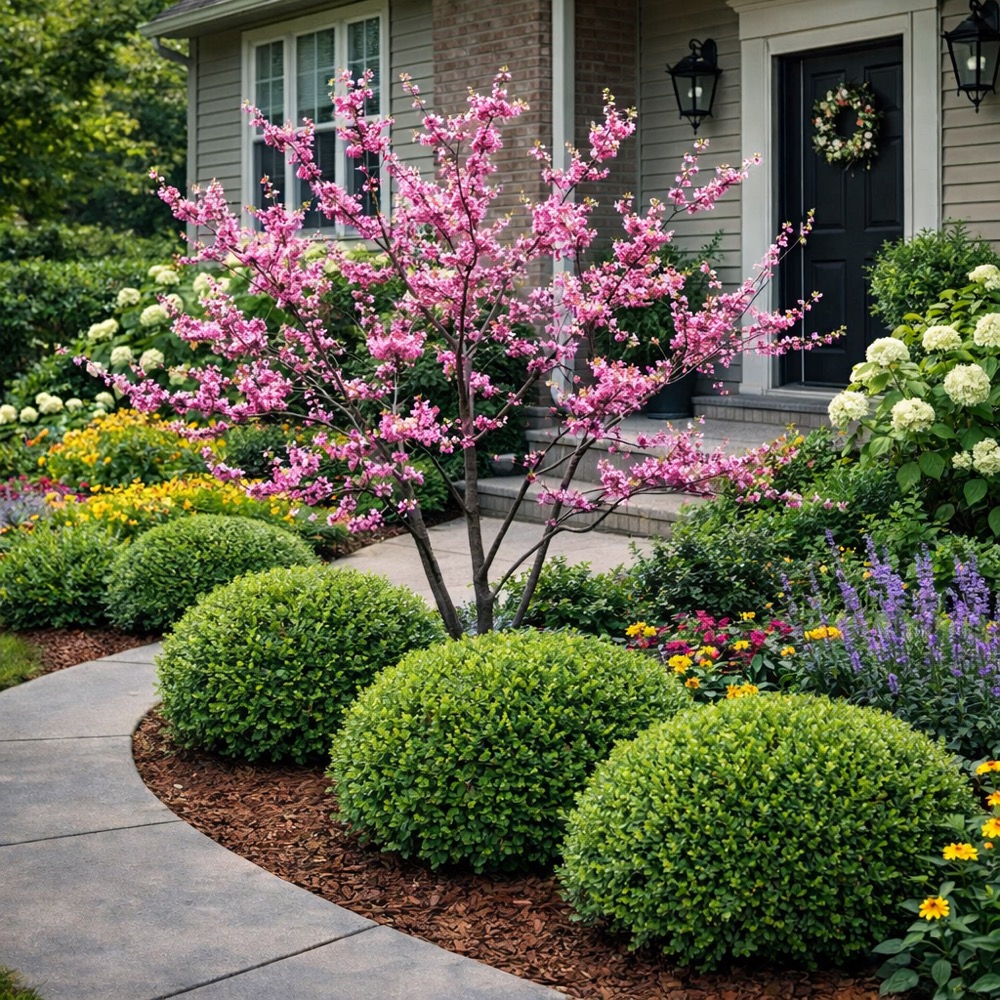
Pink Pompom™ Redbud
Cercis canadensis ‘Pink Pompom™’

  1. Mature Size: 10–15′ H × 10–15′ W
  2. Light Requirements: Full sun to part shade
  3. Ideal Soil Conditions: Moist, well‑drained soil
  4. Notable Characteristics: Double pompom‑like pink blooms; whimsical and showy in spring.
  5. Deer Resistance: Low

Oklahoma Sparkler® Redbud
Cercis canadensis ‘Oklahoma Sparkler®’

  1. Mature Size: 10–15′ H × 10–15′ W
  2. Light Requirements: Full sun to part shade
  3. Ideal Soil Conditions: Moist, well‑drained soil
  4. Notable Characteristics: Compact, vigorous with bright rosy spring flowers — excellent smaller landscape choice.
  5. Deer Resistance: Low

Botanical Name: Cercis canadensis var. texensis ‘Oklahoma’

Common Name: Oklahoma Redbud

Mature Height and Width:
15–20′ tall × 15–20′ wide

Growth Habit: Upright-rounded small ornamental tree with single to multi-trunk structure and balanced branching architecture. Canopy moderately dense with layered branching and visible trunk development. Moderate growth rate with improved heat and drought tolerance relative to species.

Foliage Description: Thick glossy heart-shaped foliage emerging bronze-red and maturing to dark green. Leaves slightly smaller and thicker than Eastern Redbud with dense canopy layering and smooth texture.

Flower Description: Deep rosy-magenta pea-like flowers borne densely along stems and branches prior to leaf emergence. Bloom clusters smaller but more numerous, creating saturated canopy display.

Bloom Time: Early spring before foliage emergence.

Fall Color: Yellow to muted bronze tones.

Light Requirements: Full sun to part shade.

Hardiness Zone: USDA Zones 6–9

Notable Landscape Uses: Specimen ornamental tree; lawn accent; patio tree; courtyard focal; streetscape planting; foundation accent.

Deer Resistance: Moderate
Young growth may experience browsing.
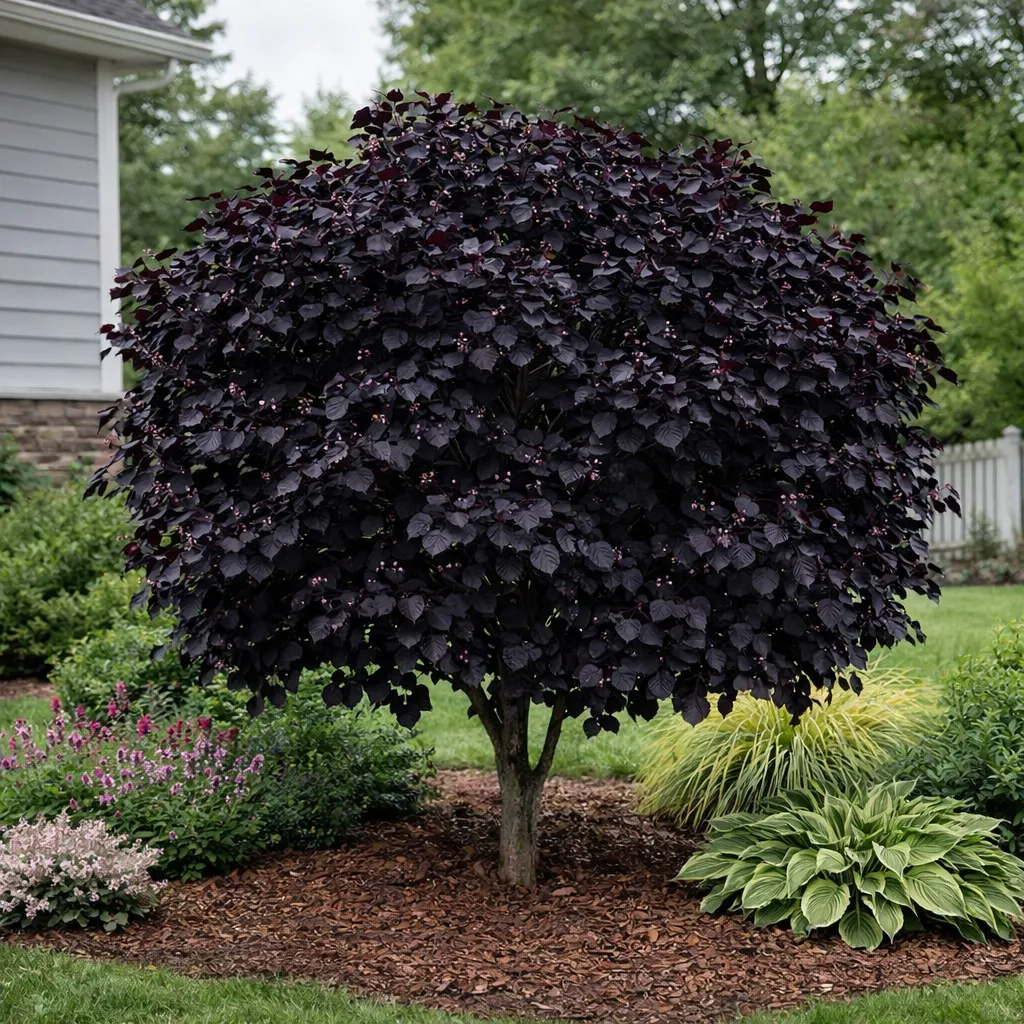
Botanical Name: Cercis canadensis ‘Midnight Express’

Common Name: Midnight Express Redbud

Mature Height and Width:
15–20′ tall × 15–18′ wide

Growth Habit: Upright-rounded small ornamental tree with strong central leader and moderately dense branching structure. Canopy balanced with layered branch architecture and visible trunk development. Moderate growth rate.

Foliage Description: Deep burgundy to near-black heart-shaped foliage with smooth texture and strong summer color retention. Leaves provide dense canopy layering with slightly glossy surface and minimal green fade.

Flower Description: Rosy lavender-pink pea-like flowers borne along stems and branches prior to leaf emergence. Bloom density moderate with typical redbud trunk and branch flowering habit.

Bloom Time: Early spring before foliage emergence.

Fall Color: Yellow to muted bronze tones.

Light Requirements: Full sun to part shade; best foliage color achieved in full sun.

Hardiness Zone: USDA Zones 5–9

Notable Landscape Uses: Specimen ornamental tree; lawn accent; courtyard focal; patio tree; foundation accent; streetscape planting.

Deer Resistance: Moderate
Young growth may experience browsing.
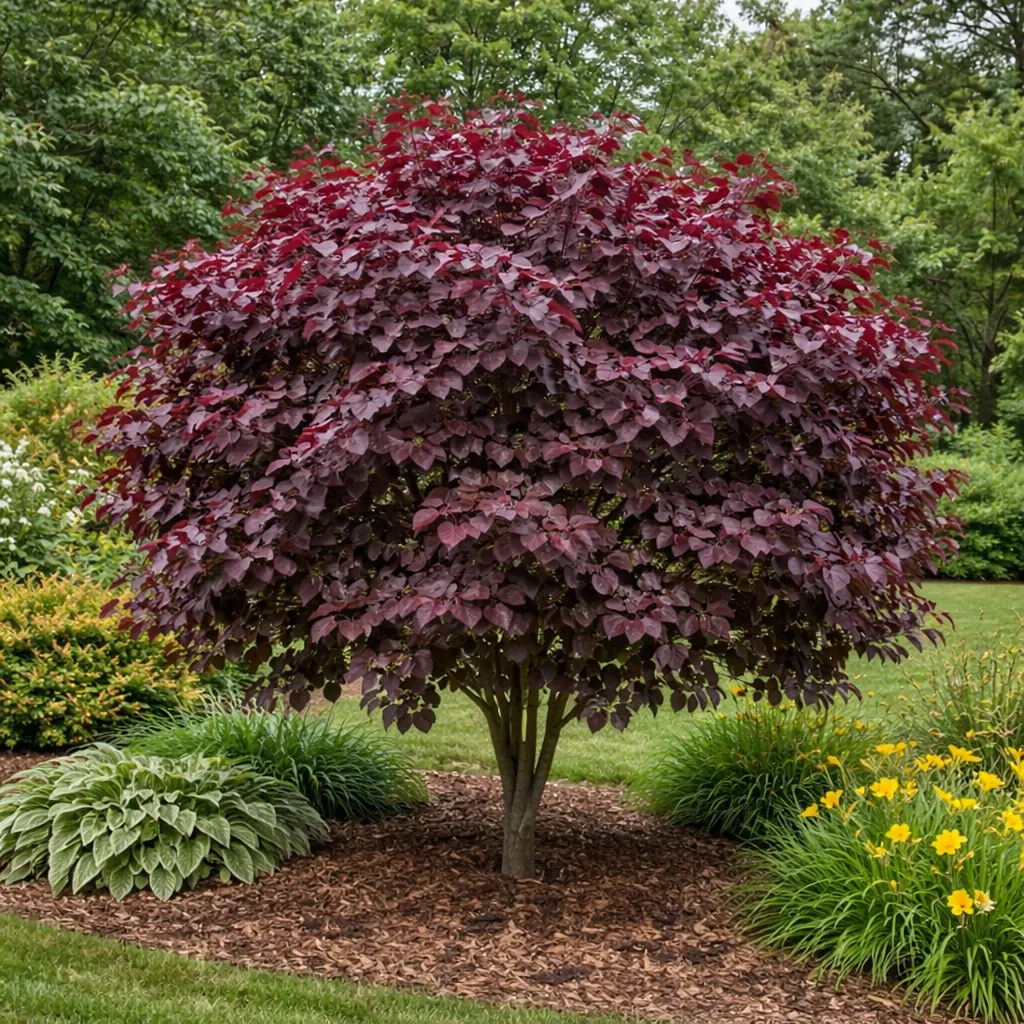
Botanical Name: Cercis canadensis ‘Merlot’

Common Name: Merlot Redbud

Mature Height and Width:
12–15′ tall × 12–15′ wide

Growth Habit: Compact upright-rounded small ornamental tree with strong central leader and dense branching structure. Canopy moderately dense with improved structural uniformity and visible trunk development. Moderate growth rate with tighter architecture than standard redbud.

Foliage Description: Thick glossy heart-shaped foliage emerging deep burgundy-purple and maintaining dark coloration through summer with minimal green fade. Leaves slightly smaller and thicker than Forest Pansy with dense canopy layering.

Flower Description: Rosy lavender-pink pea-like flowers borne along stems and branches prior to leaf emergence. Bloom density moderate with classic redbud trunk and branch flowering pattern.

Bloom Time: Early spring before foliage emergence.

Fall Color: Yellow to muted bronze tones.

Light Requirements: Full sun to part shade; best foliage color achieved in full sun.

Hardiness Zone: USDA Zones 5–9

Notable Landscape Uses: Specimen ornamental tree; patio tree; courtyard focal; foundation accent; small lawn tree; streetscape planting.

Deer Resistance: Moderate
Young growth may experience browsing.
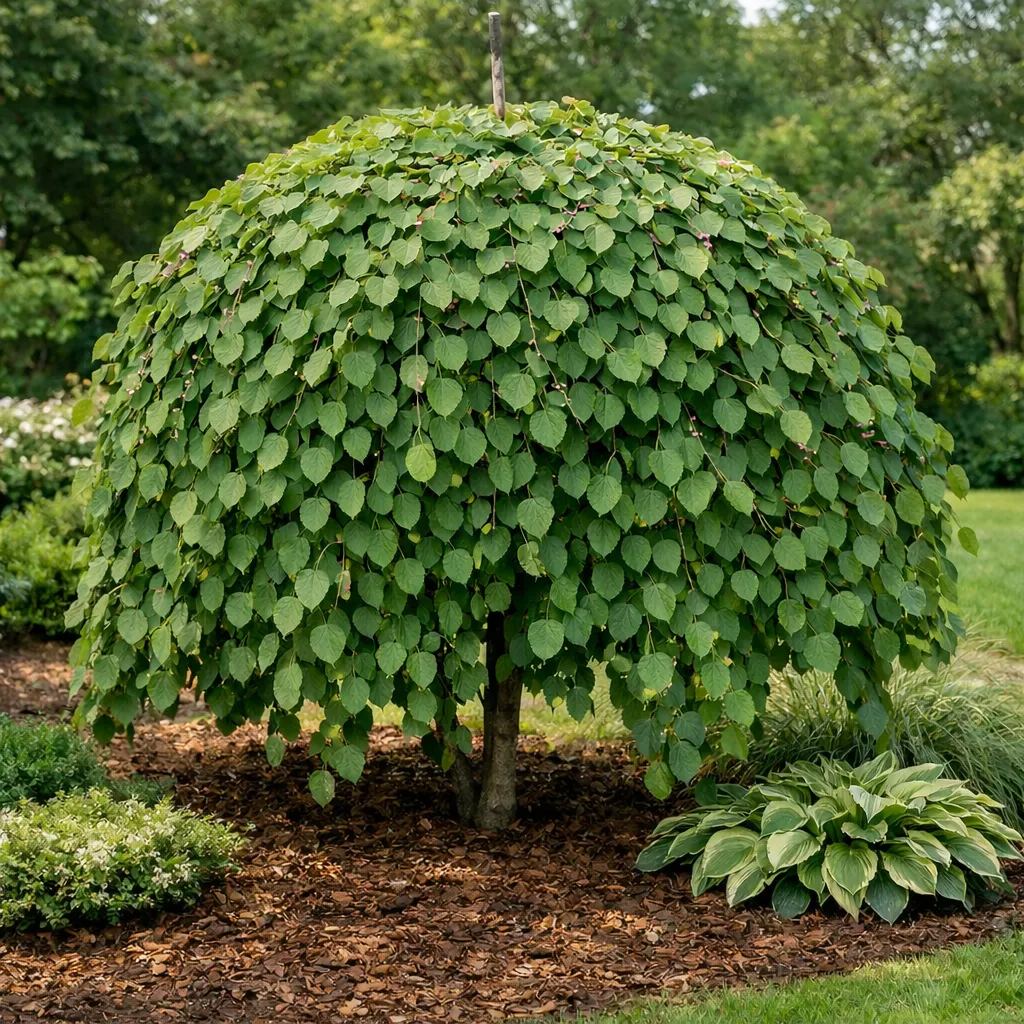
Botanical Name: Cercis canadensis ‘Lavender Twist’

Common Name: Lavender Twist Weeping Redbud

Mature Height and Width:
5–8′ tall (dependent on staking height) × 6–10′ wide

Growth Habit: Strongly weeping ornamental tree with cascading pendulous branches forming umbrella canopy. Final height determined by staking height of central leader; tree maintains that height while lateral spread and pendulous growth continue. Dense layered branching with pronounced downward orientation.

Foliage Description: Medium green heart-shaped deciduous foliage with smooth texture and dense layering along cascading branches. Leaves provide full canopy coverage with moderate interior visibility.

Flower Description: Abundant lavender-pink pea-like flowers borne along stems, branches, and trunk prior to leaf emergence. Bloom density moderate to heavy with classic redbud flowering pattern.

Bloom Time: Early spring before foliage emergence.

Fall Color: Yellow to muted bronze tones.

Light Requirements: Full sun to part shade.

Hardiness Zone: USDA Zones 5–9

Notable Landscape Uses: Specimen ornamental tree; patio focal; container-trained specimen; courtyard accent; foundation feature planting; small space architectural tree.

Deer Resistance: Moderate
Young growth may experience browsing.
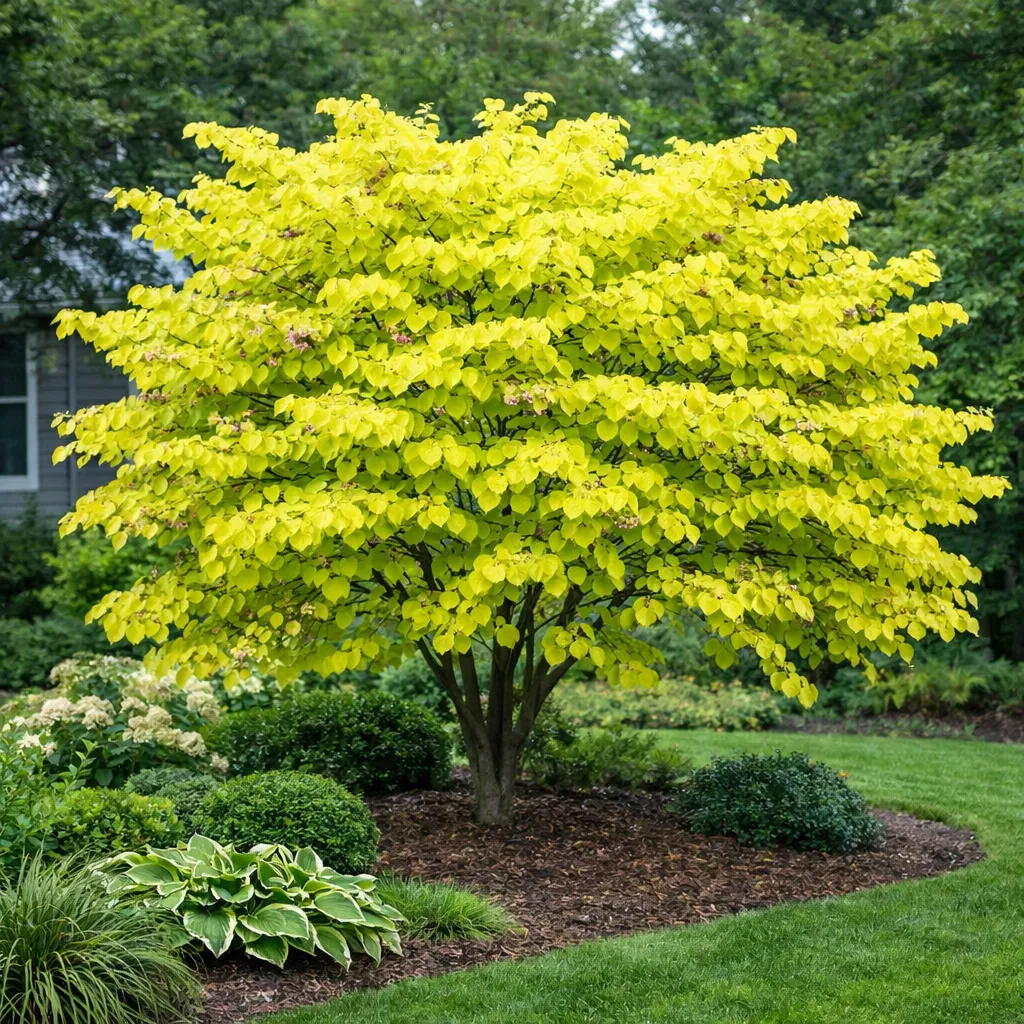
Botanical Name: Cercis canadensis ‘Hearts of Gold’

Common Name: Hearts of Gold Redbud

Mature Height and Width:
15–20′ tall × 18–22′ wide

Growth Habit: Upright-rounded small ornamental tree with single to multi-trunk structure and balanced branching architecture. Canopy moderately dense with layered branching and visible trunk development. Moderate growth rate.

Foliage Description: Heart-shaped foliage emerging bright golden-yellow to chartreuse and maturing to soft yellow-green. Leaves display luminous coloration with moderate canopy density and smooth texture.

Flower Description: Rosy lavender-pink pea-like flowers borne along stems and branches prior to leaf emergence. Bloom density moderate with classic redbud trunk and branch flowering pattern.

Bloom Time: Early spring before foliage emergence.

Fall Color: Yellow to muted bronze tones.

Light Requirements: Full sun to part shade; best foliage color achieved with some afternoon protection in hotter exposures.

Hardiness Zone: USDA Zones 5–9

Notable Landscape Uses: Specimen ornamental tree; lawn accent; patio tree; courtyard focal; foundation accent; color contrast planting.

Deer Resistance: Moderate
Young growth may experience browsing.
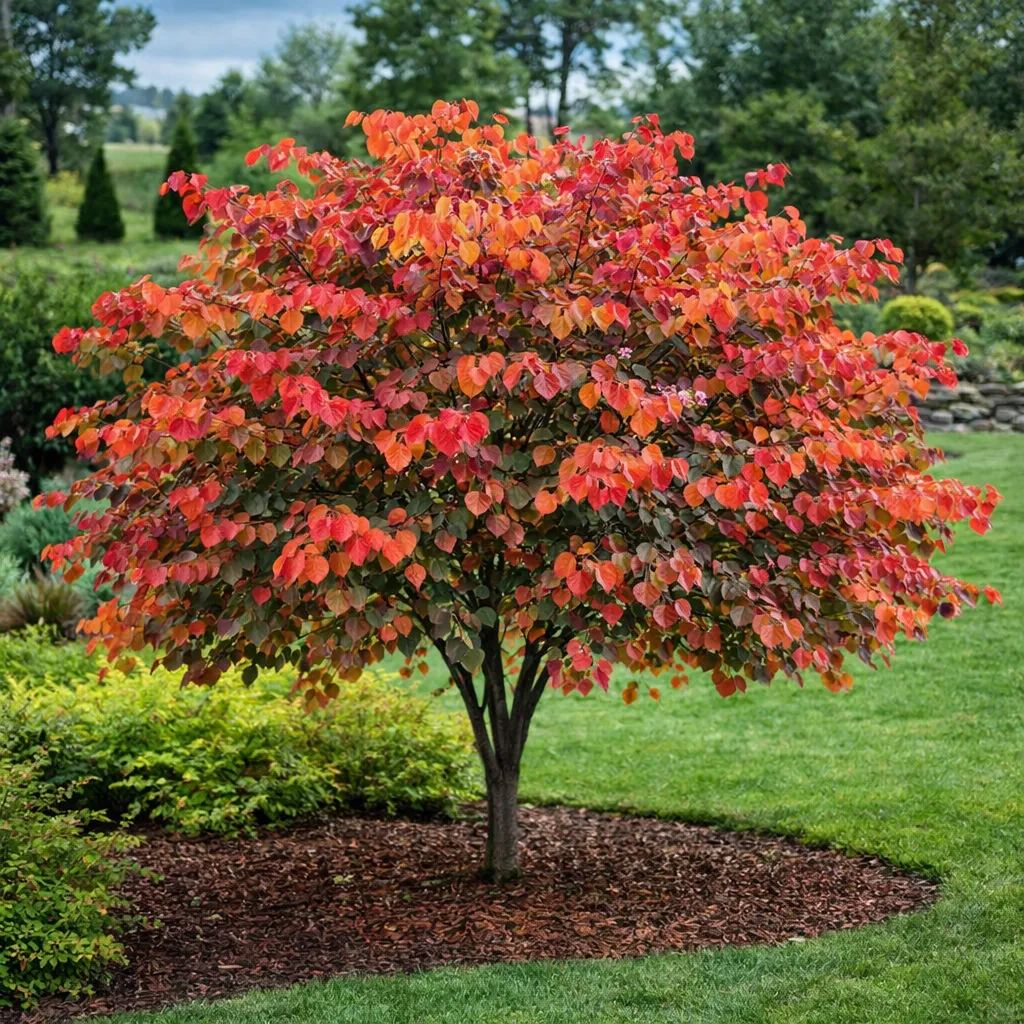
Botanical Name: Cercis canadensis ‘Hearts Afire’

Common Name: Hearts Afire Redbud

Mature Height and Width:
15–20′ tall × 15–18′ wide

Growth Habit: Upright-rounded small ornamental tree with strong central leader and balanced branching structure. Canopy moderately dense with layered branch architecture and visible trunk development. Moderate growth rate.

Foliage Description: Heart-shaped foliage emerging burgundy-red and transitioning through orange and yellow tones before maturing to green. Leaves present multi-stage color layering within canopy creating dynamic seasonal foliage progression. Moderate canopy density with smooth leaf texture.

Flower Description: Rosy lavender-pink pea-like flowers borne along stems and branches prior to leaf emergence. Bloom density moderate with classic redbud trunk and branch flowering pattern.

Bloom Time: Early spring before foliage emergence.

Fall Color: Yellow to muted bronze tones.

Light Requirements: Full sun to part shade; best foliage coloration achieved in full sun.

Hardiness Zone: USDA Zones 5–9

Notable Landscape Uses: Specimen ornamental tree; lawn accent; patio tree; courtyard focal; foundation accent; collector landscape specimen.

Deer Resistance: Moderate
Young growth may experience browsing.
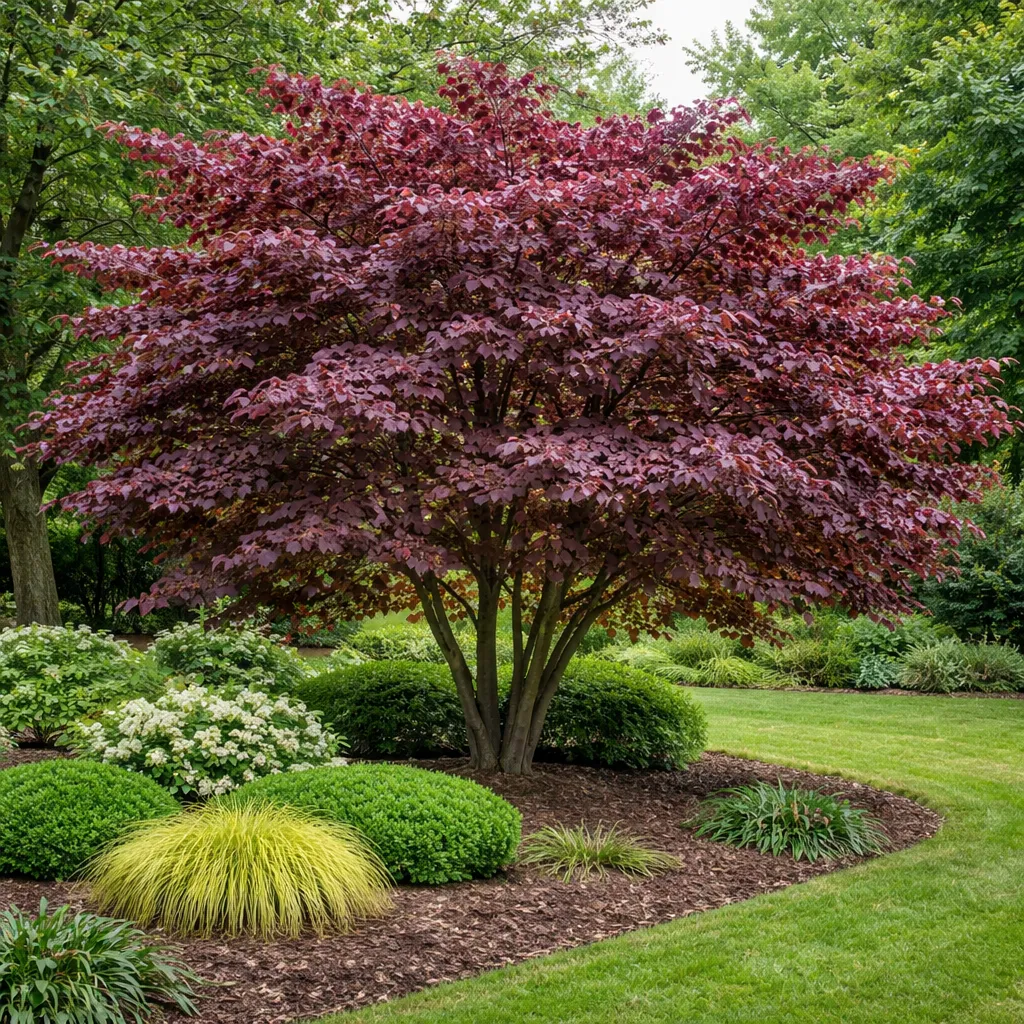
Botanical Name: Cercis canadensis ‘Forest Pansy’

Common Name: Forest Pansy Redbud

Mature Height and Width:
20–30′ tall × 20–30′ wide

Growth Habit: Broad-rounded small ornamental tree with multi-trunk tendency and spreading horizontal branching. Canopy moderately open with layered branch structure and visible trunk architecture. Moderate growth rate.

Foliage Description: Large heart-shaped leaves emerging deep burgundy-purple in spring, transitioning to maroon-green tones in summer. Foliage texture smooth with moderate canopy density and layered leaf presentation.

Flower Description: Rosy lavender-pink pea-like flowers borne along stems and branches prior to leaf emergence. Bloom density moderate with classic redbud trunk and branch flowering pattern.

Bloom Time: Early spring before foliage emergence.

Fall Color: Yellow to muted bronze tones.

Light Requirements: Full sun to part shade; best foliage color in full sun with some afternoon protection in hotter exposures.

Hardiness Zone: USDA Zones 5–9

Notable Landscape Uses: Specimen ornamental tree; lawn accent; patio tree; naturalized planting; woodland edge; courtyard focal.

Deer Resistance: Moderate
Young growth may experience browsing.
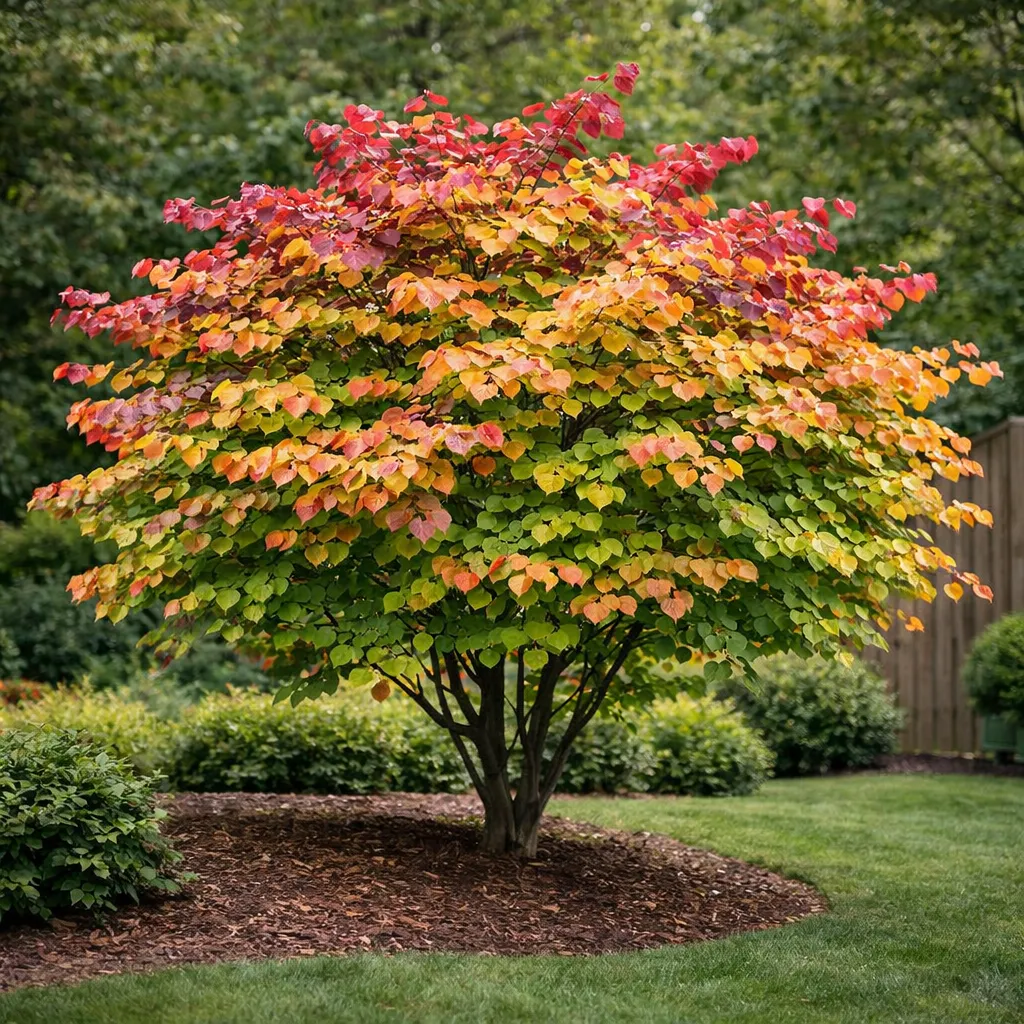
Botanical Name: Cercis canadensis ‘Flame Thrower’

Common Name: Flame Thrower Redbud

Mature Height and Width:
15–20′ tall × 15–18′ wide

Growth Habit: Upright-rounded small ornamental tree with single to multi-trunk structure and layered branching. Canopy moderately dense with balanced crown development and visible trunk architecture. Moderate growth rate.

Foliage Description: Heart-shaped foliage displaying sequential color progression beginning burgundy-purple, transitioning through red, orange, yellow, and maturing to green. Leaves present layered multi-season color effect within canopy. Moderate canopy density with smooth leaf texture.

Flower Description: Rosy lavender-pink pea-like flowers borne along stems and branches prior to leaf emergence. Bloom density moderate with classic redbud trunk and branch flowering pattern.

Bloom Time: Early spring before foliage emergence.

Fall Color: Yellow to muted bronze tones.

Light Requirements: Full sun to part shade; best color progression achieved in full sun.

Hardiness Zone: USDA Zones 5–9

Notable Landscape Uses: Specimen ornamental tree; lawn accent; courtyard focal; patio tree; collector specimen; foundation feature planting.

Deer Resistance: Moderate
Young growth may experience browsing.

Structural Identity for Flame Thrower Redbud

To differentiate clearly from:

Carolina Sweetheart → variegated foliage pattern
Forest Pansy → solid burgundy foliage
Rising Sun → yellow-apricot foliage progression
Eastern Redbud species → g
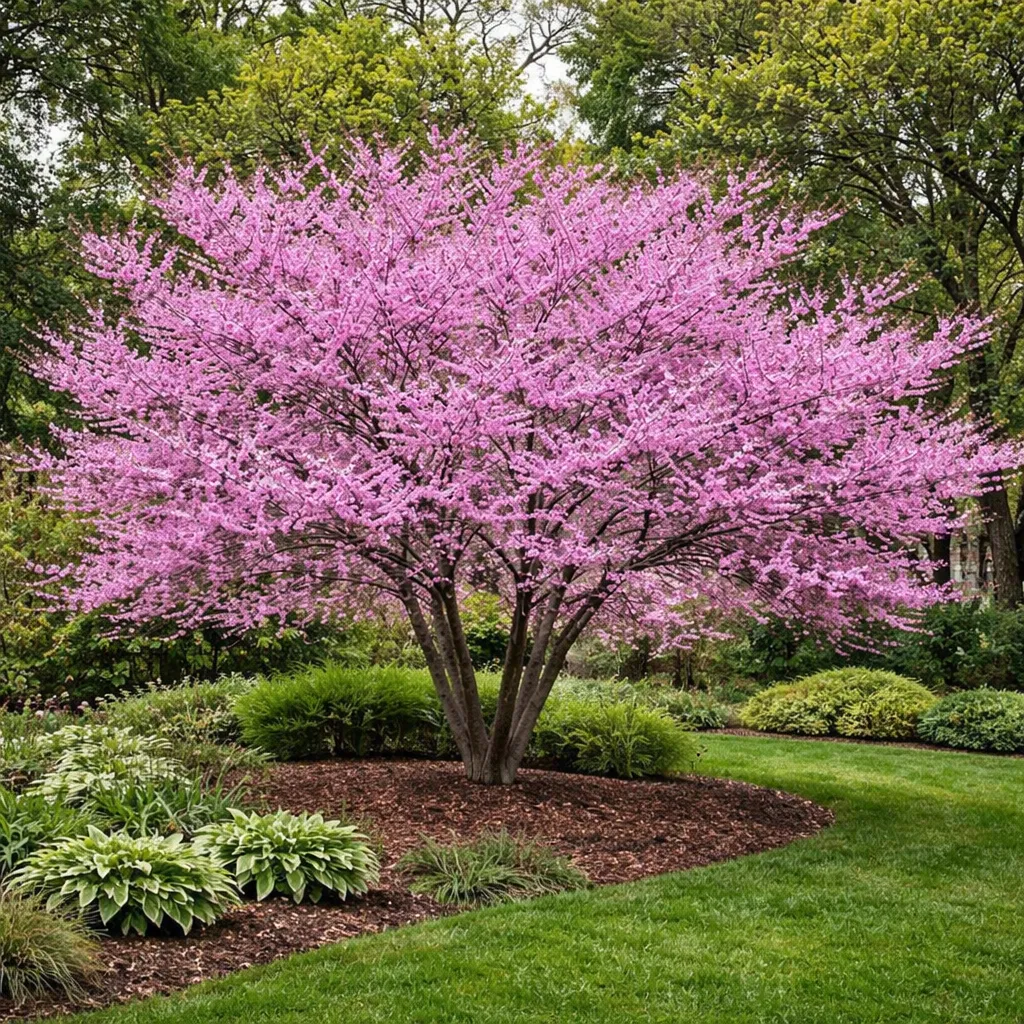
Botanical Name: Cercis canadensis

Common Name: Eastern Redbud

Mature Height and Width:
20–30′ tall × 25–35′ wide

Growth Habit: Broad-rounded small ornamental tree with multi-trunk tendency and spreading horizontal branching. Canopy moderately open with layered branch structure and visible trunk architecture. Moderate growth rate.

Foliage Description: Medium green heart-shaped deciduous foliage with smooth texture and moderate canopy density. Leaves emerge light green to bronze-tinged and mature to uniform medium green.

Flower Description: Abundant rosy lavender-pink pea-like flowers borne along stems, branches, and trunk prior to leaf emergence. Blooms small but densely distributed creating strong early spring ornamental display.

Bloom Time: Early spring before foliage emergence.

Fall Color: Yellow to muted bronze tones.

Light Requirements: Full sun to part shade.

Hardiness Zone: USDA Zones 4–9

Notable Landscape Uses: Specimen ornamental tree; naturalized planting; woodland edge; lawn accent; understory tree; courtyard planting.

Deer Resistance: Moderate
Young growth may experience browsing.
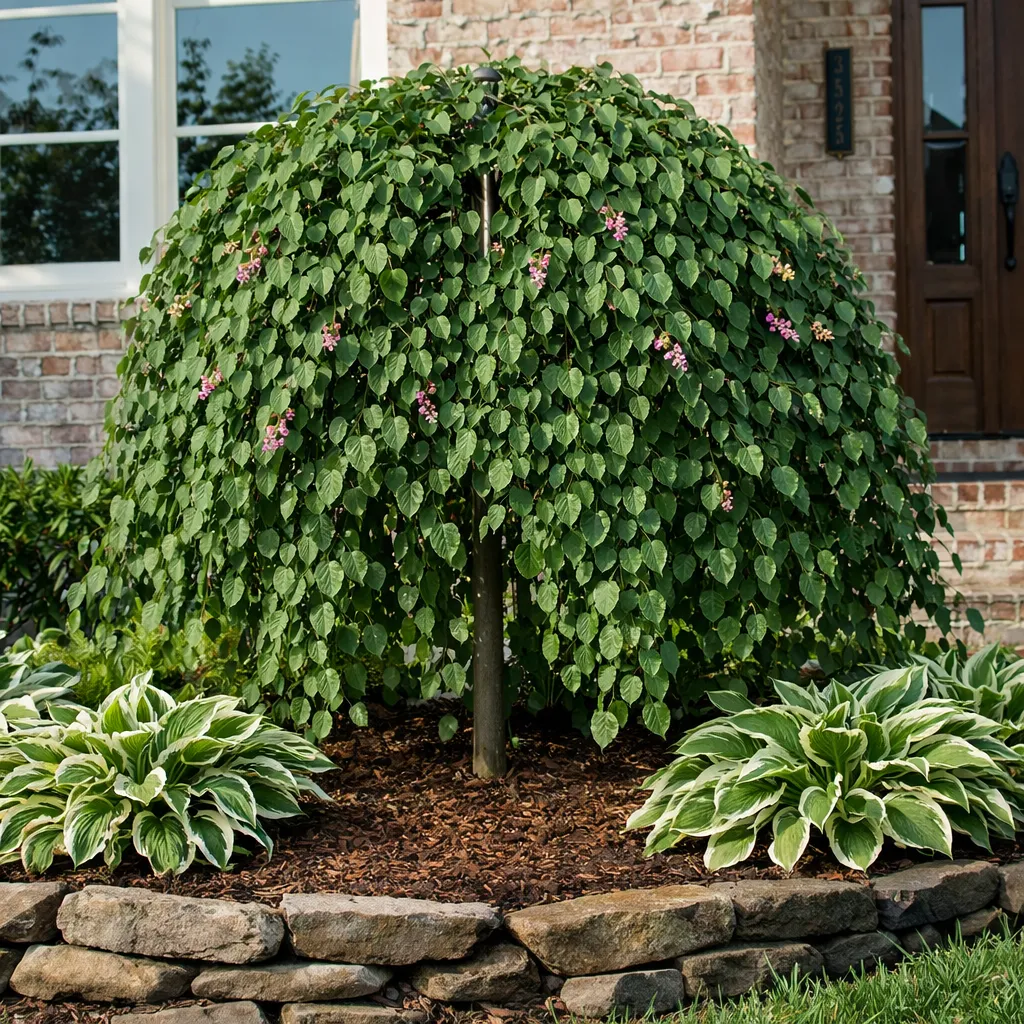
Botanical Name: Cercis canadensis ‘Cascading Hearts’

Common Name: Cascading Hearts Weeping Redbud

Mature Height and Width:
5–8′ tall (dependent on staking height) × 6–10′ wide

Growth Habit: Strongly pendulous weeping ornamental tree forming umbrella canopy with cascading branches. Final height determined by staking height of central leader; tree maintains that height while lateral spread and cascading structure continue. Dense layered branching with pronounced downward orientation.

Foliage Description: Small glossy heart-shaped green foliage with dense layering along pendulous branches. Leaves display smooth texture with high canopy coverage and fine textural presentation.

Flower Description: Rosy lavender-pink pea-like flowers borne along stems and branches prior to leaf emergence. Bloom density moderate with typical redbud trunk and branch flowering pattern.

Bloom Time: Early spring before foliage emergence.

Fall Color: Yellow to muted bronze tones.

Light Requirements: Full sun to part shade.

Hardiness Zone: USDA Zones 5–9

Notable Landscape Uses: Specimen ornamental tree; patio focal; container-trained specimen; courtyard accent; foundation feature planting; small space architectural focal.

Deer Resistance: Moderate
Young growth may experience browsing.
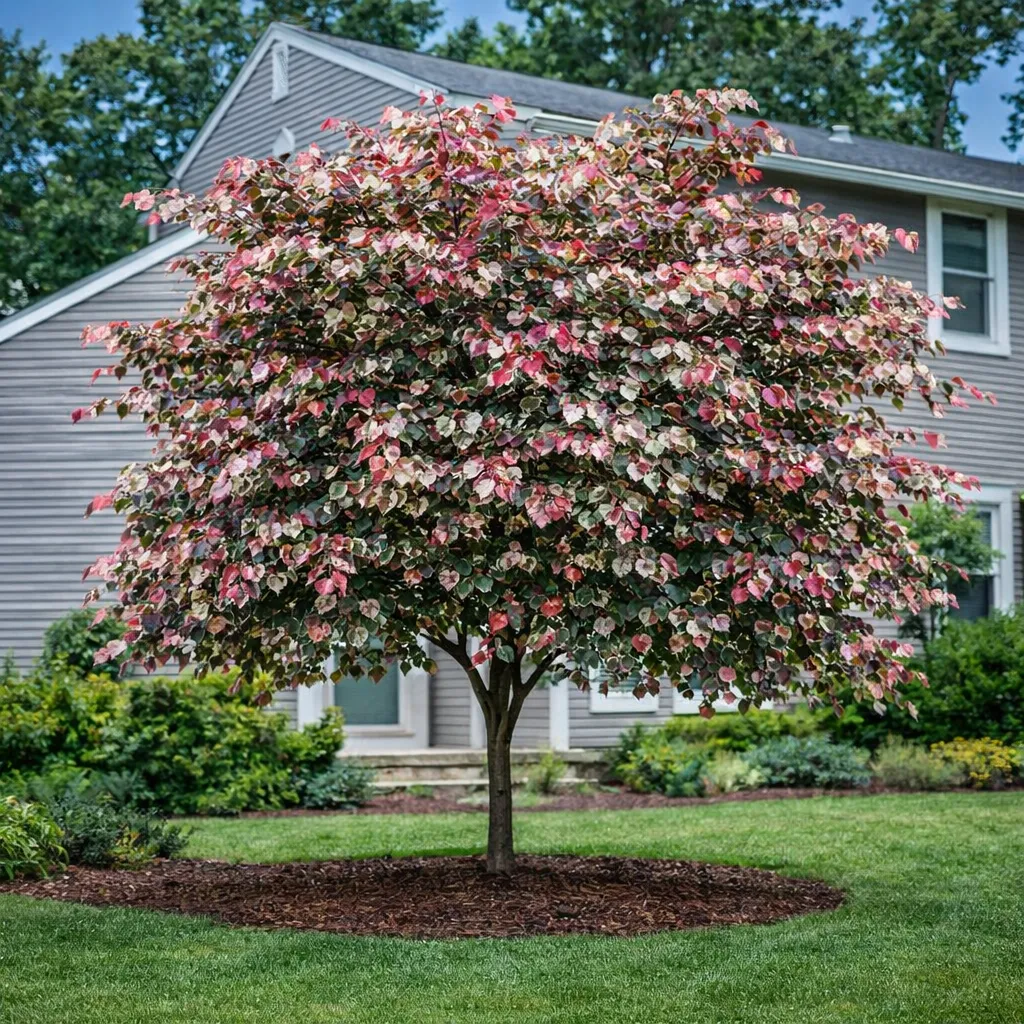
Botanical Name: Cercis canadensis ‘Carolina Sweetheart’

Common Name: Carolina Sweetheart Redbud

Mature Height and Width:
20–30′ tall × 20–30′ wide

Growth Habit: Upright-rounded small ornamental tree with moderate branching density and layered canopy structure. Typically develops a strong central leader with secondary branching and balanced crown architecture. Moderate growth rate.

Foliage Description: Variegated heart-shaped foliage displaying irregular patterns of burgundy, pink, white, and green. New growth emerges with strong pink and burgundy tones, transitioning to multi-tonal variegation through summer. Moderate canopy density with layered leaf presentation.

Flower Description: Rosy lavender-pink pea-like flowers borne along stems and branches prior to leaf emergence. Bloom density moderate with typical redbud trunk and branch flowering habit.

Bloom Time: Early spring before foliage emergence.

Fall Color: Variable yellow to muted bronze tones.

Light Requirements: Full sun to part shade; best foliage coloration achieved with partial afternoon protection in hotter exposures.

Hardiness Zone: USDA Zones 5–9

Notable Landscape Uses: Specimen ornamental tree; lawn accent; patio tree; focal foundation planting; courtyard tree; collector landscape specimen.

Deer Resistance: Moderate
Young growth may experience browsing.
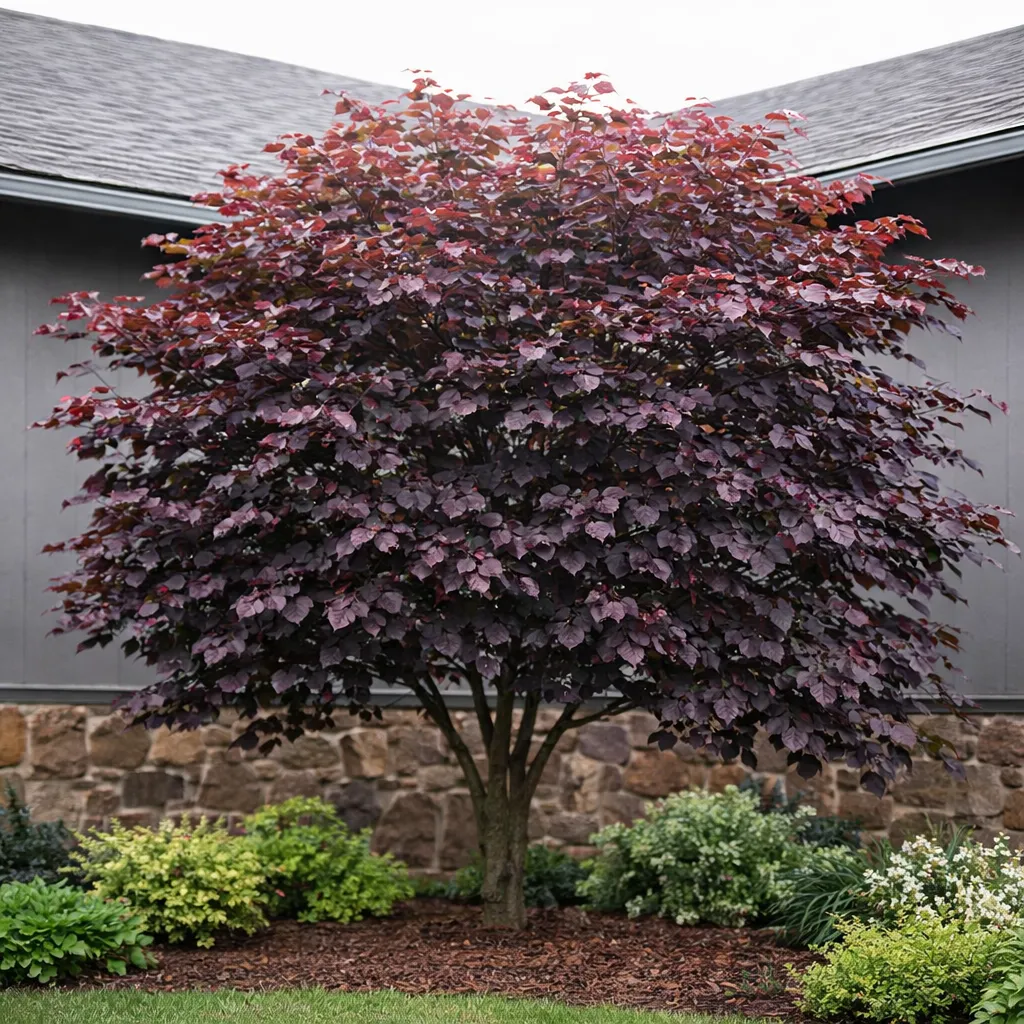
Botanical Name: Cercis canadensis ‘Burgundy Hearts’

Common Name: Burgundy Hearts Redbud

Mature Height and Width:
20–25′ tall × 20–25′ wide

Growth Habit: Upright-rounded small ornamental tree with strong central leader and balanced branching structure. Canopy moderately dense with layered branch architecture and visible trunk development. Moderate growth rate with improved structural uniformity compared to older purple-leaf cultivars.

Foliage Description: Glossy burgundy heart-shaped foliage with improved summer color retention and reduced green fade. Leaves display smooth texture with layered canopy presentation and moderate density.

Flower Description: Rosy lavender-pink pea-like flowers borne along stems and branches prior to leaf emergence. Bloom density moderate with classic redbud trunk and branch flowering pattern.

Bloom Time: Early spring before foliage emergence.

Fall Color: Yellow to muted bronze tones.

Light Requirements: Full sun to part shade; best foliage color and canopy density in full sun.

Hardiness Zone: USDA Zones 5–9

Notable Landscape Uses: Specimen ornamental tree; lawn accent; patio tree; courtyard focal; streetscape planting; foundation accent.

Deer Resistance: Moderate
Young growth may experience browsing.
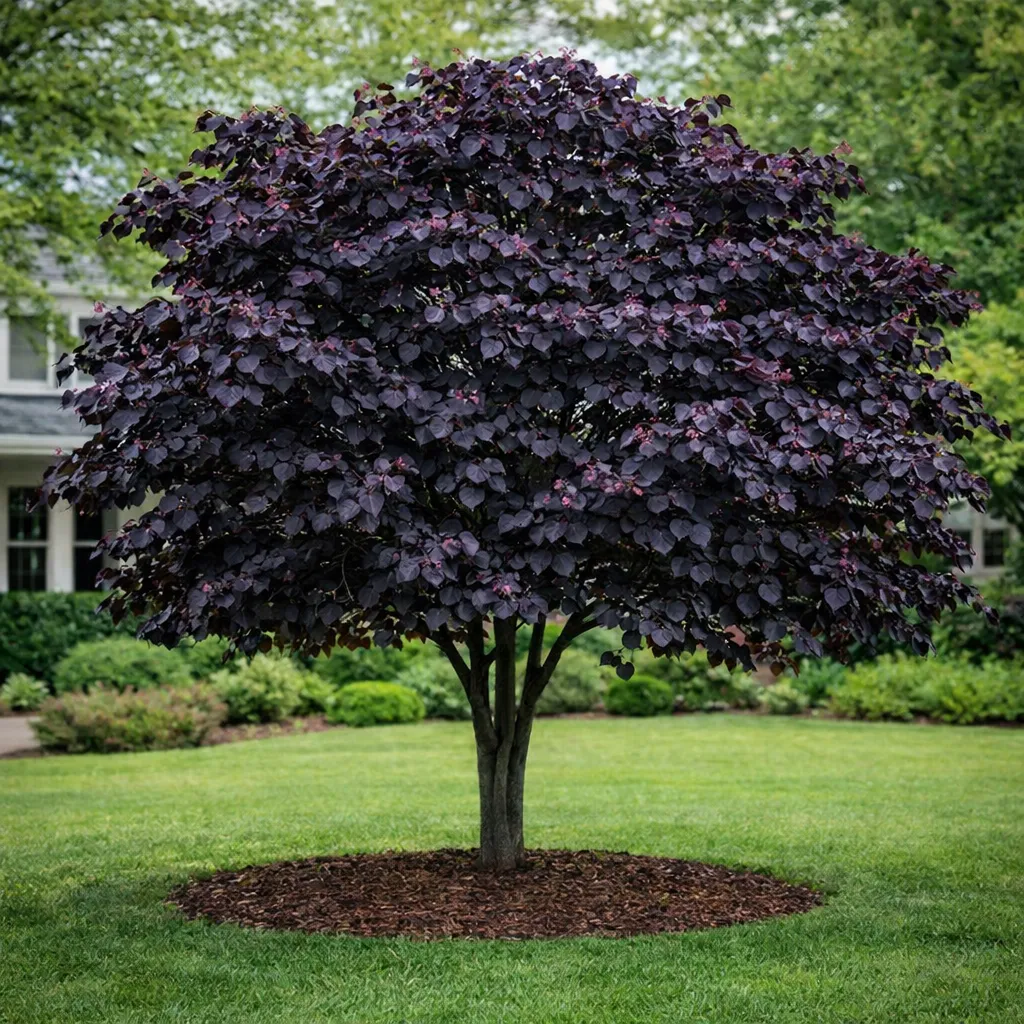
Botanical Name: Cercis canadensis ‘Black Pearl’

Common Name: Black Pearl Redbud

Mature Height and Width:
20–25′ tall × 20–25′ wide

Growth Habit: Upright-rounded small ornamental tree with strong central leader and balanced branching structure. Canopy moderately dense with layered branch architecture and visible trunk development. Moderate growth rate.

Foliage Description: Deep burgundy to near-black heart-shaped foliage with glossy surface and strong color retention through summer. Leaves maintain darker tone compared to Forest Pansy with reduced green fade.

Flower Description: Rosy lavender-pink pea-like flowers borne along stems and branches prior to leaf emergence. Bloom density moderate with classic redbud trunk and branch flowering pattern.

Bloom Time: Early spring before foliage emergence.

Fall Color: Yellow to muted bronze tones.

Light Requirements: Full sun to part shade; best foliage color and density in full sun.

Hardiness Zone: USDA Zones 5–9

Notable Landscape Uses: Specimen ornamental tree; lawn accent; patio tree; courtyard focal; streetscape planting; foundation accent.

Deer Resistance: Moderate
Young growth may experience browsing.
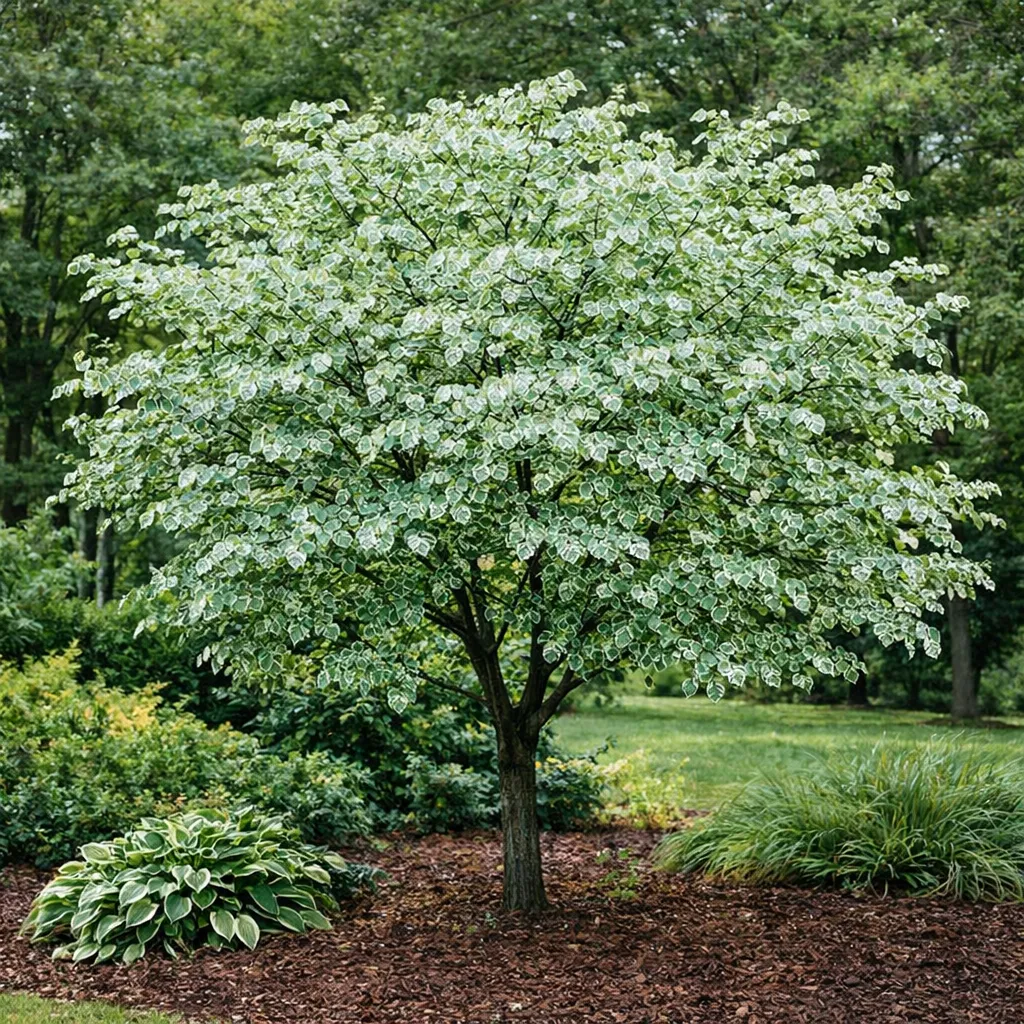
Botanical Name: Cercis canadensis ‘Alley Cat’

Common Name: Alley Cat Redbud

Mature Height and Width:
20–25′ tall × 20–25′ wide

Growth Habit: Upright-rounded small ornamental tree with single to multi-trunk structure and balanced branching architecture. Canopy moderately dense with layered branching and visible trunk development. Moderate growth rate.

Foliage Description: Variegated heart-shaped foliage displaying irregular white and green marbling patterns. Leaves emerge pink-tinged before transitioning to green and white variegation. Moderate canopy density with smooth leaf texture and layered presentation.

Flower Description: Rosy lavender-pink pea-like flowers borne along stems and branches prior to leaf emergence. Bloom density moderate with classic redbud trunk and branch flowering pattern.

Bloom Time: Early spring before foliage emergence.

Fall Color: Yellow to muted bronze tones.

Light Requirements: Full sun to part shade; partial shade helps preserve variegation and prevent leaf scorch.

Hardiness Zone: USDA Zones 5–9

Notable Landscape Uses: Specimen ornamental tree; woodland edge planting; courtyard focal; collector specimen; foundation accent; shade garden feature.

Deer Resistance: Moderate
Young growth may experience browsing.
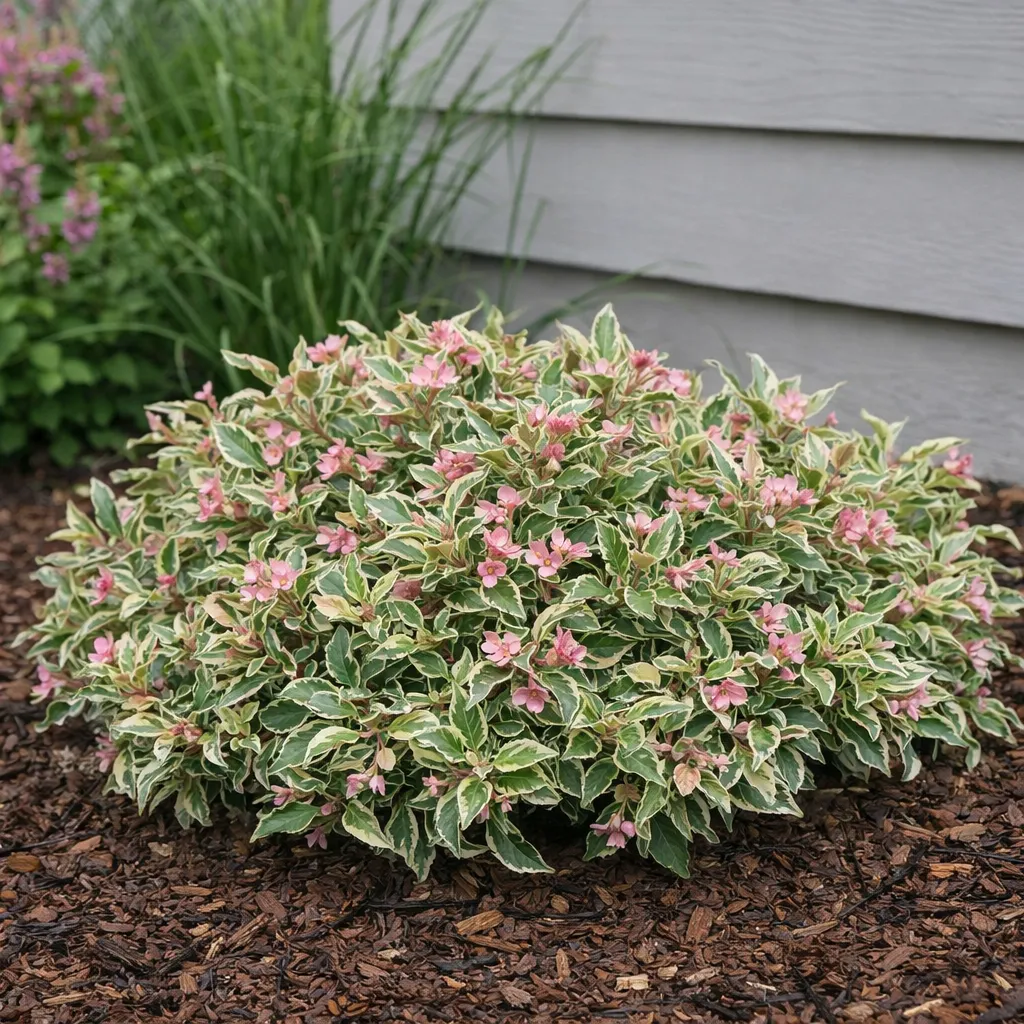
Botanical Name: Weigela florida ‘Verweig’

Common Name: My Monet® Weigela

Mature Height and Width:
12–18″ tall × 18–24″ wide

Growth Habit: Low spreading dwarf shrub with dense branching and compact mound to irregular spreading form. Short internodes create tight canopy with moderate outward spread and layered branching structure. Slow growth rate.

Foliage Description: Small variegated foliage displaying green centers with creamy white margins and pink blush tones, especially on new growth. Leaves provide fine-textured canopy with dense coverage and seasonal pink coloration intensity.

Flower Description: Small funnel-shaped soft pink flowers borne along stems in late spring with scattered rebloom potential. Bloom density moderate but secondary to foliage ornamental value.

Bloom Time: Late spring with occasional sporadic rebloom.

Fall Color: Variable pink to bronze tones with subtle seasonal color shifts.

Light Requirements: Full sun to part shade; best variegation and pink coloration in full sun with some afternoon protection in hotter exposures.

Hardiness Zone: USDA Zones 4–8

Notable Landscape Uses: Low border plantings; edging; rock gardens; container plantings; foundation edging; small space massing.

Deer Resistance: Moderate-High
Occasional browsing possible but generally not preferred.
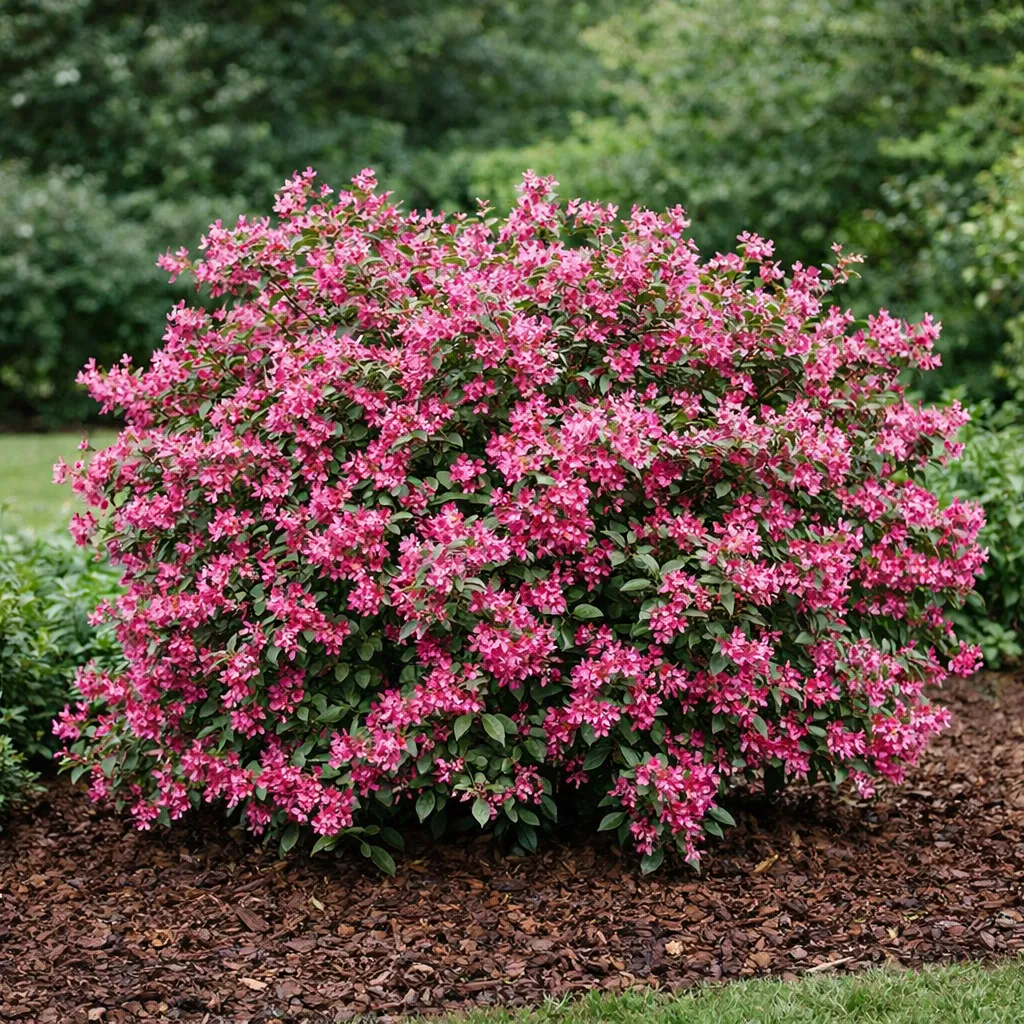
Botanical Name: Weigela florida ‘Bokrasopin’ (Sonic Bloom® series)

Common Name: Sonic Bloom® Weigela

Mature Height and Width:
4–5′ tall × 4–5′ wide

Growth Habit: Upright-rounded deciduous shrub with moderate branching density and naturally arching stems. Canopy moderately dense with layered branch structure and balanced shrub architecture. Moderate growth rate.

Foliage Description: Medium green ovate foliage with smooth texture and moderate canopy density. Leaves provide uniform backdrop for flowering with natural tonal variation and layered presentation.

Flower Description: Abundant funnel-shaped bright pink flowers borne along stems with heavy spring display and strong rebloom through summer and fall. Bloom clusters moderate in size with consistent canopy distribution.

Bloom Time: Late spring with continuous rebloom through summer and early fall.

Fall Color: Minimal ornamental fall coloration; foliage transitions to muted yellow-green.

Light Requirements: Full sun for best flowering and compact structure.

Hardiness Zone: USDA Zones 4–8

Notable Landscape Uses: Specimen shrub; foundation planting; mixed shrub borders; mass planting; patio accent; informal hedge.

Deer Resistance: Moderate-High
Occasional browsing possible but generally not preferred.
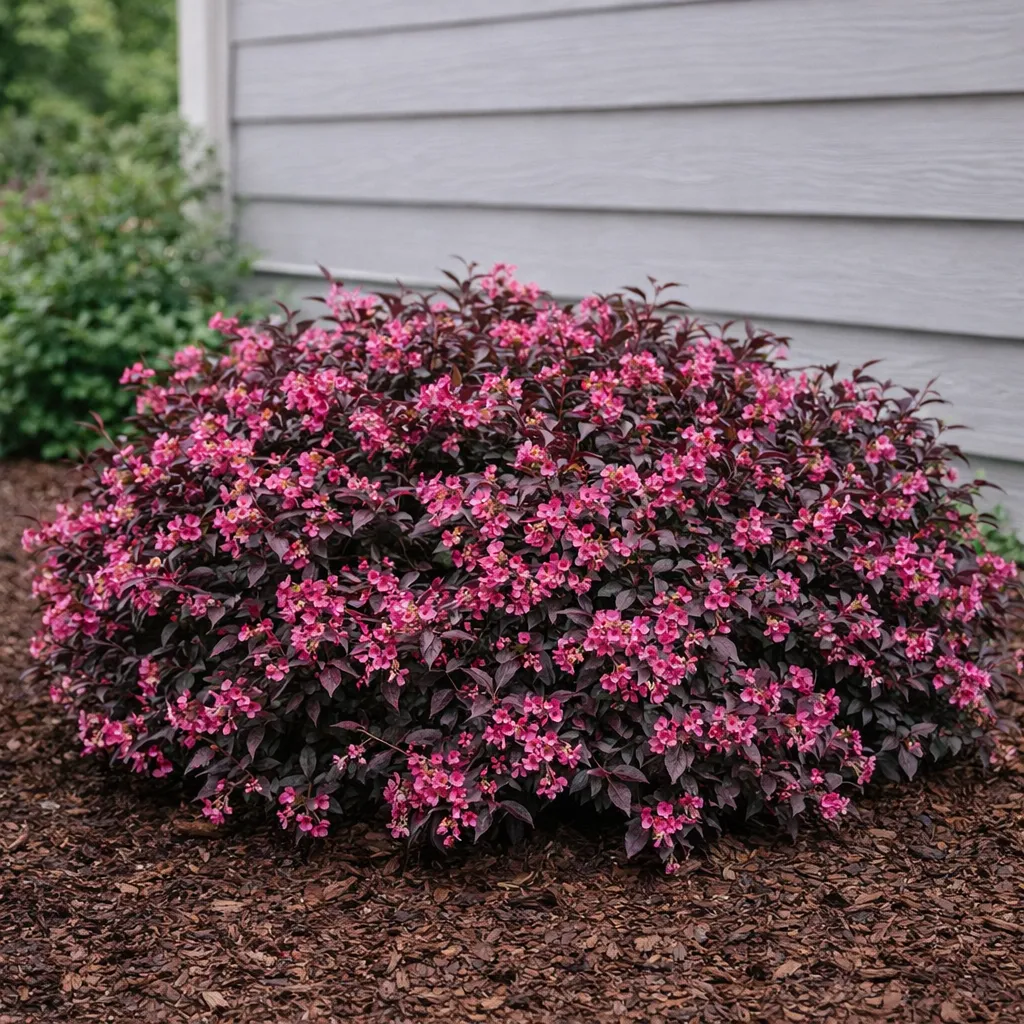
Botanical Name: Weigela florida ‘Bokraspiwi’

Common Name: Spilled Wine® Weigela

Mature Height and Width:
2–3′ tall × 3–4′ wide

Growth Habit: Low spreading deciduous shrub with arching stems and dense branching structure. Forms broad mound with outward growth and layered branch architecture. Moderate growth rate with wider spread than height.

Foliage Description: Deep burgundy ovate foliage with smooth texture and dense canopy coverage. Leaves maintain dark coloration through summer with minimal green fade, providing strong contrast backdrop to flowers.

Flower Description: Funnel-shaped bright pink flowers borne along stems with moderate to heavy spring bloom and occasional rebloom. Flower clusters distributed across canopy and contrast strongly with dark foliage.

Bloom Time: Late spring with sporadic summer rebloom.

Fall Color: Burgundy to muted bronze tones.

Light Requirements: Full sun for best foliage color and bloom density.

Hardiness Zone: USDA Zones 4–8

Notable Landscape Uses: Low mass planting; foundation edging; slope stabilization; mixed shrub borders; container planting; groundcover shrub.

Deer Resistance: Moderate-High
Occasional browsing possible but generally not preferred.
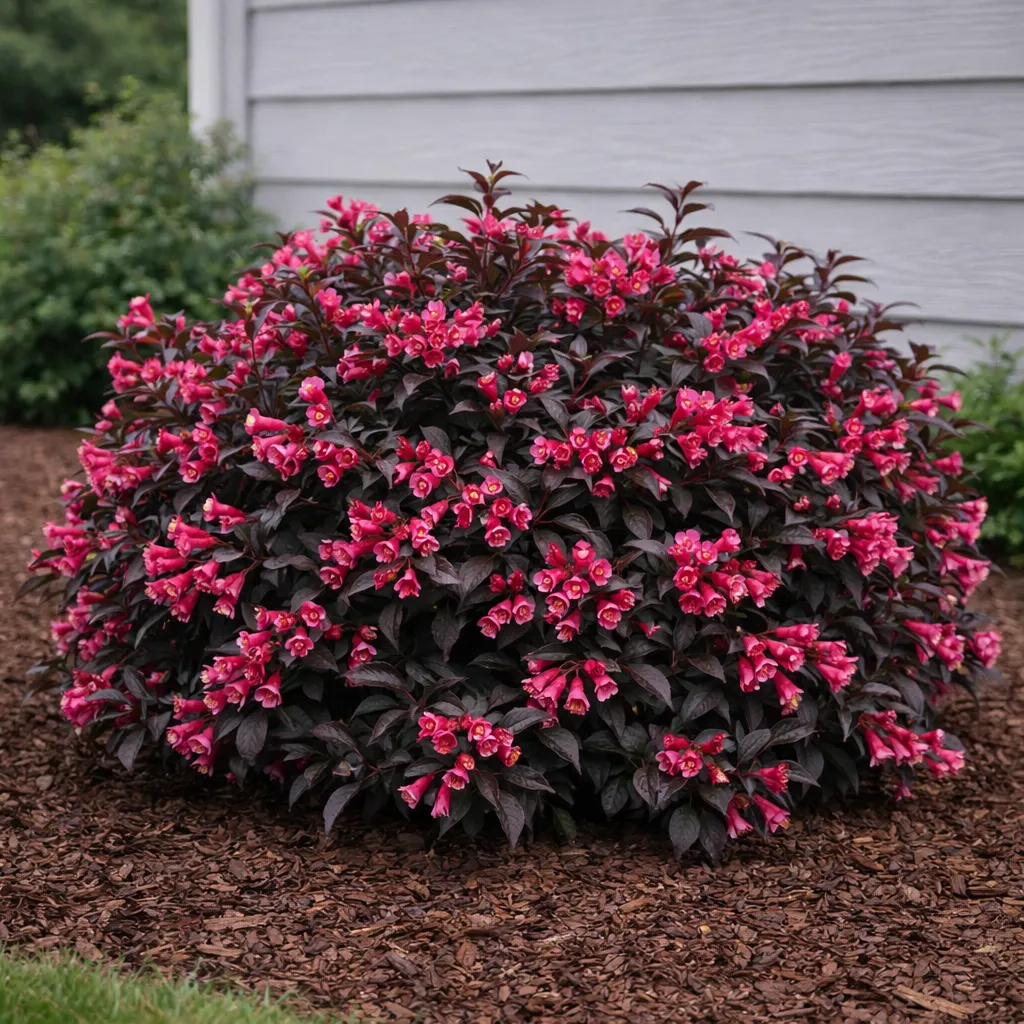
Botanical Name: Weigela florida ‘Alexandra’

Common Name: Wine & Roses® Weigela

Mature Height and Width:
4–5′ tall × 4–5′ wide

Growth Habit: Upright-rounded deciduous shrub with moderate branching density and naturally arching stems. Canopy moderately dense with layered branch structure and balanced shrub architecture. Moderate growth rate.

Foliage Description: Deep burgundy ovate foliage with smooth texture and moderate canopy density. Leaves maintain strong dark coloration through summer with minimal green fade, providing consistent ornamental contrast.

Flower Description: Funnel-shaped bright rose-pink flowers borne along stems with heavy late spring bloom and sporadic summer rebloom. Flower clusters moderately sized and distributed across canopy.

Bloom Time: Late spring with occasional summer rebloom.

Fall Color: Burgundy to muted bronze tones.

Light Requirements: Full sun for best foliage color and flowering performance.

Hardiness Zone: USDA Zones 4–8

Notable Landscape Uses: Specimen shrub; foundation planting; mixed shrub borders; informal hedge; patio accent; mass planting.

Deer Resistance: Moderate-High
Occasional browsing possible but generally not preferred.
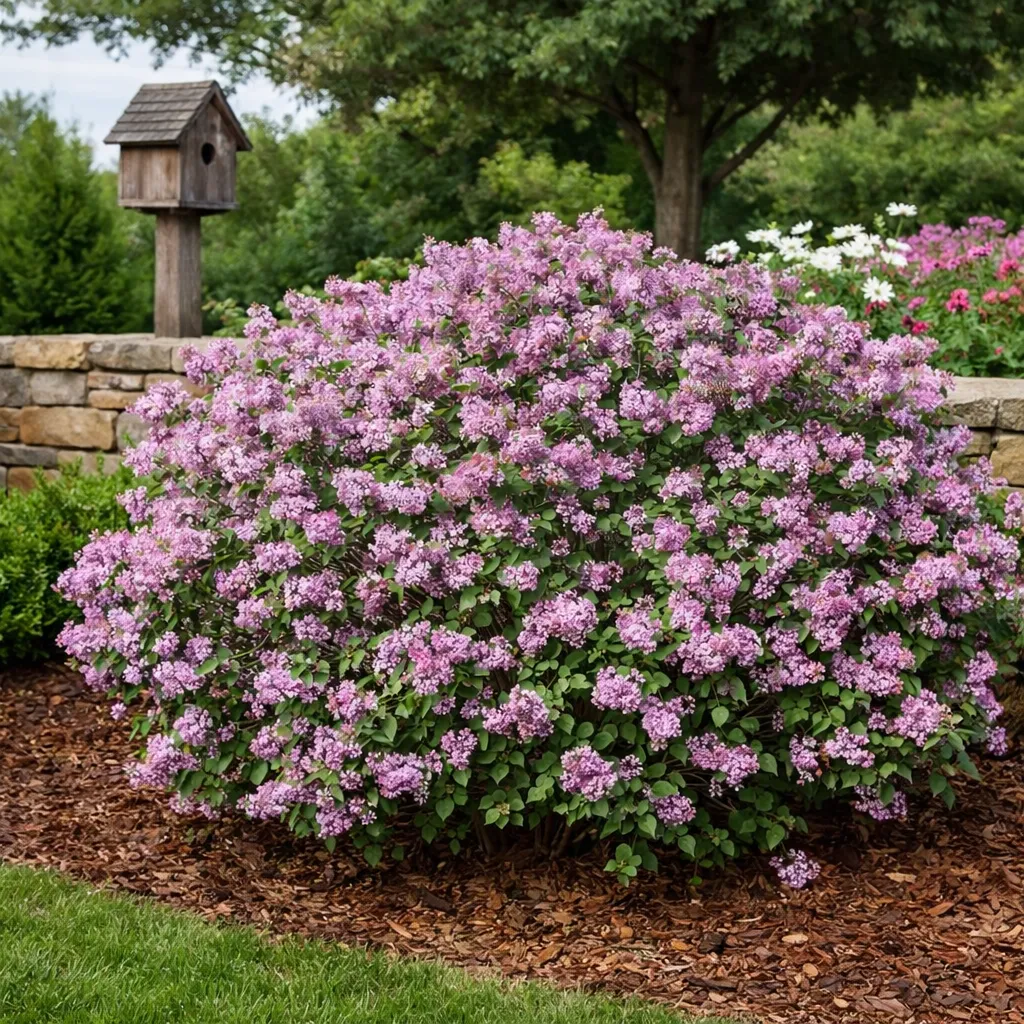
Botanical Name: Syringa x ‘SMNJRPI’
Common Name: Bloomerang Purpink Lilac

Mature Height and Width:
4–6′ tall × 4–6′ wide

Growth Habit:
Compact upright-rounded deciduous shrub with multiple basal stems and dense branching; develops a layered canopy with flowering stems extending slightly above foliage mass; moderate interior openness.

Foliage Description:
Medium green ovate foliage with matte texture; dense but dimensional canopy supporting repeat flowering cycles; maintains clean summer foliage.

Flower Description (if applicable):
Soft lavender-pink panicles with subtle purple undertones composed of small tubular florets; abundant spring bloom followed by intermittent rebloom through summer and fall.

Bloom Time:
Heavy spring bloom with repeat flowering from midsummer through fall

Fall Color (if applicable):
Minimal ornamental fall color; foliage may fade to yellow-green before leaf drop.

Light Requirements:
Full sun (optimal flowering with 6+ hours daily)

Hardiness Zone:
3–7

Notable Landscape Uses:
Mixed shrub borders, foundation plantings, cottage gardens, patio screening, pollinator gardens, accent shrub in perennial borders.

Deer Resistance:
Moderate-High; occasional browsing possible in Northeast landscapes.
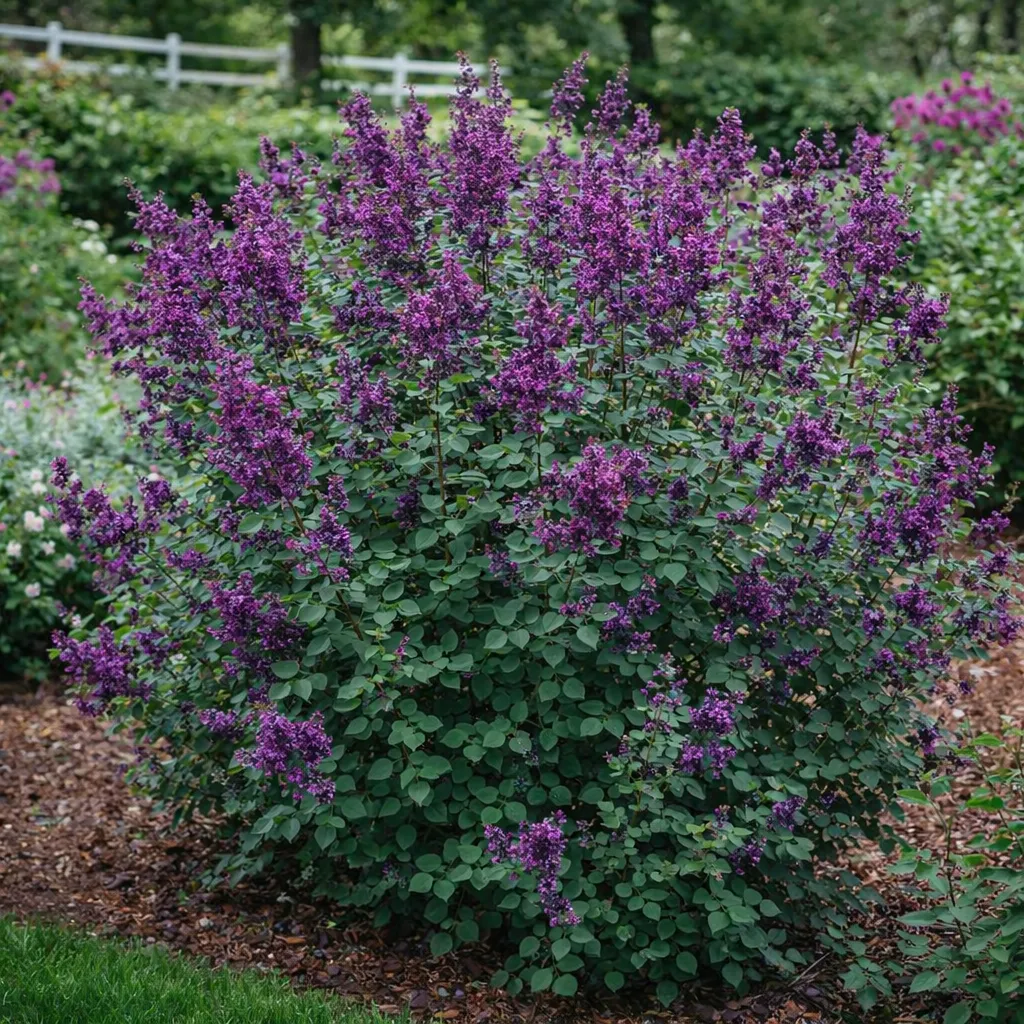
Botanical Name: Syringa x ‘SMSJBP7’
Common Name: Bloomerang Dark Purple Lilac

Mature Height and Width:
4–6′ tall × 4–6′ wide

Growth Habit:
Compact upright-rounded deciduous shrub with multiple basal stems and dense branching; strong vertical flowering stems rise above foliage canopy while maintaining moderate interior openness.

Foliage Description:
Medium green ovate foliage with matte surface and dense layering; forms a dimensional canopy supporting repeat flowering stems; clean summer foliage presentation.

Flower Description (if applicable):
Deep purple to violet-lavender panicles composed of small tubular florets; abundant spring bloom followed by intermittent rebloom through summer and fall.

Bloom Time:
Heavy spring bloom with repeat flowering from midsummer through fall

Fall Color (if applicable):
Minimal ornamental fall color; foliage may fade to soft yellow-green prior to leaf drop.

Light Requirements:
Full sun (best flowering performance with 6+ hours daily)

Hardiness Zone:
3–7

Notable Landscape Uses:
Mixed shrub borders, foundation plantings, cottage gardens, patio screening, pollinator gardens, accent shrub in perennial borders.

Deer Resistance:
Moderate; occasional browsing possible in Northeast landscapes.

Perennials
Black Mondo GrassOphiopogon planiscapus ‘Nigrescens’ Mature Size: 6–8″ H × 10–12″ W Light Requirements: Part shade to full shade; tolerates morning sun Ideal Soil Conditions: Moist, well‑drained, organically rich soil Notable Characteristics: Dramatic deep black foliage in low mounding clumps. Produces small lilac flowers and blue berries. Excellent contrast plant in shade borders, rock gardens, or containers. Deer Resistance: Moderate to High
Trees & Shrubs
Botanical Name: Cornus kousaCommon Name: Kousa Dogwood Mature Height and Width:15–25' tall × 15–25' wide Growth Habit:Small deciduous ornamental tree with upright form in youth maturing to a broad, layered, horizontal branching structure; develops sculptural multi-tiered canopy with moderate interior openness. Foliage Description:Medium to dark green ovate foliage with subtle surface texture and opposite arrangement; dense summer canopy transitioning to attractive fall coloration. Flower Description (if applicable):Showy creamy white to soft blush four-bracted blooms appearing after leaf emergence; bracts pointed and slightly overlapping with greenish true flowers at center. Bloom Time:Late spring to early summer Fall Color (if applicable):Attractive red to burgundy fall coloration with occasional purple tones. Light Requirements:Full sun to partial shade Hardiness Zone:5–8 Notable Landscape Uses:Specimen tree, patio tree, lawn accent, woodland edge planting, courtyard focal point, layered understory tree, residential foundation accent. Deer Resistance:Low to moderate; young growth may be browsed in Northeast landscapes.
Botanical Name: Acer palmatum ‘Shishigashira’ Common Name: Lion’s Head Japanese Maple Mature Height and Width: 8–12' tall × 6–8' wide Growth Habit: Upright, compact, and densely branched; forms a rounded to oval canopy with stiff, ascending branch structure. Internodes are short, creating a tight, architectural framework. Foliage Description: Small, crinkled, heavily textured palmate leaves with tightly curled margins. Spring and summer foliage is rich medium green with a glossy surface. Leaves cluster densely along upright stems, creating a tufted appearance. Flower Description: Small reddish-purple flowers in spring; not ornamentally significant. Bloom Time: Mid-spring Fall Color: Exceptional golden-yellow to orange with frequent red highlights; often one of the strongest fall displays among green Japanese maples. Light Requirements: Full sun to partial shade; tolerates more sun exposure than many palmatum cultivars in Zones 5–7 when adequately irrigated. Hardiness Zone: USDA Zones 5–8 Notable Landscape Uses:Architectural specimen for formal gardens; vertical accent in foundation plantings; courtyard focal point; collector gardens; structured element in Japanese-inspired landscapes; suitable for larger decorative containers. Deer Resistance: ModerateNot a preferred browse species, but compact new growth can be nipped, particularly in winter or high-pressure deer regions. Young plants are more susceptible and benefit from protection during establishment.
Botanical Name: Acer palmatum ‘Mikawa Yatsubusa’ Common Name: Mikawa Yatsubusa Dwarf Japanese Maple Mature Height and Width: 6–8' tall × 4–6' wide Growth Habit: Compact, upright to broadly pyramidal form with exceptionally tight, layered branching. Dense, architectural structure with very short internodes creating a stacked, shingled foliage appearance. Slow growing. Foliage Description: Small to medium palmate leaves (5–7 lobes) held densely along stems. Spring foliage emerges bright green with slight reddish edging, maturing to rich medium green in summer. Leaves overlap tightly, creating a textured, tiered look unique to the cultivar. Flower Description: Small reddish-purple flowers in spring; not ornamentally significant. Bloom Time: Mid-spring Fall Color: Brilliant yellow to orange, often with warm golden tones; color develops evenly across the canopy. Light Requirements: Full sun to partial shade; benefits from some afternoon protection in hotter exposures to prevent leaf scorch. Hardiness Zone: USDA Zones 5–8 Notable Landscape Uses:Architectural specimen for small gardens; focal point in foundation beds; ideal for Japanese-style or collector gardens; accent in courtyard plantings; suitable for large decorative containers; valued for its distinctive layered structure. Deer Resistance: ModerateNot a preferred deer browse, but tender new growth may be sampled in spring or during food scarcity. Dense branching does not prevent browsing if pressure is high. Young plants should be protected in heavy deer areas.
Botanical Name: Acer palmatum ‘Skeeter’s Broom’ Common Name: Skeeter’s Broom Japanese Maple Mature Height and Width: 8–12' tall × 4–6' wide Growth Habit: Upright, narrow, and compact; dense, broom-like branching structure with tight internodes. Maintains a refined, vertical silhouette with age. Foliage Description: Small, palmate leaves (typically 5 lobes) emerging bright crimson-red in spring. Summer foliage matures to deep burgundy-red and generally holds color better than many red dwarf forms. Leaves are noticeably smaller and more compact than standard Acer palmatum cultivars. Flower Description: Small purplish-red flowers in spring; not ornamentally significant. Bloom Time: Mid-spring Fall Color: Bright scarlet to crimson-red Light Requirements: Full sun to partial shade; performs well in full sun in Zones 5–7 with adequate moisture. Hardiness Zone: USDA Zones 5–8 Notable Landscape Uses:Narrow vertical accent in foundation plantings; specimen for smaller landscapes; architectural focal point in courtyard gardens; formal garden designs; suitable for larger decorative containers in protected settings. Deer Resistance: ModerateWhile not a primary deer preference, the compact structure can make new growth accessible. Browsing typically occurs on tender spring growth or in winter when food sources are limited. Young plants benefit from protection in high-pressure areas.
Botanical Name: Acer palmatum ‘Twombly’s Red Sentinel’ Common Name: Twombly’s Red Sentinel Japanese Maple Mature Height and Width: 15–20' tall × 6–8' wide Growth Habit: Strongly upright, columnar form with a narrow, vertical branching structure. Maintains a tight silhouette compared to broader red Japanese maples. Foliage Description: Deep burgundy-red palmate leaves (5–7 lobes). Emerges rich crimson in spring and holds dark red coloration well through summer with minimal fading. Leaves are slightly smaller and more compact along vertical stems. Flower Description: Small purplish-red spring flowers; not ornamentally significant. Bloom Time: Mid-spring Fall Color: Bright scarlet to crimson-red Light Requirements: Full sun to partial shade; tolerates more sun than many red Japanese maples in Zones 5–7 when adequately irrigated. Hardiness Zone: USDA Zones 5–8 Notable Landscape Uses:Vertical accent in narrow planting beds; architectural focal point near entryways; columnar specimen for tight foundation plantings; formal garden settings; contrasting vertical element among low shrubs; suitable for limited-space residential landscapes. Deer Resistance: ModerateJapanese maples are not typically preferred browse, but upright forms can experience tip browsing, particularly on young plants in winter or high-pressure deer regions. Protection is recommended during establishment.
Botanical Name: Acer shirasawanum ‘Autumn Moon’ Common Name: Autumn Moon Japanese Maple Mature Height and Width: 8–10' tall × 8–10' wide Growth Habit: Upright, rounded to broadly vase-shaped form; moderately dense branching with a balanced canopy. Slower growing than Acer palmatum cultivars. Foliage Description: Large, rounded palmate leaves with 9–11 lobes. Emerges vibrant orange-yellow to chartreuse with pinkish-red margins in spring. Summer foliage matures to soft golden-yellow with orange overlay and subtle green undertones in shade. Color intensity increases with filtered light. Flower Description: Small purplish-red flowers in spring; followed by ornamental red samaras that may add subtle seasonal interest. Bloom Time: Mid-spring Fall Color: Brilliant orange to fiery red Light Requirements: Partial shade to filtered sun; prefers protection from hot afternoon sun to prevent leaf scorch. Hardiness Zone: USDA Zones 5–7 Notable Landscape Uses:Specimen tree for woodland gardens; focal point in protected foundation beds; understory accent beneath taller shade trees; courtyard planting; high-end residential landscapes where foliage color contrast is desired. Deer Resistance: ModerateWhile not a preferred browse plant, deer will feed on tender foliage and new growth, especially in spring or during food scarcity. Young plants require protection in high-pressure areas.
Botanical Name: Acer palmatum var. dissectum ‘Orangeola’ Common Name: Orangeola Dwarf Japanese Maple Mature Height and Width: 4-6' tall × 4-6' wide Growth Habit: Gracefully cascading, semi-upright dissectum form; develops a strong central structure with long, flowing pendulous branches. More vertical presence than many laceleaf types while retaining a weeping character. Foliage Description: Finely dissected laceleaf foliage. Emerges bright orange-red to fiery crimson in spring, matures to deep red with bronze undertones in summer, often showing interior green shading in lower canopy. Flower Description: Small reddish-purple spring flowers; not ornamentally significant. Bloom Time: Mid-spring Fall Color: Outstanding orange to scarlet-red; often one of the strongest fall displays among red dissectums. Light Requirements: Full sun to partial shade; best color retention with morning sun and afternoon protection in hotter exposures. Hardiness Zone: USDA Zones 5–8 Notable Landscape Uses:Specimen tree for island beds; accent near patios or entryways; cascading focal point on slopes; Japanese-style gardens; layered understory planting beneath taller canopy trees; large containers in protected settings. Deer Resistance: ModerateJapanese maples are not preferred forage, but deer may browse tender new growth, especially in winter or in high-pressure areas. Young plants are more susceptible than established specimens.
Botanical Name: Acer palmatum var. dissectum ‘Crimson Queen’ Common Name: Crimson Queen Dwarf Japanese Maple Mature Height and Width: 8–10' tall × 10–12' wide Growth Habit: Low, cascading, mounded form with strongly pendulous, arching branches; develops a layered, umbrella-like structure with age. Foliage Description: Deep crimson-red, finely dissected laceleaf foliage. Emerges bright red in spring, matures to rich burgundy-red in summer, holding color well compared to many dissectum types. Flower Description: Small, inconspicuous reddish-purple flowers borne in spring; not ornamentally significant. Bloom Time: Mid-spring Fall Color: Brilliant scarlet to deep crimson Light Requirements: Full sun to partial shade; best color retention in morning sun with afternoon protection in hotter exposures. Hardiness Zone: USDA Zones 5–8 Notable Landscape Uses:Specimen tree for island beds; focal point in foundation plantings; accent for courtyard and patio gardens; Japanese-style landscapes; cascading element near walls, water features, or slopes; suitable for large decorative containers. Deer Resistance: ModerateJapanese maples are not preferred forage, but tender new growth may be browsed, particularly in winter or high-pressure deer areas. Young plants are more vulnerable than established specimens.
Botanical Name: Acer palmatum ‘Bloodgood’ Common Name: Bloodgood Japanese Maple Mature Height & Width: 15–20' tall × 15–20' wide Growth Habit: Upright, broad-rounded canopy with balanced branching; develops a graceful, layered structure with age Foliage: Deep burgundy-red, palmate leaves (5–7 lobes) emerging rich crimson in spring; retains strong red coloration through summer with slight bronzing in high heat Flower Description: Small, inconspicuous purplish-red flowers in clusters Bloom Time: Mid to late spring Fall Color: Brilliant scarlet to crimson Light Requirements: Full sun to partial shade; benefits from afternoon protection in hotter exposures Hardiness Zone: USDA Zones 5–8 Notable Landscape Uses:Specimen tree; focal point in foundation plantings; courtyard gardens; woodland edge plantings; patio accent; high-end residential landscapes; Japanese-inspired garden design.
Botanical Name: Picea glauca ‘Pendula’ Common Name: Weeping White Spruce Mature Height and Width:20–30' tall × 6–10' wide (varies with staking and training) Growth Habit: Strong central leader with pronounced pendulous branching. Narrow pyramidal to irregular columnar form depending on staking. Branches cascade downward along trunk, creating vertical draping effect. Moderate growth rate. Foliage Description: Short, fine-textured blue-green to gray-green needles borne densely along pendulous branchlets. Softer texture than Colorado spruce. Moderate density with visible trunk and interior structure. Flower Description: Inconspicuous; not ornamental. Bloom Time: Spring (non-ornamental reproductive structures). Fall Color: Evergreen; consistent blue-green to gray-green year-round. Light Requirements: Full sun. Hardiness Zone: USDA Zones 2–6 (performs well in Northeast Zones 5–6). Notable Landscape Uses: Vertical specimen; accent tree; focal point in island bed; entry feature; narrow evergreen statement; architectural garden element. Deer Resistance: Moderate-HighYoung plants may experience browsing in Northeast Zones 5–7.
Vanderwolf’s Pyramid Limber Pine Pinus flexilis ‘Vanderwolf’s Pyramid’ Mature Size: 20–30′ H × 10–15′ W Light Requirements: Full sun Ideal Soil Conditions: Well-drained soils; tolerates dry, rocky, or poor soils once established Notable Characteristics:Dense, upright pyramidal form with long, twisted, blue-green needles that give a soft, graceful texture. Excellent specimen for year-round structure and color. Drought tolerant and very cold hardy. Deer Resistance: Moderate to High
Botanical Name: Cedrus atlantica ‘Glauca’ Common Name: Blue Atlas Cedar (Upright Form) Mature Height and Width:40–60' tall × 30–40' wide Growth Habit: Upright pyramidal when young, maturing to a broad pyramidal to irregularly spreading canopy. Strong central leader with wide, layered horizontal scaffold branches. Moderate growth rate. Foliage Description: Short, stiff needles borne in dense clusters along woody stems. Silver-blue to blue-gray coloration. Needle clusters create textured layered branch planes with visible structural depth. Flower Description: Inconspicuous; not ornamental. Bloom Time: Spring (non-ornamental reproductive structures). Fall Color: Evergreen; consistent blue-gray foliage year-round. Light Requirements: Full sun for strongest blue coloration and structural density. Hardiness Zone: USDA Zones 6–9 (reliable in protected Zone 6; marginal in colder Zone 5 sites). Notable Landscape Uses: Large lawn specimen; park planting; estate-scale focal point; windbreak component; architectural evergreen statement. Deer Resistance: HighCoarse branching and clustered needles provide strong resistance in Northeast Zones 5–7 once established.
Botanical Name: Cedrus atlantica ‘Glauca Pendula’ Common Name: Weeping Blue Atlas Cedar Mature Height and Width:10–25' tall × 10–20' wide (highly variable depending on staking and training) Growth Habit: Strong central leader when staked, with dramatically pendulous cascading branches. Irregular sculptural form. Architecture determined by early training; develops broad horizontal spread if not vertically trained. Moderate growth rate. Foliage Description: Short stiff needles in dense clusters along drooping branchlets. Intense silver-blue to powder-blue coloration. Needles arranged in rosettes along woody stems, creating textured layered drape. Flower Description: Inconspicuous; not ornamental. Bloom Time: Spring (non-ornamental reproductive structures). Fall Color: Evergreen; consistent blue to blue-gray year-round. Light Requirements: Full sun for strongest color and density. Hardiness Zone: USDA Zones 6–9 (reliable in protected Zone 6; marginal in colder Zone 5 sites). Notable Landscape Uses: Specimen focal point; sculptural accent; island bed feature; courtyard planting; architectural evergreen centerpiece; sloped garden accent. Deer Resistance: HighSharp clustered needles and coarse branching provide strong resistance in Northeast Zones 5–7 once established.
Botanical Name: Picea abies ‘Cupressina’ Common Name: Columnar Norway Spruce Mature Height and Width:25–35' tall × 6–10' wide Growth Habit: Strongly upright, narrowly columnar evergreen with a dominant central leader. Ascending branches held close to trunk, forming a tight vertical profile. Moderate growth rate. Foliage Description: Short, dark green needles borne densely along ascending branchlets. Texture moderately coarse compared to arborvitae. Canopy dense but with visible vertical branch structure. Flower Description: Inconspicuous; not ornamental. Bloom Time: Spring (non-ornamental reproductive structures). Fall Color: Evergreen; consistent deep green year-round. Light Requirements: Full sun for best density and structure. Hardiness Zone: USDA Zones 3–7. Notable Landscape Uses: Vertical accent; narrow privacy screen; property line planting; driveway flanking; formal evergreen column; windbreak component. Deer Resistance: Moderate-HighYoung plants may experience browsing in Northeast Zones 5–7.
Botanical Name: Picea pungens ‘Hoopsii’ Common Name: Hoopsi Blue Spruce Mature Height and Width:30–50' tall × 15–20' wide Growth Habit: Upright pyramidal evergreen with strong central leader and evenly spaced horizontal branch tiers. Symmetrical when young, maturing with natural contour variation. Moderate growth rate. Foliage Description: Stiff, sharply pointed needles with intense silver-blue to steel-blue coloration. Needles held radially around branches, producing dense layered branch planes. Consistent blue coloration across canopy in full sun. Flower Description: Inconspicuous; not ornamental. Bloom Time: Spring (non-ornamental reproductive structures). Fall Color: Evergreen; consistent silver-blue foliage year-round. Light Requirements: Full sun for strongest blue coloration and density. Hardiness Zone: USDA Zones 2–7. Notable Landscape Uses: Specimen evergreen; lawn focal point; windbreak component; large-scale foundation backdrop; winter structure tree. Deer Resistance: ModerateYoung plants may experience browsing pressure in Northeast Zones 5–7.
Botanical Name: Picea pungens ‘Globosa’ Common Name: Globosa Blue Spruce Mature Height and Width:3–5' tall × 4–6' wide Growth Habit: Dwarf, broadly rounded to flattened globe form. Low, spreading evergreen with dense branching and layered horizontal structure. Typically wider than tall at maturity. Slow growth rate. Foliage Description: Short, stiff needles with silver-blue to steel-blue coloration. Dense needle coverage along short internodes. Color consistent throughout canopy with slight natural tonal variation. Flower Description: Inconspicuous; not ornamental. Bloom Time: Spring (non-ornamental reproductive structures). Fall Color: Evergreen; consistent blue foliage year-round. Light Requirements: Full sun for best color and density. Hardiness Zone: USDA Zones 2–7. Notable Landscape Uses: Foundation massing; front border planting; rock garden specimen; walkway edge accent; low evergreen structure; courtyard planting. Deer Resistance: Moderate-HighMay experience occasional browsing in Northeast Zones 5–7.
Botanical Name: Picea pungens ‘Baby Blue’ Common Name: Baby Blue Colorado Spruce Mature Height and Width:20–25' tall × 8–12' wide Growth Habit: Narrow pyramidal to conical evergreen with strong central leader and layered horizontal branching. Dense but not compacted. Moderate growth rate. Foliage Description: Stiff, sharp needles with strong blue to silver-blue coloration. Needles held radially around stems, producing dense layered branch planes. Consistent blue tone across canopy. Flower Description: Inconspicuous; not ornamental. Bloom Time: Spring (non-ornamental reproductive structures). Fall Color: Evergreen; consistent blue foliage year-round. Light Requirements: Full sun for best color retention. Hardiness Zone: USDA Zones 2–7. Notable Landscape Uses: Specimen evergreen; windbreak component; privacy screen; lawn focal point; winter structure tree; holiday tree form. Deer Resistance: Moderate-HighYoung plants may experience browsing in Northeast Zones 5–7.
Botanical Name: Picea pungens ‘Fat Albert’ Common Name: Fat Albert Blue Spruce Mature Height and Width:15–25' tall × 10–20' wide Growth Habit: Broad pyramidal evergreen with strong central leader. Dense, symmetrical branching forming a wide conical silhouette. Slower growing and fuller than seed-grown Colorado spruce. Foliage Description: Stiff, sharply pointed needles with intense silver-blue to steel-blue coloration. Needles borne radially along branches, producing dense layered branch tiers. Consistent blue tone in full sun. Flower Description: Inconspicuous; not ornamental. Bloom Time: Spring (non-ornamental reproductive structures). Fall Color: Evergreen; consistent silver-blue foliage year-round. Light Requirements: Full sun for strongest color and density. Hardiness Zone: USDA Zones 2–7 (reliable in Northeast Zones 5–7). Notable Landscape Uses: Lawn specimen; foundation backdrop; windbreak component; evergreen focal point; formal accent tree. Deer Resistance: HighSharp needles and dense branching provide strong resistance in Northeast Zones 5–7 once established.
Botanical Name: Picea pungens ‘Iseli Fastigiate’ Common Name: Columnar Blue Spruce Mature Height and Width:25–35' tall × 8–12' wide Growth Habit: Narrow upright pyramidal to columnar evergreen with strong central leader. Ascending branches held relatively tight to trunk while maintaining visible horizontal tiering. Moderate growth rate. Foliage Description: Stiff, sharply pointed needles with silver-blue to steel-blue coloration. Needles borne radially around stems, creating dense layered branch structure. Consistent blue coloration in full sun. Flower Description: Inconspicuous; not ornamental. Bloom Time: Spring (non-ornamental reproductive structures). Fall Color: Evergreen; consistent silver-blue foliage year-round. Light Requirements: Full sun for best density and blue coloration. Hardiness Zone: USDA Zones 2–7. Notable Landscape Uses: Narrow privacy screen; vertical accent; property line planting; driveway flanking; formal evergreen column; windbreak component. Deer Resistance: HighSharp needles and dense branching provide strong resistance in Northeast Zones 5–7 once established.
Botanical Name: Picea glauca var. densata Common Name: Black Hills Spruce Mature Height and Width:30–50' tall × 15–25' wide Growth Habit: Dense pyramidal evergreen with strong central leader and uniform horizontal branching. More compact and fuller than standard white spruce. Moderate growth rate. Foliage Description: Short dark green needles borne densely along branchlets. Foliage finer-textured and slightly shorter than Colorado spruce. Consistent deep green coloration without blue cast. Flower Description: Inconspicuous; not ornamental. Bloom Time: Spring (non-ornamental reproductive structures). Fall Color: Evergreen; consistent dark green year-round. Light Requirements: Full sun for best density and structure. Hardiness Zone: USDA Zones 2–6 (reliable in Northeast Zones 5–6). Notable Landscape Uses: Windbreak planting; privacy screen; lawn specimen; shelterbelt tree; northern landscape evergreen. Deer Resistance: Moderate to HighGenerally resistant once established in Northeast Zones 5–7; young trees may experience occasional tip browsing.
Botanical Name: Picea pungens ‘Blue Falls’ Common Name: Blue Falls Weeping Blue Spruce Mature Height and Width:6–10' tall (staked leader) × 4–8' wide Growth Habit: Strongly pendulous evergreen with trailing branches. Height determined by staking; leader grows upward while lateral branches cascade downward. Forms a vertical accent with dramatic weeping curtain effect. Moderate growth rate. Foliage Description: Stiff silver-blue to blue-gray needles borne densely along pendulous stems. Needles sharp and radially arranged, producing layered draping texture. Consistent cool blue tone in full sun. Flower Description: Inconspicuous; not ornamental. Bloom Time: Spring (non-ornamental reproductive structures). Fall Color: Evergreen; consistent silver-blue coloration year-round. Light Requirements: Full sun for strongest blue coloration and dense growth. Hardiness Zone: USDA Zones 2–7 (reliable in Northeast Zones 5–7). Notable Landscape Uses: Vertical accent; rock garden focal point; cascading over walls; specimen in mixed conifer bed; sculptural evergreen feature. Deer Resistance: HighSharp needles provide strong resistance in Northeast Zones 5–7 once established.
Botanical Name: Picea abies ‘Pendula’ Common Name: Weeping Norway Spruce Mature Height and Width:10–20' tall (dependent on staking) × 6–10' wide Growth Habit: Strongly weeping evergreen with a narrow, irregular vertical form when staked. Branches cascade sharply downward from a trained central leader. Without staking, habit becomes spreading and ground-hugging. Architecture is highly sculptural and irregular. Foliage Description: Medium to dark green needles, short and stiff, borne densely along pendulous branches. Foliage texture moderately coarse with visible branch structure beneath. Needles maintain consistent green coloration throughout the season. Flower Description: Inconspicuous; non-ornamental cones typical of species. Bloom Time: Spring (cones not primary ornamental feature). Fall Color: Evergreen; maintains green year-round. Light Requirements: Full sun for best structure and density. Hardiness Zone: USDA Zones 3–7 (very reliable in Northeast Zones 5–7). Notable Landscape Uses: Specimen evergreen; vertical architectural accent; focal point in mixed conifer garden; estate lawn specimen; dramatic entry feature. Deer Resistance: Moderate to HighGenerally avoided once established; occasional winter tip browsing possible under extreme pressure.
Botanical Name: Chamaecyparis obtusa ‘Fernspray Gold’ Common Name: Golden Fernspray Hinoki Cypress Mature Height and Width:8–12' tall × 4–6' wide (slow to moderate growth rate) Growth Habit: Upright, irregular pyramidal evergreen with strongly layered, fern-like branching. Vertical leader present. Branching forms flattened horizontal tiers with cascading secondary sprays. Naturally asymmetrical and architectural rather than dense and compact. Foliage Description: Distinct fern-like, deeply dissected scale sprays with pronounced texture. New growth bright golden-yellow, especially at tips and outer layers. Interior foliage matures to yellow-green to medium green. Branch sprays are finely divided, soft-textured, and clearly separated, creating visible air space between layers. Flower Description: Inconspicuous; not ornamental. Bloom Time: Spring (non-ornamental cones). Fall Color: Evergreen; golden tones persist year-round, slightly deeper green toward interior in winter. Light Requirements: Full sun to partial shade; best golden coloration in full sun with consistent moisture and good drainage. Hardiness Zone: USDA Zones 5–8 (reliable in Northeast Zones 5–7 with protection from harsh winter winds). Notable Landscape Uses: Specimen evergreen; rock garden vertical accent; mixed conifer garden focal point; foundation feature; architectural courtyard planting. Deer Resistance: HighConsistently strong resistance in Northeast Zones 5–7 field conditions.
Botanical Name: Chamaecyparis obtusa ‘Nana Lutea’ Common Name: Dwarf Golden Hinoki Cypress Mature Height and Width:3–5' tall × 3–5' wide (slow growing; compact form) Growth Habit: Dense, irregularly pyramidal to broadly mounded evergreen with layered, shell-like branching. Slow growth rate. Naturally compact with sculptural pad development, not tightly sheared. Foliage Description: Bright golden-yellow to chartreuse new growth aging to deeper yellow-green interior foliage. Scale-like sprays arranged in cupped, fan-shaped layers creating visible tiered structure and interior depth. Color most intense in full sun. Flower Description: Inconspicuous; not ornamental. Bloom Time: Spring (non-ornamental cones). Fall Color: Evergreen; golden tones persist year-round, slightly deeper in winter. Light Requirements: Full sun to partial shade; best color and density in full sun with adequate moisture. Hardiness Zone: USDA Zones 5–8 (reliable in Northeast Zones 5–7 with good drainage). Notable Landscape Uses: Rock garden specimen; foundation accent; mixed conifer garden; small courtyard focal point; low architectural evergreen in formal beds. Deer Resistance: HighConsistently strong resistance in Northeast Zones 5–7 field conditions.
Botanical Name: Chamaecyparis obtusa ‘Nana Gracilis’ Common Name: Dwarf Hinoki Cypress Mature Height and Width:4-6' tall × 2-4' wide (slow growing; often smaller in first decade) Growth Habit: Dense, irregular pyramidal to broadly conical evergreen with sculptural, layered branching. Slow growth rate. Naturally compact but not tight or sheared. Foliage Description: Deep rich green scale foliage arranged in tightly layered, fan-like sprays. Shell-like cupped branch pads stack irregularly, creating visible tiered texture and interior depth. New growth slightly lighter green at tips. Flower Description: Inconspicuous; not ornamental. Bloom Time: Spring (non-ornamental cones). Fall Color: Evergreen; dark green retained year-round. Light Requirements: Full sun to partial shade; best density and structure in full sun with adequate moisture. Hardiness Zone: USDA Zones 4–8 (very reliable in Northeast Zones 5–7). Notable Landscape Uses: Foundation accent; rock garden specimen; courtyard focal point; mixed conifer composition; small-scale architectural evergreen. Deer Resistance: HighConsistently strong resistance in Northeast Zones 5–7 field conditions.
Botanical Name: Chamaecyparis obtusa ‘Aurea’ Common Name: Golden Hinoki Cypress Mature Height and Width:15–25' tall × 8–12' wide Growth Habit: Upright pyramidal evergreen with strong central leader and layered, slightly irregular branching. Broader at the base with ascending branch sprays. Slow to moderate growth rate. Foliage Description: Scale-like foliage arranged in flattened fan-shaped sprays. New growth bright golden-yellow, maturing to yellow-green with darker interior foliage. Layered shell-like branching creates sculptural texture and visible depth. Flower Description: Inconspicuous; not ornamental. Bloom Time: Spring (non-ornamental reproductive structures). Fall Color: Evergreen; golden to yellow-green foliage retained year-round, richest on outer growth. Light Requirements: Full sun to light partial shade; best golden coloration in full sun without excessive scorch. Hardiness Zone: USDA Zones 4–8 (reliable in Northeast Zones 5–7). Notable Landscape Uses: Foundation accent; mixed conifer garden; vertical focal point; courtyard planting; color contrast specimen. Deer Resistance: HighHinoki cypress selections show strong resistance in Northeast Zones 5–7 field conditions.
Botanical Name: Chamaecyparis obtusa ‘Gracilis’ Common Name: Slender Hinoki Cypress Mature Height and Width:15–20' tall × 6–10' wide Growth Habit: Narrow pyramidal evergreen with irregular layered branching. Strong central leader with ascending branchlets forming loose, shell-like sprays. Slow to moderate growth rate. Foliage Description: Dark green scale-like foliage arranged in flattened fan-shaped sprays. Texture layered and slightly cupped, creating sculptural depth. Interior branching visible between layers. Flower Description: Inconspicuous; not ornamental. Bloom Time: Spring (non-ornamental reproductive structures). Fall Color: Evergreen; consistent deep green year-round. Light Requirements: Full sun to partial shade; best density and structure in full sun. Hardiness Zone: USDA Zones 4–8 (reliable in Northeast Zones 5–7). Notable Landscape Uses: Foundation vertical accent; courtyard focal point; mixed conifer garden; entry planting; evergreen screen component. Deer Resistance: Moderate-HighMay experience light browsing under heavy pressure in Northeast Zones 5–7.
Botanical Name: Hydrangea paniculata ‘Pink Diamond’ (standard form) Common Name: Pink Diamond Hydrangea Tree Mature Height and Width:8–12' tall × 6–8' wide (canopy dimension on grafted standard) Growth Habit: Tree-form hydrangea trained to a single clear trunk. Broadly rounded to slightly irregular canopy with upright to slightly arching stems. Moderate to vigorous growth rate. More open structure than ‘Phantom.’ Foliage Description: Medium green ovate leaves with serrated margins. Moderate canopy density with visible branching between bloom clusters. Flower Description: Large conical panicles emerging creamy white and maturing to medium to deep pink as season progresses. Panicles more open and airy than ‘Phantom,’ with visible individual florets and lighter texture. Bloom Time: Mid-summer through early fall. Fall Color: Panicles deepen to pink-red; foliage yellow-brown before leaf drop. Light Requirements: Full sun to partial shade; strongest pink coloration in full sun. Hardiness Zone: USDA Zones 3–8 (reliable in Northeast Zones 5–7). Notable Landscape Uses: Lawn specimen; foundation accent; patio focal point; late-season flowering tree; mixed border anchor. Deer Resistance: ModerateFlower buds and new growth may be browsed in Northeast Zones 5–7.
Botanical Name: Hydrangea paniculata ‘Phantom’ (standard form) Common Name: Phantom Hydrangea Tree Mature Height and Width:8–10' tall × 6–8' wide (canopy dimension on grafted standard) Growth Habit: Tree-form hydrangea trained to a single clear trunk. Broadly rounded to slightly irregular canopy with strong upright stems supporting large panicles. Vigorous growth rate with substantial stem thickness compared to smaller cultivars. Foliage Description: Medium to dark green ovate leaves with serrated margins. Larger leaf size than dwarf selections. Moderate canopy density with visible branching beneath bloom clusters. Flower Description: Very large, dense conical panicles emerging creamy white, often aging to soft blush pink late in season. Panicles thicker and fuller than ‘Limelight,’ with broader base and heavier flower mass. Bloom Time: Mid-summer through early fall. Fall Color: Panicles age to pale pink; foliage yellow-brown before leaf drop. Light Requirements: Full sun to partial shade; strongest stems and largest panicles in full sun. Hardiness Zone: USDA Zones 3–8 (reliable in Northeast Zones 5–7). Notable Landscape Uses: Foundation focal point; lawn specimen; patio accent; formal garden element; large late-season flowering feature. Deer Resistance: ModerateFlower buds and new growth may be browsed in Northeast Zones 5–7.
Botanical Name: Hydrangea paniculata ‘Limelight’ (standard form) Common Name: Limelight Hydrangea Tree Mature Height and Width:6–8' tall × 6–7' wide (grafted standard form; canopy dimension only) Growth Habit: Tree-form hydrangea trained on a single clear trunk with rounded to broadly oval flowering canopy. Dense upper branching with upright stems supporting large panicles. Moderate to fast growth rate. Foliage Description: Medium green ovate leaves with serrated margins. Moderate leaf size and density. Leaves provide backdrop beneath large panicles. Flower Description: Large conical panicles emerging lime-green, transitioning to creamy white, then soft pink to rose in late season. Panicles held upright on strong stems. Dense bloom coverage across canopy. Bloom Time: Mid-summer through early fall. Fall Color: Panicles age to pink to muted rose; foliage yellow-brown before leaf drop. Light Requirements: Full sun to partial shade; strongest stems and bloom density in full sun. Hardiness Zone: USDA Zones 3–8 (reliable in Northeast Zones 5–7). Notable Landscape Uses: Foundation focal point; patio accent; small lawn specimen; formal garden element; entry planting. Deer Resistance: ModerateFlower buds and new growth may experience browsing pressure in Northeast Zones 5–7.
Botanical Name: Hibiscus syriacus ‘Pink Chiffon’ (standard form) Common Name: Pink Chiffon Rose of Sharon Tree Mature Height and Width:8–12' tall × 5–7' wide (canopy dimension on grafted standard) Growth Habit: Tree-form Rose of Sharon trained to a single clear trunk. Upright-rounded to slightly vase-shaped canopy with moderately dense branching. Moderate growth rate. Foliage Description: Medium green ovate leaves with serrated margins. Moderate canopy density allowing interior branching visibility. Flower Description: Semi-double soft pink flowers with layered inner petaloids forming a frilled, ruffled center. Lacks a strong dark burgundy eye. Blooms produced along current season’s growth. Bloom Time: Mid-summer through early fall. Fall Color: Yellow; foliage drops with frost. Light Requirements: Full sun for strongest flowering and canopy structure. Hardiness Zone: USDA Zones 5–9 (reliable in Northeast Zones 5–7). Notable Landscape Uses: Patio specimen; foundation accent; container feature (large pot); small lawn focal point; late-season flowering element. Deer Resistance: ModerateTender new growth and flowers may be browsed in Northeast Zones 5–7.
Botanical Name: Hibiscus syriacus ‘Minerva’ (standard form) Common Name: Minerva Rose of Sharon Tree Mature Height and Width:8–12' tall × 5–7' wide (canopy dimension on grafted standard) Growth Habit: Tree-form Rose of Sharon trained to a single clear trunk. Upright-rounded to slightly vase-shaped canopy with moderately dense branching. Moderate growth rate. Foliage Description: Medium green ovate leaves with coarse serration. Moderate canopy density allowing interior structure visibility. Flower Description: Large single lavender-pink flowers with a distinct deep red to burgundy eye. Five overlapping petals with prominent central staminal column. Blooms produced on current season’s growth. Bloom Time: Mid-summer through early fall. Fall Color: Yellow; foliage drops after frost. Light Requirements: Full sun for strongest flowering and structural density. Hardiness Zone: USDA Zones 5–9 (reliable in Northeast Zones 5–7). Notable Landscape Uses: Lawn specimen; foundation accent; patio planting; late-season flowering focal point; small ornamental tree. Deer Resistance: ModerateTender growth and flower buds may be browsed in Northeast Zones 5–7.
Botanical Name: Hibiscus syriacus ‘Lucy’ (standard form) Common Name: Lucy Rose of Sharon Tree Mature Height and Width:8–12' tall × 5–7' wide (canopy dimension on grafted standard) Growth Habit: Tree-form Rose of Sharon trained to a single clear trunk. Upright-rounded to broadly oval canopy with ascending branching. Moderate growth rate. Foliage Description: Medium green ovate leaves with serrated margins. Moderate canopy density with visible branching beneath bloom clusters. Flower Description: Fully double deep pink to rose-red flowers with layered petal structure forming a dense rosette. No prominent dark eye. Flowers borne along current season’s growth. Bloom Time: Mid-summer through early fall. Fall Color: Yellow; foliage drops with frost. Light Requirements: Full sun for strongest flowering and canopy density. Hardiness Zone: USDA Zones 5–9 (reliable in Northeast Zones 5–7). Notable Landscape Uses: Front yard focal tree; foundation accent; patio specimen; formal garden planting; late-season flowering highlight. Deer Resistance: ModerateNew growth and flowers may be browsed in Northeast Zones 5–7.
Botanical Name: Hibiscus syriacus ‘Lavender Chiffon’ (standard form) Common Name: Lavender Chiffon Rose of Sharon Tree Mature Height and Width:8–12' tall × 4–6' wide (canopy dimension on grafted standard) Growth Habit: Tree-form Rose of Sharon trained to a single clear trunk. Upright-rounded to slightly vase-shaped canopy with ascending branching. Moderate growth rate. Foliage Description: Medium green ovate leaves with coarse serration. Moderate canopy density with visible branch structure between flower clusters. Flower Description: Semi-double lavender flowers with layered inner petaloids forming a soft, ruffled center. Five primary outer petals with frilled central tuft. Lacks strong dark eye compared to single-flowered cultivars. Bloom Time: Mid-summer through early fall. Fall Color: Yellow; foliage drops after frost. Light Requirements: Full sun for strongest bloom production and canopy structure. Hardiness Zone: USDA Zones 5–9 (reliable in Northeast Zones 5–7). Notable Landscape Uses: Front yard focal point; foundation accent; patio planting; small flowering lawn specimen; late-season color element. Deer Resistance: ModerateTender growth and flowers may be browsed in Northeast Zones 5–7.
Botanical Name: Hibiscus syriacus ‘Azurri Blue Satin’ (standard form) Common Name: Azurri Blue Satin Rose of Sharon Tree Mature Height and Width:8–12' tall × 4–6' wide (canopy dimension on grafted standard) Growth Habit: Tree-form Rose of Sharon trained to a single clear trunk. Upright, vase-shaped to rounded canopy with ascending branching. Moderate growth rate. More open and refined branching than older seedling types. Foliage Description: Medium green, coarsely toothed ovate leaves. Moderate canopy density with visible branching structure. Foliage provides backdrop to prominent summer blooms. Flower Description: Large single blue to blue-violet flowers with a distinct dark red to burgundy eye. Five-petaled, slightly overlapping form with prominent central staminal column. Blooms produced along current season’s growth. Bloom Time: Mid-summer through early fall. Fall Color: Yellow; foliage drops with frost. Light Requirements: Full sun for strongest bloom production and canopy density. Hardiness Zone: USDA Zones 5–9 (reliable in Northeast Zones 5–7). Notable Landscape Uses: Lawn specimen; foundation accent; patio planting; small focal tree; late-season flowering element. Deer Resistance: ModerateTender new growth and flowers may be browsed in Northeast Zones 5–7.
Botanical Name: Salix integra ‘Hakuro Nishiki’ (standard form) Common Name: Dappled Willow Tree Mature Height and Width:6–10' tall × 6–8' wide (canopy dimension on grafted standard) Growth Habit: Tree-form shrub grafted onto a single clear trunk. Rounded to broadly spherical canopy composed of dense fine branching. Rapid growth rate; requires periodic pruning to maintain shape and variegation intensity. Foliage Description: Variegated narrow lanceolate leaves emerging pink in spring, transitioning to white and green mottled foliage through summer. New growth strongest in color. Moderate to dense canopy with fine-textured branching. Flower Description: Small inconspicuous catkins in early spring; not ornamental at landscape scale. Bloom Time: Early spring (non-ornamental catkins). Fall Color: Yellow; foliage drops late in season. Light Requirements: Full sun for best variegation and color intensity. Hardiness Zone: USDA Zones 4–8 (reliable in Northeast Zones 5–7). Notable Landscape Uses: Foundation accent; courtyard feature; patio planting; small garden focal point; mixed border vertical accent. Deer Resistance: Low to ModerateTender new growth frequently browsed in Northeast Zones 5–7.
Botanical Name: Rhododendron ‘Girard’s Fuchsia’ Common Name: Girard’s Fuchsia Azalea Mature Height and Width: 2–3' tall × 3–4' wide Growth Habit: Low, compact, mounded evergreen shrub with dense branching. Naturally forms a tight but slightly spreading cushion over time. Moderate growth rate. Foliage Description: Small, elliptic dark green evergreen leaves with a smooth texture. Foliage often develops a noticeable burgundy-bronze tint in fall and winter in Zones 5–7, adding seasonal interest. Flower Description: Abundant, vibrant fuchsia-purple single blooms with slightly wavy petal edges. Flowers are saturated in color and densely produced in spring. Bloom Time: Mid-spring Fall Color: Evergreen; foliage may develop burgundy-bronze winter coloration. Light Requirements: Full sun to partial shade; best flowering with 4–6 hours of direct sunlight. Hardiness Zone: USDA Zones 5–8 Notable Landscape Uses:Low foundation plantings; mass plantings for bold spring color; woodland-edge gardens; slope plantings; border accents; small-space evergreen shrub; suitable for container use in protected settings. Deer Resistance: Low to ModerateAzaleas are commonly browsed by deer, especially new growth and flower buds. Protection is recommended in moderate to heavy deer pressure areas in Zones 5–7.
Botanical Name: Rhododendron ‘Girard’s Rose’ Common Name: Girard’s Rose Azalea Mature Height and Width:2–3' tall × 3–4' wide Growth Habit: Low, spreading to mounded evergreen azalea with dense branching. Broadly rounded form, typically wider than tall. Moderate growth rate. Foliage Description: Small, dark green evergreen leaves with a matte to light natural sheen. Dense foliage coverage with tight twig structure. Leaves may develop slight bronze cast in winter. Flower Description: Medium-sized single rose-pink flowers with slightly deeper pink blotch. Five-lobed funnel form. Blooms borne in clusters across upper canopy. Bloom Time: Mid to late spring. Fall Color: Evergreen; foliage may bronze slightly in winter. Light Requirements: Partial shade to filtered sun; tolerates morning sun with afternoon protection. Hardiness Zone: USDA Zones 5–8. Notable Landscape Uses: Foundation massing; low border; woodland edge planting; evergreen ground-layer structure; small-scale front bed accent. Deer Resistance: ModerateEvergreen foliage may experience browsing pressure in Northeast Zones 5–7.
Dappled WillowSalix integra ‘Hakuro‑nishiki’ Mature Size: 4–7′ H × 4–7′ W (variegation often more pronounced in sun) Light Requirements: Full sun to part shade (foliage color best in sun) Ideal Soil Conditions: Moist, well‑drained soil; tolerates wet sites and rain gardens Notable Characteristics: Distinctive variegated foliage of green, white, and pink flashes early season. Soft, arching habit makes a colorful accent or informal screen. Deer Resistance: Low to Moderate — browsed when tender growth is available.Note: Spring and early summer foliage showy; regular pruning helps maintain compact form.
Botanical Name: Syringa pubescens subsp. patula ‘Miss Kim’ Common Name: Miss Kim Lilac Mature Height and Width:4–7' tall × 5–7' wide Growth Habit: Upright-rounded to broadly rounded deciduous shrub. Dense branching with fine twig structure. Moderate growth rate. More refined and compact than common lilac. Foliage Description: Small, dark green ovate leaves with smooth margins. Foliage appears finer-textured than Syringa vulgaris. Leaves often develop burgundy to reddish-purple tones in fall. Flower Description: Fragrant single lavender to pale violet flower clusters (panicles) borne at stem tips. Panicles smaller and more refined than common lilac. Individual florets tubular with four-lobed petals. Bloom Time: Mid to late spring (slightly later than common lilac). Fall Color: Burgundy to reddish-purple in favorable conditions. Light Requirements: Full sun for best flowering. Hardiness Zone: USDA Zones 3–8. Notable Landscape Uses: Foundation planting; walkway edge; small hedge; mixed border; patio accent; compact screening. Deer Resistance: ModerateMay experience browsing in Northeast Zones 5–7 but typically less preferred than tender new growth shrubs.
Ivory Halo® Red Twig DogwoodCornus alba ‘Bailhalo’ Mature Size: 6–8′ H × 6–8′ W Light Requirements: Full sun to part shade Ideal Soil Conditions: Moist, well‑drained soil; adaptable to average conditions Notable Characteristics: Striking creamy‑white variegated foliage with vivid red stems that light up winter landscapes. Loose, arching habit great for mass plantings or foundation beds. Deer Resistance: Low to Moderate — browsed in local landscapes, especially new growth.Note: Performs well in a variety of sites; good maintenance pruning improves winter stem display.
Botanical Name: Carpinus betulus ‘Fastigiata’ Common Name: European Columnar Hornbeam Mature Height and Width:30–40' tall × 15–20' wide Growth Habit: Narrow upright to broadly columnar when young, maturing to a dense oval to upright-oval form. Strong central leader with ascending branches that hold tight vertical structure. Moderate growth rate. Foliage Description: Deciduous, medium to dark green ovate leaves with serrated margins and pronounced veining. Dense canopy in summer with layered branching. Leaves turn yellow to yellow-brown in fall and may persist into winter (marcescent). Flower Description: Inconspicuous green catkins in spring; not ornamental. Bloom Time: Mid-spring. Fall Color: Yellow to yellow-brown; foliage often persists dried into winter. Light Requirements: Full sun to partial shade. Hardiness Zone: USDA Zones 4–8. Notable Landscape Uses: Formal screening; driveway flanking; property line structure; allee planting; privacy hedge (when clipped); vertical architectural accent. Deer Resistance: ModerateYoung plants may experience browsing in Northeast Zones 5–7.
Green Weeping WillowSalix babylonica (standard form) Mature Size: 30–50′ H × 30–50′ W Light Requirements: Full sun Ideal Soil Conditions: Moist to wet, well‑drained soils Notable Characteristics: Classic weeping form with long cascading branches; great for water’s edge or large spaces. Deer Resistance: Low to Moderate
Gold Weeping WillowSalix babylonica ‘Chrysocoma’ (Gold form) Mature Size: 30–50′ H × 30–50′ W Light Requirements: Full sun Ideal Soil Conditions: Moist to wet, well‑drained soils; excellent for rain gardens or edges of water features Notable Characteristics: Graceful, cascading habit with golden‑toned twig highlights; dramatic focal tree. Deer Resistance: Low to Moderate
Botanical Name: Liquidambar styraciflua ‘Cherokee’ Common Name: Cherokee Sweetgum Mature Height and Width:40–60' tall × 25–35' wide Growth Habit: Upright pyramidal when young, maturing to a broad pyramidal to oval canopy. Strong central leader with ascending scaffold branches. Moderate to fast growth rate. Foliage Description: Deciduous, star-shaped leaves with five sharply pointed lobes. Medium green during the growing season with moderate density. Leaves held alternately along well-spaced branches, allowing visible canopy structure. Flower Description: Inconspicuous greenish flowers in spring; not ornamental. Bloom Time: Mid-spring. Fall Color: Strong red to burgundy tones, often with orange highlights. Color intensity varies with site conditions. Light Requirements: Full sun. Hardiness Zone: USDA Zones 5–9. Notable Landscape Uses: Large shade tree; street tree (with space); lawn specimen; property line planting; autumn color accent; park or institutional landscapes. Deer Resistance: ModerateYoung trees may experience browsing pressure in Northeast Zones 5–7.
Botanical Name: Syringa reticulata ‘Ivory Silk’ Common Name: Ivory Silk Japanese Tree Lilac Mature Height and Width:20–30' tall × 15–20' wide Growth Habit: Upright oval to broadly rounded small tree with strong central leader. Well-spaced ascending scaffold branches. Moderate growth rate. More tree-form and less suckering than common lilac. Foliage Description: Medium to dark green ovate leaves with smooth margins. Leaves larger and glossier than Syringa vulgaris. Moderate canopy density with visible branching structure. Flower Description: Large creamy-white panicles held upright at branch tips. Panicles broad and somewhat conical, appearing in dense clusters across upper canopy. Fragrant. Bloom Time: Early to mid-summer (later than common lilac). Fall Color: Yellow to yellow-brown; not highly ornamental. Light Requirements: Full sun for best flowering and canopy structure. Hardiness Zone: USDA Zones 3–7 (reliable in Northeast Zones 5–7). Notable Landscape Uses: Street tree; lawn specimen; patio shade tree; late-season flowering accent; urban planting. Deer Resistance: ModerateNew growth may experience browsing in Northeast Zones 5–7 but generally less preferred than common lilac.
Bloomerang® Dark Purple Lilac TreeSyringa reticulata ‘Bloomerang Dark Purple’ Mature Size: 10–12′ H × 8–10′ W Light Requirements: Full sun Ideal Soil Conditions: Well‑drained soil rich in organic matter Notable Characteristics: Upright lilac tree with deep purple blooms; extended bloom season compared to typical tree lilacs. Deer Resistance: Moderate to High
Miss Kim Lilac TreeSyringa reticulata ‘Miss Kim’ Mature Size: 6-8′ H × 4-6′ W Light Requirements: Full sun to part shade Ideal Soil Conditions: Well‑drained, fertile soils Notable Characteristics: Small ornamental tree form of Japanese tree lilac with creamy white late spring flowers and tidy habit. Deer Resistance: Moderate to High
Sugar Tyme® CrabappleMalus ‘Sugar Tyme’ Mature Size: 12–20′ H × 10–15′ W Light Requirements: Full sun Ideal Soil Conditions: Well‑drained soil; tolerates urban stress Notable Characteristics: Compact tree with showy pink contrast to green foliage and superb disease resistance. Deer Resistance: Low to Moderate
Splendour® Crabapple (often sold as Profusion Crabapple)Malus ‘Profusion’ Mature Size: 10–15′ H × 10–15′ W Light Requirements: Full sun Ideal Soil Conditions: Moist, well‑drained soil Notable Characteristics: Bright pink blossoms and strong resistance to common crabapple diseases; good fruit set for wildlife. Deer Resistance: Low to Moderate
Snowdrift CrabappleMalus ‘Snowdrift’ Mature Size: 12–15′ H × 10–15′ W Light Requirements: Full sun Ideal Soil Conditions: Moist, well‑drained soil Notable Characteristics: Nearly sterile white blossoms with excellent form and little fruit litter; good fall color and strong branching. Deer Resistance: Low to Moderate
Royal Raindrops® CrabappleMalus ‘Royal Raindrops’ Mature Size: 15–20′ H × 15–20′ W Light Requirements: Full sun Ideal Soil Conditions: Well‑drained soils with medium fertility Notable Characteristics: Distinctive purplish foliage with rose‑pink blooms and minimal fruiting; strong disease resistance makes it a reliable landscape tree. Deer Resistance: Low to Moderate
Prairie Fire CrabappleMalus ‘Prairiefire’ Mature Size: 15–20′ H × 15–20′ W Light Requirements: Full sun Ideal Soil Conditions: Moist, well‑drained soil; tolerates average conditions and urban sites Notable Characteristics: Deep rosy‑pink buds open to fragrant, single blossoms; excellent disease resistance and good fall color. Moderate fruit that doesn’t litter. Deer Resistance: Low to Moderate — occasional browsing on young foliage/flowers.
Ginkgo (Maidenhair Tree)Ginkgo biloba Mature Size: 50–80′ H × 30–40′ W (varies by cultivar) Light Requirements: Full sun Ideal Soil Conditions: Well‑drained soil; tolerant of clay and urban conditions once established Notable Characteristics: Ancient, fan‑leaf tree with excellent fall color (bright gold). Very tolerant and long‑lived. Deer Resistance: Moderate to High — generally avoided by deer.
Botanical Name: Cornus × ‘Rutgan’ Common Name: Stellar Pink Dogwood Mature Height and Width:15–20' tall × 15–20' wide Growth Habit: Upright-rounded to broadly spreading small deciduous tree. Strong central leader when young, developing layered horizontal branching with age. More open branching structure than Cornus florida. Moderate growth rate. Foliage Description: Medium green ovate leaves with smooth margins and prominent venation. Leaves slightly thicker and more lustrous than Cornus florida. Moderate canopy density with visible branch structure. Flower Description: Large overlapping pink bracts (not true petals) surrounding a small central green flower cluster. Bracts deeper pink at emergence, softening slightly as they age. Four-bract form typical of hybrid dogwoods. Bloom Time: Mid-spring. Fall Color: Reddish-purple to burgundy. Light Requirements: Full sun to partial shade; best flowering in full sun with adequate moisture. Hardiness Zone: USDA Zones 5–8 (reliable in Northeast Zones 5–7). Notable Landscape Uses: Front yard specimen; foundation accent; woodland-edge focal point; lawn specimen; small canopy tree for residential landscapes. Deer Resistance: ModerateYoung growth and buds may experience browsing in Northeast Zones 5–7.
Botanical Name: Cornus florida ‘Scarlet Fire’ Common Name: Scarlet Fire Flowering Dogwood Mature Height and Width:20–25' tall × 20–25' wide Growth Habit: Upright-rounded to broadly spreading small deciduous tree. Strong central leader when young, maturing to layered horizontal branching with moderate canopy openness. Moderate growth rate. Foliage Description: Medium to dark green ovate leaves with prominent venation. Leaves slightly glossy with moderate density. Healthy foliage retention through summer under proper siting. Flower Description: Large overlapping deep pink to rose-red bracts surrounding a small central green flower cluster. Bracts broader and more saturated in color than typical pink Cornus florida selections. Four-bract structure per bloom. Bloom Time: Mid-spring. Fall Color: Reddish-purple to burgundy. Light Requirements: Full sun to partial shade; best performance with morning sun and afternoon protection in hotter sites. Hardiness Zone: USDA Zones 5–9 (reliable in Northeast Zones 5–7 with appropriate siting). Notable Landscape Uses: Front yard focal point; lawn specimen; woodland-edge accent; estate planting; high-impact spring flowering tree. Deer Resistance: ModerateYoung growth and flower buds may experience browsing pressure in Northeast Zones 5–7.
Red Dogwood (Florida)Cornus florida (red bracted selections) Mature Size: 15–30′ H × 15–30′ W Light Requirements: Full sun to part shade Ideal Soil Conditions: Moist, well‑drained, acidic soils Notable Characteristics: Vibrant red bracts in spring and strong fall foliage display. Deer Resistance: Low
Pink Dogwood (Florida)Cornus florida (pink forms) Mature Size: 15–30′ H × 15–30′ W Light Requirements: Full sun to part shade Ideal Soil Conditions: Moist, acidic, well‑drained soils Notable Characteristics: Classic pink spring bracts with a spreading form and reliable fall color. Deer Resistance: Low
Celestial™ DogwoodCornus × rutgersensis ‘Celestial’ Mature Size: 15–20′ H × 15–20′ W Light Requirements: Full sun to part shade Ideal Soil Conditions: Moist, well‑drained, rich soils Notable Characteristics: Large white bracts in spring with uniform shape and strong branching. Deer Resistance: LowNote: A Rutgers hybrid known for increased resistance to anthracnose and powdery mildew.
Heritage® River BirchBetula nigra ‘Cully’ (Heritage®) Mature Size: 40–60′ H × 30–50′ W Light Requirements: Full sun to part shade Ideal Soil Conditions: Moist to wet, well‑drained soils; tolerates clay, heat, and occasional flooding Notable Characteristics: Improved selection of native river birch with lighter, creamy tan exfoliating bark and vigorous growth. More resistant to leaf spot and heat than the species. Deer Resistance: Moderate to High — not a preferred browse species
Thundercloud™ PlumPrunus cerasifera ‘Thundercloud’ Mature Size: 15–25′ H × 15–20′ W Light Requirements: Full sun Ideal Soil Conditions: Well‑drained, fertile soils Notable Characteristics: Dark purple foliage with small rosy blossoms in spring and small plums later. Effective contrast tree. Deer Resistance: Low
Double Pink Weeping CherryPrunus subhirtella ‘Plena’ (or similar cultivar) Mature Size: 15–25′ H × 15–25′ W (weeping canopy) Light Requirements: Full sun Ideal Soil Conditions: Moist, well‑drained soil; mulch to moderate root temperatures Notable Characteristics: Elegant, pendulous habit with double pink spring blossoms that cascade toward the ground. Great as a garden centerpiece or soft screening tree. Deer Resistance: Low — young foliage and blossoms may be browsed.
Snow Fountain® Weeping CherryPrunus × yedoensis ‘Snow Fountains’ Mature Size: 4-8′ H × 10-12′ W (weeping canopy) Light Requirements: Full sun Ideal Soil Conditions: Moist, well‑drained soil; amend with organics where soil is poor Notable Characteristics: Graceful, cascading branches with abundant snow‑white spring blossoms. Eye‑catching, fountain‑like form perfect as a specimen or focal point in the landscape. Deer Resistance: Low — Weeping cherries are typically browsed if deer pressure is present.
Botanical Name: Prunus × yedoensis Common Name: Yoshino Cherry Mature Height and Width:30–40' tall × 30–40' wide Growth Habit: Broadly spreading to rounded deciduous flowering tree with strong lateral branching. Develops a wide canopy with arching scaffold limbs. Moderate growth rate. Foliage Description: Medium green ovate leaves with serrated margins. Leaves emerge bronze-green in spring, mature to medium green in summer. Moderate canopy density with visible branching after bloom. Flower Description: Single pale pink to nearly white five-petaled flowers borne in abundant clusters along bare branches before full leaf emergence. Blooms create a soft cloud-like effect. Bloom Time: Early to mid-spring. Fall Color: Yellow to bronze. Light Requirements: Full sun for best flowering and canopy development. Hardiness Zone: USDA Zones 5–8 (reliable in Northeast Zones 5–7). Notable Landscape Uses: Front yard specimen; street tree; park planting; spring focal point; lawn accent; entry canopy tree. Deer Resistance: Low to ModerateYoung growth and flower buds may experience browsing in Northeast Zones 5–7.
Okame CherryPrunus × incam ‘Okame’ Mature Size: 20–30′ H × 20–30′ W Light Requirements: Full sun Ideal Soil Conditions: Moist, well‑drained soils; adaptable once established Notable Characteristics: Early spring blooms of rosy pink flowers; excellent flowering tree for smaller spaces. Deer Resistance: Low
Botanical Name: Prunus serrulata ‘Kwanzan’ Common Name: Kwanzan Cherry Mature Height and Width:25–35' tall × 25–35' wide Growth Habit: Upright vase-shaped when young, maturing to a broad, rounded to spreading canopy. Strong lateral branching with arching outer limbs. Moderate growth rate. Foliage Description: Deciduous, medium green serrated leaves emerging bronze in spring. Moderate canopy density with visible branch structure beneath bloom. Flower Description: Large, fully double pink blossoms borne in dense clusters along branches. Deep pink buds open to rich pink pom-pom style blooms. Flowers lack visible stamens due to double form. Bloom Time: Mid to late spring. Fall Color: Yellow to bronze-orange. Light Requirements: Full sun. Hardiness Zone: USDA Zones 5–8. Notable Landscape Uses: Lawn specimen; street tree (with space); spring focal point; park planting; ornamental front yard accent. Deer Resistance: Low to ModerateYoung growth and flower buds may experience browsing pressure in Northeast Zones 5–7.
Autumnalis CherryPrunus × subhirtella ‘Autumnalis’ Mature Size: 20–30′ H × 20–30′ W Light Requirements: Full sun Ideal Soil Conditions: Moist, well‑drained soil; consistent moisture during establishment Notable Characteristics: Light pink blossoms that may bloom sporadically in fall and full in spring — exceptional multi‑season interest. Deer Resistance: Low — often browsed by deer.
Akebono CherryPrunus × yedoensis ‘Akebono’ Mature Size: 25–35′ H × 20–30′ W Light Requirements: Full sun Ideal Soil Conditions: Moist, well‑drained soil; tolerates average garden soils Notable Characteristics: Soft pink double spring blossoms with an upright spreading habit; classic ornamental flowering cherry. Deer Resistance: Low — browsed readily, especially young foliage and buds.
Botanical Name: Acer rubrum ‘Sun Valley’ Common Name: Sun Valley Red Maple Mature Height and Width:35–45' tall × 25–35' wide Growth Habit: Upright oval to rounded canopy with a strong central leader. Dense branching structure with well-spaced ascending scaffold limbs. Moderate growth rate. Seedless selection. Foliage Description: Deciduous, three- to five-lobed medium green leaves with moderate thickness. Canopy moderately dense with visible layered branching. Flower Description: Small red flowers in early spring before leaf emergence; not ornamental at landscape scale. Seedless cultivar. Bloom Time: Early spring. Fall Color: Bright red to red-orange; typically develops slightly earlier than ‘October Glory’ and is often consistent in intensity. Light Requirements: Full sun to partial shade. Hardiness Zone: USDA Zones 4–7 (performs reliably in Northeast Zones 5–7). Notable Landscape Uses: Lawn shade tree; street tree; front yard specimen; fall color accent; urban planting where seed drop is a concern. Deer Resistance: ModerateYoung trees may experience browsing pressure in Northeast Zones 5–7.
Sugar MapleAcer saccharum Mature Size: 60–80′ H × 40–50′ W Light Requirements: Full sun to part shade Ideal Soil Conditions: Moist, well‑drained, slightly acidic soil Notable Characteristics: Classic maple with rich orange‑red fall color and dense shade canopy. Excellent long‑lived landscape tree. Deer Resistance: Moderate to High
Red Sunset® MapleAcer × freemanii ‘Jeffsred’ Mature Size: 40–50′ H × 35–45′ W Light Requirements: Full sun to part shade Ideal Soil Conditions: Moist, well‑drained soils Notable Characteristics: Reliable red fall color with vigorous growth and good urban tolerance. Deer Resistance: Moderate to High
Botanical Name: Acer rubrum ‘October Glory’ Common Name: October Glory Red Maple Mature Height and Width:40–50' tall × 30–40' wide Growth Habit: Upright oval to rounded canopy with a strong central leader when young, maturing to a broad oval form. Moderate to fast growth rate. Balanced scaffold branching with moderate canopy density. Foliage Description: Deciduous, three- to five-lobed medium green leaves with a smooth upper surface. Moderate leaf size and density. Leaves held evenly along ascending branches with visible canopy layering. Flower Description: Small red flowers in early spring before or with emerging foliage; not highly ornamental at landscape scale. Bloom Time: Early spring. Fall Color: Bright red to deep crimson; color typically develops later than many red maple cultivars and holds well into fall. Light Requirements: Full sun to partial shade. Hardiness Zone: USDA Zones 4–9. Notable Landscape Uses: Lawn shade tree; street tree (with space); large front yard specimen; autumn color accent; park and institutional planting. Deer Resistance: ModerateYoung trees may experience browsing pressure in Northeast Zones 5–7.
Sunset Cascade™ Redbud Cercis canadensis ‘Sunset Cascade™’ Mature Size: 10–15′ H × 10–15′ W Light Requirements: Full sun to part shade Ideal Soil Conditions: Moist, well‑drained soil Notable Characteristics: Cascading habit with bold spring flowers and striking silhouette. Deer Resistance: Low
Botanical Name: Cercis canadensis ‘Ruby Falls’ Common Name: Ruby Falls Weeping Redbud Mature Height and Width:6–8' tall (dependent on staking height) × 5–7' wideUltimate height is largely determined by staking; plant will not significantly exceed the height at which the leader is trained. Growth Habit: Strongly weeping, umbrella-form small ornamental tree. Upright central leader when staked, with branches cascading sharply downward to form a rounded canopy. Naturally dense drape with interior branching visible near trunk. Foliage Description: Rounded, heart-shaped leaves emerging burgundy to deep purple, maturing to dark wine-purple through summer. Slight gloss, not high sheen. Leaves held densely along pendulous stems, creating layered curtain effect. Flower Description: Bright rosy-pink pea-like flowers borne directly along stems and older wood (cauliflorous). Flowers appear before foliage emerges, evenly spaced along weeping branches rather than clustered at tips. Bloom Time: Early to mid-spring (prior to leaf-out). Fall Color: Foliage may develop muted maroon to bronze tones before leaf drop. Light Requirements: Full sun to partial shade; best foliage color in full sun. Hardiness Zone: USDA Zones 5–9 (reliable in Northeast Zones 5–7). Notable Landscape Uses: Small courtyard specimen; patio focal point; foundation accent; entry feature; architectural small-space ornamental. Deer Resistance: ModerateYoung growth may be browsed under heavy pressure; protection recommended when newly planted.
Botanical Name: Cercis canadensis ‘JN2’ Common Name: Rising Sun Redbud Mature Height and Width:8–12' tall × 8–12' wide Growth Habit: Upright to broadly vase-shaped small deciduous tree with multiple stems or a short central leader. Open branching structure with layered canopy. Moderate growth rate. Foliage Description: Heart-shaped leaves emerging apricot-orange, transitioning to golden yellow, then maturing to light green. New growth often displays multiple color stages simultaneously. Moderate canopy density with visible branch structure. Flower Description: Small rosy-pink pea-like flowers borne along branches before leaf emergence. Typical redbud floral display. Bloom Time: Early spring (prior to or with emerging foliage). Fall Color: Yellow. Light Requirements: Full sun to partial shade; best foliage color in partial shade in hotter sites. Hardiness Zone: USDA Zones 5–9. Notable Landscape Uses: Front yard focal point; small lawn specimen; courtyard planting; patio accent tree; color contrast in mixed border. Deer Resistance: ModerateYoung growth may be browsed in Northeast Zones 5–7.
Botanical Name: Cercis canadensis ‘Rise and Shine’ Common Name: Rise and Shine Redbud Mature Height and Width:8–12' tall × 10–15' wide Growth Habit: Broad, low-branched small ornamental tree with wide-spreading canopy. Strong horizontal branching with slightly arching tips. Can develop layered, umbrella-like structure with age. Moderate growth rate. Foliage Description: Rounded, heart-shaped leaves emerging bright golden-yellow in spring. Foliage maintains clear yellow to chartreuse tone through summer when grown in full sun. Interior foliage may deepen slightly toward yellow-green. Leaves moderately spaced, allowing visible branch structure beneath. Flower Description: Rosy-pink pea-like flowers borne directly along stems and older wood prior to leaf emergence. Flowers appear evenly spaced along branches, not clustered only at tips. Bloom Time: Early to mid-spring (before leaf-out). Fall Color: Foliage transitions to soft yellow to light chartreuse tones before leaf drop. Light Requirements: Full sun to light partial shade; strongest yellow foliage color in full sun with adequate moisture. Hardiness Zone: USDA Zones 5–9 (reliable in Northeast Zones 5–7). Notable Landscape Uses: Lawn specimen; focal point in mixed shrub border; patio shade accent; small-scale ornamental for suburban landscapes; color contrast tree against dark evergreens. Deer Resistance: ModerateYoung growth may be browsed under heavy pressure; protection recommended when newly planted.
Botanical Name: Cercis canadensis ‘Purple Rain’ Common Name: Purple Rain Weeping Redbud Mature Height and Width:6–10' tall (dependent on staking height) × 6–10' wide Growth Habit: Strongly weeping ornamental tree with cascading branch structure forming umbrella-like canopy. Final height determined by staking height of central leader; tree will maintain that height and continue lateral and pendulous growth. Dense layered branching with pronounced downward branch orientation. Foliage Description: Glossy deep burgundy to purple heart-shaped foliage with smooth texture and dense canopy layering. Leaves maintain dark coloration through summer with minimal fade compared to earlier purple-leaf redbud cultivars. Flower Description: Rosy lavender-pink pea-like flowers borne along stems and branches prior to leaf emergence. Bloom density moderate with strong trunk and branch flowering typical of Cercis. Bloom Time: Early spring before foliage emergence. Fall Color: Variable bronze to muted yellow tones. Light Requirements: Full sun to part shade; best foliage color in full sun. Hardiness Zone: USDA Zones 5–9 Notable Landscape Uses: Specimen ornamental tree; patio focal; courtyard accent; small lawn tree; container-trained specimen; architectural focal planting. Deer Resistance: ModerateYoung growth may experience browsing.
Pink Pompom™ RedbudCercis canadensis ‘Pink Pompom™’ Mature Size: 10–15′ H × 10–15′ W Light Requirements: Full sun to part shade Ideal Soil Conditions: Moist, well‑drained soil Notable Characteristics: Double pompom‑like pink blooms; whimsical and showy in spring. Deer Resistance: Low
Oklahoma Sparkler® RedbudCercis canadensis ‘Oklahoma Sparkler®’ Mature Size: 10–15′ H × 10–15′ W Light Requirements: Full sun to part shade Ideal Soil Conditions: Moist, well‑drained soil Notable Characteristics: Compact, vigorous with bright rosy spring flowers — excellent smaller landscape choice. Deer Resistance: Low
Botanical Name: Cercis canadensis var. texensis ‘Oklahoma’ Common Name: Oklahoma Redbud Mature Height and Width:15–20' tall × 15–20' wide Growth Habit: Upright-rounded small ornamental tree with single to multi-trunk structure and balanced branching architecture. Canopy moderately dense with layered branching and visible trunk development. Moderate growth rate with improved heat and drought tolerance relative to species. Foliage Description: Thick glossy heart-shaped foliage emerging bronze-red and maturing to dark green. Leaves slightly smaller and thicker than Eastern Redbud with dense canopy layering and smooth texture. Flower Description: Deep rosy-magenta pea-like flowers borne densely along stems and branches prior to leaf emergence. Bloom clusters smaller but more numerous, creating saturated canopy display. Bloom Time: Early spring before foliage emergence. Fall Color: Yellow to muted bronze tones. Light Requirements: Full sun to part shade. Hardiness Zone: USDA Zones 6–9 Notable Landscape Uses: Specimen ornamental tree; lawn accent; patio tree; courtyard focal; streetscape planting; foundation accent. Deer Resistance: ModerateYoung growth may experience browsing.
Botanical Name: Cercis canadensis ‘Midnight Express’ Common Name: Midnight Express Redbud Mature Height and Width:15–20' tall × 15–18' wide Growth Habit: Upright-rounded small ornamental tree with strong central leader and moderately dense branching structure. Canopy balanced with layered branch architecture and visible trunk development. Moderate growth rate. Foliage Description: Deep burgundy to near-black heart-shaped foliage with smooth texture and strong summer color retention. Leaves provide dense canopy layering with slightly glossy surface and minimal green fade. Flower Description: Rosy lavender-pink pea-like flowers borne along stems and branches prior to leaf emergence. Bloom density moderate with typical redbud trunk and branch flowering habit. Bloom Time: Early spring before foliage emergence. Fall Color: Yellow to muted bronze tones. Light Requirements: Full sun to part shade; best foliage color achieved in full sun. Hardiness Zone: USDA Zones 5–9 Notable Landscape Uses: Specimen ornamental tree; lawn accent; courtyard focal; patio tree; foundation accent; streetscape planting. Deer Resistance: ModerateYoung growth may experience browsing.
Botanical Name: Cercis canadensis ‘Merlot’ Common Name: Merlot Redbud Mature Height and Width:12–15' tall × 12–15' wide Growth Habit: Compact upright-rounded small ornamental tree with strong central leader and dense branching structure. Canopy moderately dense with improved structural uniformity and visible trunk development. Moderate growth rate with tighter architecture than standard redbud. Foliage Description: Thick glossy heart-shaped foliage emerging deep burgundy-purple and maintaining dark coloration through summer with minimal green fade. Leaves slightly smaller and thicker than Forest Pansy with dense canopy layering. Flower Description: Rosy lavender-pink pea-like flowers borne along stems and branches prior to leaf emergence. Bloom density moderate with classic redbud trunk and branch flowering pattern. Bloom Time: Early spring before foliage emergence. Fall Color: Yellow to muted bronze tones. Light Requirements: Full sun to part shade; best foliage color achieved in full sun. Hardiness Zone: USDA Zones 5–9 Notable Landscape Uses: Specimen ornamental tree; patio tree; courtyard focal; foundation accent; small lawn tree; streetscape planting. Deer Resistance: ModerateYoung growth may experience browsing.
Botanical Name: Cercis canadensis ‘Lavender Twist’ Common Name: Lavender Twist Weeping Redbud Mature Height and Width:5–8' tall (dependent on staking height) × 6–10' wide Growth Habit: Strongly weeping ornamental tree with cascading pendulous branches forming umbrella canopy. Final height determined by staking height of central leader; tree maintains that height while lateral spread and pendulous growth continue. Dense layered branching with pronounced downward orientation. Foliage Description: Medium green heart-shaped deciduous foliage with smooth texture and dense layering along cascading branches. Leaves provide full canopy coverage with moderate interior visibility. Flower Description: Abundant lavender-pink pea-like flowers borne along stems, branches, and trunk prior to leaf emergence. Bloom density moderate to heavy with classic redbud flowering pattern. Bloom Time: Early spring before foliage emergence. Fall Color: Yellow to muted bronze tones. Light Requirements: Full sun to part shade. Hardiness Zone: USDA Zones 5–9 Notable Landscape Uses: Specimen ornamental tree; patio focal; container-trained specimen; courtyard accent; foundation feature planting; small space architectural tree. Deer Resistance: ModerateYoung growth may experience browsing.
Botanical Name: Cercis canadensis ‘Hearts of Gold’ Common Name: Hearts of Gold Redbud Mature Height and Width:15–20' tall × 18–22' wide Growth Habit: Upright-rounded small ornamental tree with single to multi-trunk structure and balanced branching architecture. Canopy moderately dense with layered branching and visible trunk development. Moderate growth rate. Foliage Description: Heart-shaped foliage emerging bright golden-yellow to chartreuse and maturing to soft yellow-green. Leaves display luminous coloration with moderate canopy density and smooth texture. Flower Description: Rosy lavender-pink pea-like flowers borne along stems and branches prior to leaf emergence. Bloom density moderate with classic redbud trunk and branch flowering pattern. Bloom Time: Early spring before foliage emergence. Fall Color: Yellow to muted bronze tones. Light Requirements: Full sun to part shade; best foliage color achieved with some afternoon protection in hotter exposures. Hardiness Zone: USDA Zones 5–9 Notable Landscape Uses: Specimen ornamental tree; lawn accent; patio tree; courtyard focal; foundation accent; color contrast planting. Deer Resistance: ModerateYoung growth may experience browsing.
Botanical Name: Cercis canadensis ‘Hearts Afire’ Common Name: Hearts Afire Redbud Mature Height and Width:15–20' tall × 15–18' wide Growth Habit: Upright-rounded small ornamental tree with strong central leader and balanced branching structure. Canopy moderately dense with layered branch architecture and visible trunk development. Moderate growth rate. Foliage Description: Heart-shaped foliage emerging burgundy-red and transitioning through orange and yellow tones before maturing to green. Leaves present multi-stage color layering within canopy creating dynamic seasonal foliage progression. Moderate canopy density with smooth leaf texture. Flower Description: Rosy lavender-pink pea-like flowers borne along stems and branches prior to leaf emergence. Bloom density moderate with classic redbud trunk and branch flowering pattern. Bloom Time: Early spring before foliage emergence. Fall Color: Yellow to muted bronze tones. Light Requirements: Full sun to part shade; best foliage coloration achieved in full sun. Hardiness Zone: USDA Zones 5–9 Notable Landscape Uses: Specimen ornamental tree; lawn accent; patio tree; courtyard focal; foundation accent; collector landscape specimen. Deer Resistance: ModerateYoung growth may experience browsing.
Botanical Name: Cercis canadensis ‘Forest Pansy’ Common Name: Forest Pansy Redbud Mature Height and Width:20–30' tall × 20–30' wide Growth Habit: Broad-rounded small ornamental tree with multi-trunk tendency and spreading horizontal branching. Canopy moderately open with layered branch structure and visible trunk architecture. Moderate growth rate. Foliage Description: Large heart-shaped leaves emerging deep burgundy-purple in spring, transitioning to maroon-green tones in summer. Foliage texture smooth with moderate canopy density and layered leaf presentation. Flower Description: Rosy lavender-pink pea-like flowers borne along stems and branches prior to leaf emergence. Bloom density moderate with classic redbud trunk and branch flowering pattern. Bloom Time: Early spring before foliage emergence. Fall Color: Yellow to muted bronze tones. Light Requirements: Full sun to part shade; best foliage color in full sun with some afternoon protection in hotter exposures. Hardiness Zone: USDA Zones 5–9 Notable Landscape Uses: Specimen ornamental tree; lawn accent; patio tree; naturalized planting; woodland edge; courtyard focal. Deer Resistance: ModerateYoung growth may experience browsing.
Botanical Name: Cercis canadensis ‘Flame Thrower’ Common Name: Flame Thrower Redbud Mature Height and Width:15–20' tall × 15–18' wide Growth Habit: Upright-rounded small ornamental tree with single to multi-trunk structure and layered branching. Canopy moderately dense with balanced crown development and visible trunk architecture. Moderate growth rate. Foliage Description: Heart-shaped foliage displaying sequential color progression beginning burgundy-purple, transitioning through red, orange, yellow, and maturing to green. Leaves present layered multi-season color effect within canopy. Moderate canopy density with smooth leaf texture. Flower Description: Rosy lavender-pink pea-like flowers borne along stems and branches prior to leaf emergence. Bloom density moderate with classic redbud trunk and branch flowering pattern. Bloom Time: Early spring before foliage emergence. Fall Color: Yellow to muted bronze tones. Light Requirements: Full sun to part shade; best color progression achieved in full sun. Hardiness Zone: USDA Zones 5–9 Notable Landscape Uses: Specimen ornamental tree; lawn accent; courtyard focal; patio tree; collector specimen; foundation feature planting. Deer Resistance: ModerateYoung growth may experience browsing. Structural Identity for Flame Thrower Redbud To differentiate clearly from: Carolina Sweetheart → variegated foliage patternForest Pansy → solid burgundy foliageRising Sun → yellow-apricot foliage progressionEastern Redbud species → g
Botanical Name: Cercis canadensis Common Name: Eastern Redbud Mature Height and Width:20–30' tall × 25–35' wide Growth Habit: Broad-rounded small ornamental tree with multi-trunk tendency and spreading horizontal branching. Canopy moderately open with layered branch structure and visible trunk architecture. Moderate growth rate. Foliage Description: Medium green heart-shaped deciduous foliage with smooth texture and moderate canopy density. Leaves emerge light green to bronze-tinged and mature to uniform medium green. Flower Description: Abundant rosy lavender-pink pea-like flowers borne along stems, branches, and trunk prior to leaf emergence. Blooms small but densely distributed creating strong early spring ornamental display. Bloom Time: Early spring before foliage emergence. Fall Color: Yellow to muted bronze tones. Light Requirements: Full sun to part shade. Hardiness Zone: USDA Zones 4–9 Notable Landscape Uses: Specimen ornamental tree; naturalized planting; woodland edge; lawn accent; understory tree; courtyard planting. Deer Resistance: ModerateYoung growth may experience browsing.
Botanical Name: Cercis canadensis ‘Cascading Hearts’ Common Name: Cascading Hearts Weeping Redbud Mature Height and Width:5–8' tall (dependent on staking height) × 6–10' wide Growth Habit: Strongly pendulous weeping ornamental tree forming umbrella canopy with cascading branches. Final height determined by staking height of central leader; tree maintains that height while lateral spread and cascading structure continue. Dense layered branching with pronounced downward orientation. Foliage Description: Small glossy heart-shaped green foliage with dense layering along pendulous branches. Leaves display smooth texture with high canopy coverage and fine textural presentation. Flower Description: Rosy lavender-pink pea-like flowers borne along stems and branches prior to leaf emergence. Bloom density moderate with typical redbud trunk and branch flowering pattern. Bloom Time: Early spring before foliage emergence. Fall Color: Yellow to muted bronze tones. Light Requirements: Full sun to part shade. Hardiness Zone: USDA Zones 5–9 Notable Landscape Uses: Specimen ornamental tree; patio focal; container-trained specimen; courtyard accent; foundation feature planting; small space architectural focal. Deer Resistance: ModerateYoung growth may experience browsing.
Botanical Name: Cercis canadensis ‘Carolina Sweetheart’ Common Name: Carolina Sweetheart Redbud Mature Height and Width:20–30' tall × 20–30' wide Growth Habit: Upright-rounded small ornamental tree with moderate branching density and layered canopy structure. Typically develops a strong central leader with secondary branching and balanced crown architecture. Moderate growth rate. Foliage Description: Variegated heart-shaped foliage displaying irregular patterns of burgundy, pink, white, and green. New growth emerges with strong pink and burgundy tones, transitioning to multi-tonal variegation through summer. Moderate canopy density with layered leaf presentation. Flower Description: Rosy lavender-pink pea-like flowers borne along stems and branches prior to leaf emergence. Bloom density moderate with typical redbud trunk and branch flowering habit. Bloom Time: Early spring before foliage emergence. Fall Color: Variable yellow to muted bronze tones. Light Requirements: Full sun to part shade; best foliage coloration achieved with partial afternoon protection in hotter exposures. Hardiness Zone: USDA Zones 5–9 Notable Landscape Uses: Specimen ornamental tree; lawn accent; patio tree; focal foundation planting; courtyard tree; collector landscape specimen. Deer Resistance: ModerateYoung growth may experience browsing.
Botanical Name: Cercis canadensis ‘Burgundy Hearts’ Common Name: Burgundy Hearts Redbud Mature Height and Width:20–25' tall × 20–25' wide Growth Habit: Upright-rounded small ornamental tree with strong central leader and balanced branching structure. Canopy moderately dense with layered branch architecture and visible trunk development. Moderate growth rate with improved structural uniformity compared to older purple-leaf cultivars. Foliage Description: Glossy burgundy heart-shaped foliage with improved summer color retention and reduced green fade. Leaves display smooth texture with layered canopy presentation and moderate density. Flower Description: Rosy lavender-pink pea-like flowers borne along stems and branches prior to leaf emergence. Bloom density moderate with classic redbud trunk and branch flowering pattern. Bloom Time: Early spring before foliage emergence. Fall Color: Yellow to muted bronze tones. Light Requirements: Full sun to part shade; best foliage color and canopy density in full sun. Hardiness Zone: USDA Zones 5–9 Notable Landscape Uses: Specimen ornamental tree; lawn accent; patio tree; courtyard focal; streetscape planting; foundation accent. Deer Resistance: ModerateYoung growth may experience browsing.
Botanical Name: Cercis canadensis ‘Black Pearl’ Common Name: Black Pearl Redbud Mature Height and Width:20–25' tall × 20–25' wide Growth Habit: Upright-rounded small ornamental tree with strong central leader and balanced branching structure. Canopy moderately dense with layered branch architecture and visible trunk development. Moderate growth rate. Foliage Description: Deep burgundy to near-black heart-shaped foliage with glossy surface and strong color retention through summer. Leaves maintain darker tone compared to Forest Pansy with reduced green fade. Flower Description: Rosy lavender-pink pea-like flowers borne along stems and branches prior to leaf emergence. Bloom density moderate with classic redbud trunk and branch flowering pattern. Bloom Time: Early spring before foliage emergence. Fall Color: Yellow to muted bronze tones. Light Requirements: Full sun to part shade; best foliage color and density in full sun. Hardiness Zone: USDA Zones 5–9 Notable Landscape Uses: Specimen ornamental tree; lawn accent; patio tree; courtyard focal; streetscape planting; foundation accent. Deer Resistance: ModerateYoung growth may experience browsing.
Botanical Name: Cercis canadensis ‘Alley Cat’ Common Name: Alley Cat Redbud Mature Height and Width:20–25' tall × 20–25' wide Growth Habit: Upright-rounded small ornamental tree with single to multi-trunk structure and balanced branching architecture. Canopy moderately dense with layered branching and visible trunk development. Moderate growth rate. Foliage Description: Variegated heart-shaped foliage displaying irregular white and green marbling patterns. Leaves emerge pink-tinged before transitioning to green and white variegation. Moderate canopy density with smooth leaf texture and layered presentation. Flower Description: Rosy lavender-pink pea-like flowers borne along stems and branches prior to leaf emergence. Bloom density moderate with classic redbud trunk and branch flowering pattern. Bloom Time: Early spring before foliage emergence. Fall Color: Yellow to muted bronze tones. Light Requirements: Full sun to part shade; partial shade helps preserve variegation and prevent leaf scorch. Hardiness Zone: USDA Zones 5–9 Notable Landscape Uses: Specimen ornamental tree; woodland edge planting; courtyard focal; collector specimen; foundation accent; shade garden feature. Deer Resistance: ModerateYoung growth may experience browsing.
Botanical Name: Weigela florida ‘Verweig’ Common Name: My Monet® Weigela Mature Height and Width:12–18" tall × 18–24" wide Growth Habit: Low spreading dwarf shrub with dense branching and compact mound to irregular spreading form. Short internodes create tight canopy with moderate outward spread and layered branching structure. Slow growth rate. Foliage Description: Small variegated foliage displaying green centers with creamy white margins and pink blush tones, especially on new growth. Leaves provide fine-textured canopy with dense coverage and seasonal pink coloration intensity. Flower Description: Small funnel-shaped soft pink flowers borne along stems in late spring with scattered rebloom potential. Bloom density moderate but secondary to foliage ornamental value. Bloom Time: Late spring with occasional sporadic rebloom. Fall Color: Variable pink to bronze tones with subtle seasonal color shifts. Light Requirements: Full sun to part shade; best variegation and pink coloration in full sun with some afternoon protection in hotter exposures. Hardiness Zone: USDA Zones 4–8 Notable Landscape Uses: Low border plantings; edging; rock gardens; container plantings; foundation edging; small space massing. Deer Resistance: Moderate-HighOccasional browsing possible but generally not preferred.
Botanical Name: Weigela florida ‘Bokrasopin’ (Sonic Bloom® series) Common Name: Sonic Bloom® Weigela Mature Height and Width:4–5' tall × 4–5' wide Growth Habit: Upright-rounded deciduous shrub with moderate branching density and naturally arching stems. Canopy moderately dense with layered branch structure and balanced shrub architecture. Moderate growth rate. Foliage Description: Medium green ovate foliage with smooth texture and moderate canopy density. Leaves provide uniform backdrop for flowering with natural tonal variation and layered presentation. Flower Description: Abundant funnel-shaped bright pink flowers borne along stems with heavy spring display and strong rebloom through summer and fall. Bloom clusters moderate in size with consistent canopy distribution. Bloom Time: Late spring with continuous rebloom through summer and early fall. Fall Color: Minimal ornamental fall coloration; foliage transitions to muted yellow-green. Light Requirements: Full sun for best flowering and compact structure. Hardiness Zone: USDA Zones 4–8 Notable Landscape Uses: Specimen shrub; foundation planting; mixed shrub borders; mass planting; patio accent; informal hedge. Deer Resistance: Moderate-HighOccasional browsing possible but generally not preferred.
Botanical Name: Weigela florida ‘Bokraspiwi’ Common Name: Spilled Wine® Weigela Mature Height and Width:2–3' tall × 3–4' wide Growth Habit: Low spreading deciduous shrub with arching stems and dense branching structure. Forms broad mound with outward growth and layered branch architecture. Moderate growth rate with wider spread than height. Foliage Description: Deep burgundy ovate foliage with smooth texture and dense canopy coverage. Leaves maintain dark coloration through summer with minimal green fade, providing strong contrast backdrop to flowers. Flower Description: Funnel-shaped bright pink flowers borne along stems with moderate to heavy spring bloom and occasional rebloom. Flower clusters distributed across canopy and contrast strongly with dark foliage. Bloom Time: Late spring with sporadic summer rebloom. Fall Color: Burgundy to muted bronze tones. Light Requirements: Full sun for best foliage color and bloom density. Hardiness Zone: USDA Zones 4–8 Notable Landscape Uses: Low mass planting; foundation edging; slope stabilization; mixed shrub borders; container planting; groundcover shrub. Deer Resistance: Moderate-HighOccasional browsing possible but generally not preferred.
Botanical Name: Weigela florida ‘Alexandra’ Common Name: Wine & Roses® Weigela Mature Height and Width:4–5' tall × 4–5' wide Growth Habit: Upright-rounded deciduous shrub with moderate branching density and naturally arching stems. Canopy moderately dense with layered branch structure and balanced shrub architecture. Moderate growth rate. Foliage Description: Deep burgundy ovate foliage with smooth texture and moderate canopy density. Leaves maintain strong dark coloration through summer with minimal green fade, providing consistent ornamental contrast. Flower Description: Funnel-shaped bright rose-pink flowers borne along stems with heavy late spring bloom and sporadic summer rebloom. Flower clusters moderately sized and distributed across canopy. Bloom Time: Late spring with occasional summer rebloom. Fall Color: Burgundy to muted bronze tones. Light Requirements: Full sun for best foliage color and flowering performance. Hardiness Zone: USDA Zones 4–8 Notable Landscape Uses: Specimen shrub; foundation planting; mixed shrub borders; informal hedge; patio accent; mass planting. Deer Resistance: Moderate-HighOccasional browsing possible but generally not preferred.
Botanical Name: Syringa x ‘SMNJRPI’Common Name: Bloomerang Purpink Lilac Mature Height and Width:4–6' tall × 4–6' wide Growth Habit:Compact upright-rounded deciduous shrub with multiple basal stems and dense branching; develops a layered canopy with flowering stems extending slightly above foliage mass; moderate interior openness. Foliage Description:Medium green ovate foliage with matte texture; dense but dimensional canopy supporting repeat flowering cycles; maintains clean summer foliage. Flower Description (if applicable):Soft lavender-pink panicles with subtle purple undertones composed of small tubular florets; abundant spring bloom followed by intermittent rebloom through summer and fall. Bloom Time:Heavy spring bloom with repeat flowering from midsummer through fall Fall Color (if applicable):Minimal ornamental fall color; foliage may fade to yellow-green before leaf drop. Light Requirements:Full sun (optimal flowering with 6+ hours daily) Hardiness Zone:3–7 Notable Landscape Uses:Mixed shrub borders, foundation plantings, cottage gardens, patio screening, pollinator gardens, accent shrub in perennial borders. Deer Resistance:Moderate-High; occasional browsing possible in Northeast landscapes.
Botanical Name: Syringa x ‘SMSJBP7’Common Name: Bloomerang Dark Purple Lilac Mature Height and Width:4–6' tall × 4–6' wide Growth Habit:Compact upright-rounded deciduous shrub with multiple basal stems and dense branching; strong vertical flowering stems rise above foliage canopy while maintaining moderate interior openness. Foliage Description:Medium green ovate foliage with matte surface and dense layering; forms a dimensional canopy supporting repeat flowering stems; clean summer foliage presentation. Flower Description (if applicable):Deep purple to violet-lavender panicles composed of small tubular florets; abundant spring bloom followed by intermittent rebloom through summer and fall. Bloom Time:Heavy spring bloom with repeat flowering from midsummer through fall Fall Color (if applicable):Minimal ornamental fall color; foliage may fade to soft yellow-green prior to leaf drop. Light Requirements:Full sun (best flowering performance with 6+ hours daily) Hardiness Zone:3–7 Notable Landscape Uses:Mixed shrub borders, foundation plantings, cottage gardens, patio screening, pollinator gardens, accent shrub in perennial borders. Deer Resistance:Moderate; occasional browsing possible in Northeast landscapes.
Scroll to Top